There’s a version of this conversation that happens a lot. A trade or engineering business needs a new website. Someone suggests Wix or Squarespace — it’s quick, it’s cheap, and you can have something live by the weekend.
For businesses with a real product range, a strong reputation built over years, a specialist audience who knows exactly what they’re looking for, and genuine competition for customers online — a template site doesn’t just underperform. It can actively work against you.
This post looks at why the off-the-shelf approach falls short for trade and engineering businesses, what a custom build actually delivers differently, and how a recent website we built for North Harbour Ute Decks in Auckland illustrates the difference.
Why Template Sites Are Built for the Average Business — Not Yours
Template websites are designed to work for as many businesses as possible. The problem for trade and engineering businesses is that you’re not average. Your customers aren’t average. The way they research, evaluate, and decide to contact you is specific to your industry — and a generic template wasn’t built with that in mind.
Consider what a typical customer for a fabrication or engineering business actually needs from a website:
- To see real examples of completed work — not stock photography, not vague descriptions, but actual photos of the product on the job
- To understand the range of products or services available, often with enough technical detail to self-qualify before making contact
- To find the business easily — workshop address, phone number, and hours, not buried in a footer
- To get a sense of the business’s experience and reputation — how long they’ve been operating, who they work with, what their workmanship guarantee looks like
- To be able to request a quote simply and directly
A template site can technically accommodate all of these. But it rarely does them well — because it wasn’t designed with this specific customer journey in mind. The result is a site that feels slightly off, slightly generic, and slightly less convincing than the business it represents.
The Gallery Problem
For trade and engineering businesses, the gallery is often the most important part of the website. It’s where a prospective customer makes up their mind. A farmer looking for a ute deck, a landscaper shopping for a custom trailer, a dealership needing bulk vehicle fit-outs — they all want to see the finished product before they pick up the phone.
Template galleries are almost universally inadequate for this. They’re designed for photography portfolios or café menus — a uniform grid of images with no context, no categorisation, no story. For a business with dozens of different product types across multiple industries, a flat image grid tells the customer almost nothing useful.
A properly built trade website structures the gallery around the way customers actually search and think. Products grouped by type. Images captioned with relevant detail. Before and after shots where appropriate. The gallery becomes a sales tool rather than a decoration.
For trade businesses, the gallery isn’t decorative. It’s the proof. And proof needs to be organised, contextualised, and easy to navigate.
The SEO Problem With Templates
Most template websites are built with generic SEO in mind — which means they’re optimised for no one in particular.
The page titles are generic. The meta descriptions are thin. The content is structured around what looks good on the template rather than what Google needs to understand what the business does and where it operates. For a national platform like Wix or Squarespace, the priority is making their platform look good — not ranking your specific business in Glenfield, Auckland, for searches like “custom ute decks Auckland North Shore” or “galvanised flat deck fabrication Auckland”.
A custom-built website is different. The SEO foundation is built in from the start — the page structure, the headings, the meta titles and descriptions, the URL structure, the local signals embedded throughout the content. These aren’t afterthoughts bolted on after the design is finished. They’re part of the brief from day one.
For trade businesses with a geographic service area, this matters enormously. If you’re serving customers across Auckland’s North Shore, the website needs to clearly and repeatedly signal that — in the content, in the metadata, in the location-specific language that Google uses to match searches to results.
Template vs Custom Build: How They Compare
Here’s a direct comparison across the factors that matter most for trade and engineering businesses:
| Factor | Template / off-the-shelf | Custom build |
| Design | Pre-designed template, limited customisation | Built from the ground up to match your brand and audience |
| Content structure | Generic pages that fit most businesses loosely | Pages built around your specific services and products |
| Gallery / portfolio | Basic image grid, no context or structure | Organised by product type, use case, or industry |
| SEO foundation | Generic metadata, little local optimisation | Built with your target keywords and location from the start |
| Mobile experience | Responsive but often cluttered on smaller screens | Designed mobile-first for the way your customers browse |
| Scalability | Limited — adding services or pages often breaks the template | Expandable as your business grows |
| Credibility signal | Looks like every other template site in the category | Looks like a serious, established business |
| Cost | Lower upfront, often higher long-term as workarounds accumulate | Higher upfront, lower ongoing friction |
A Real Example: North Harbour Ute Decks
North Harbour Ute Decks has been one of Auckland’s most respected ute deck fabricators for over 25 years. Based in Glenfield on the North Shore, they specialise in custom steel-framed flat decks, tippers, trailers, dog boxes, bike and boat trailers, transporters, and general engineering work. Their products are New Zealand designed and built from quality mild heavy-gauge steel, hot dipped galvanised, with mahogany hardwood floors from renewable sources — and everything comes with a three-year parts and workmanship guarantee.
Owner Pat took on the business in 2007 and has spent the years since building on an already strong reputation. Hundreds of customised decks fitted annually for dealerships, farmers, commercial companies, and private owners. Customers who come back year after year. A client base built on quality and the ability to fabricate to individual specifications.
In short: a serious, established, highly regarded business with a lot to show for itself online. What they had before Sky Media rebuilt the site didn’t reflect that. The new website does.
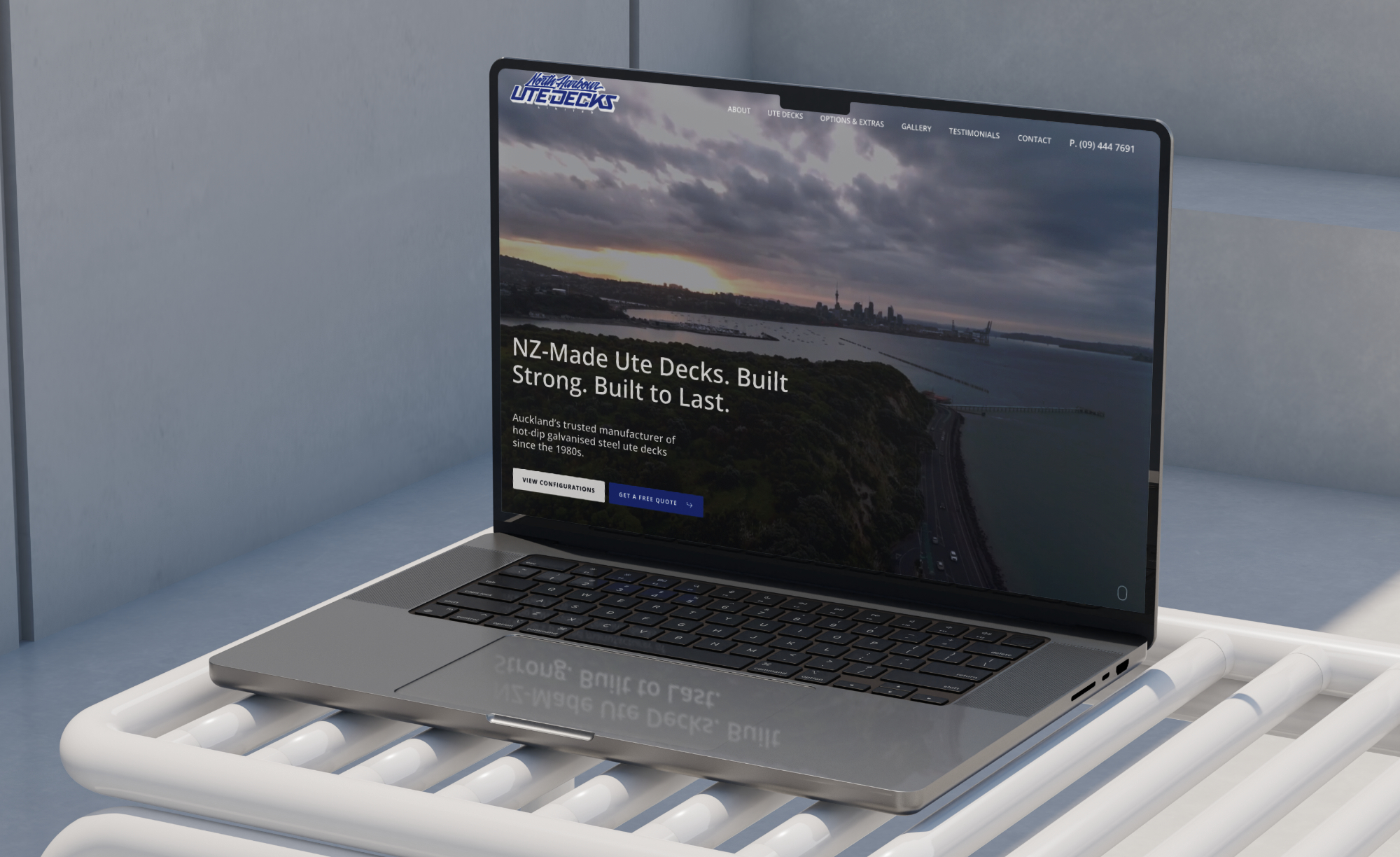
The new North Harbour Ute Decks website designed and built by Sky Media — custom WordPress build showcasing their product range, workmanship, and 25+ years of Auckland fabrication experience.
Built around their product range
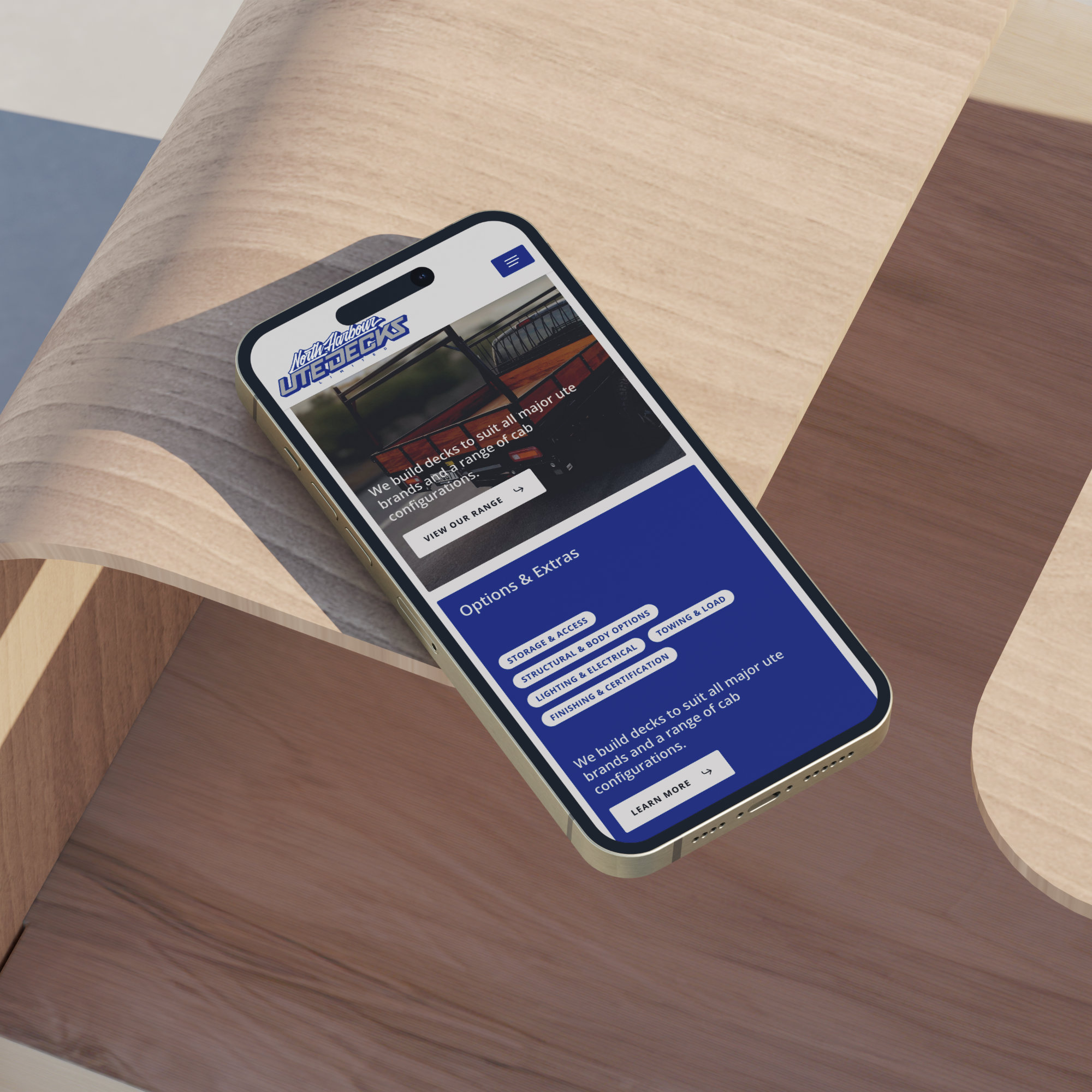
The product and services structure on the new site is built around what North Harbour Ute Decks actually makes — flat decks, tippers, trailers, dog boxes, transporters, service tool boxes, repair and re-galvanising work. Each category is given its own space and clarity, rather than being compressed into a generic “services” page that lists everything in a paragraph.
This structure does two things at once: it helps customers navigate to exactly what they’re looking for, and it gives Google a clear, well-organised signal about the full breadth of what the business offers.
Gallery built to sell, not just display
The gallery on the new site is organised and contextualised — finished products photographed properly, giving a prospective customer a genuine sense of the quality and range of work. For a business where the product is the proof, this is one of the highest-value sections on the site.
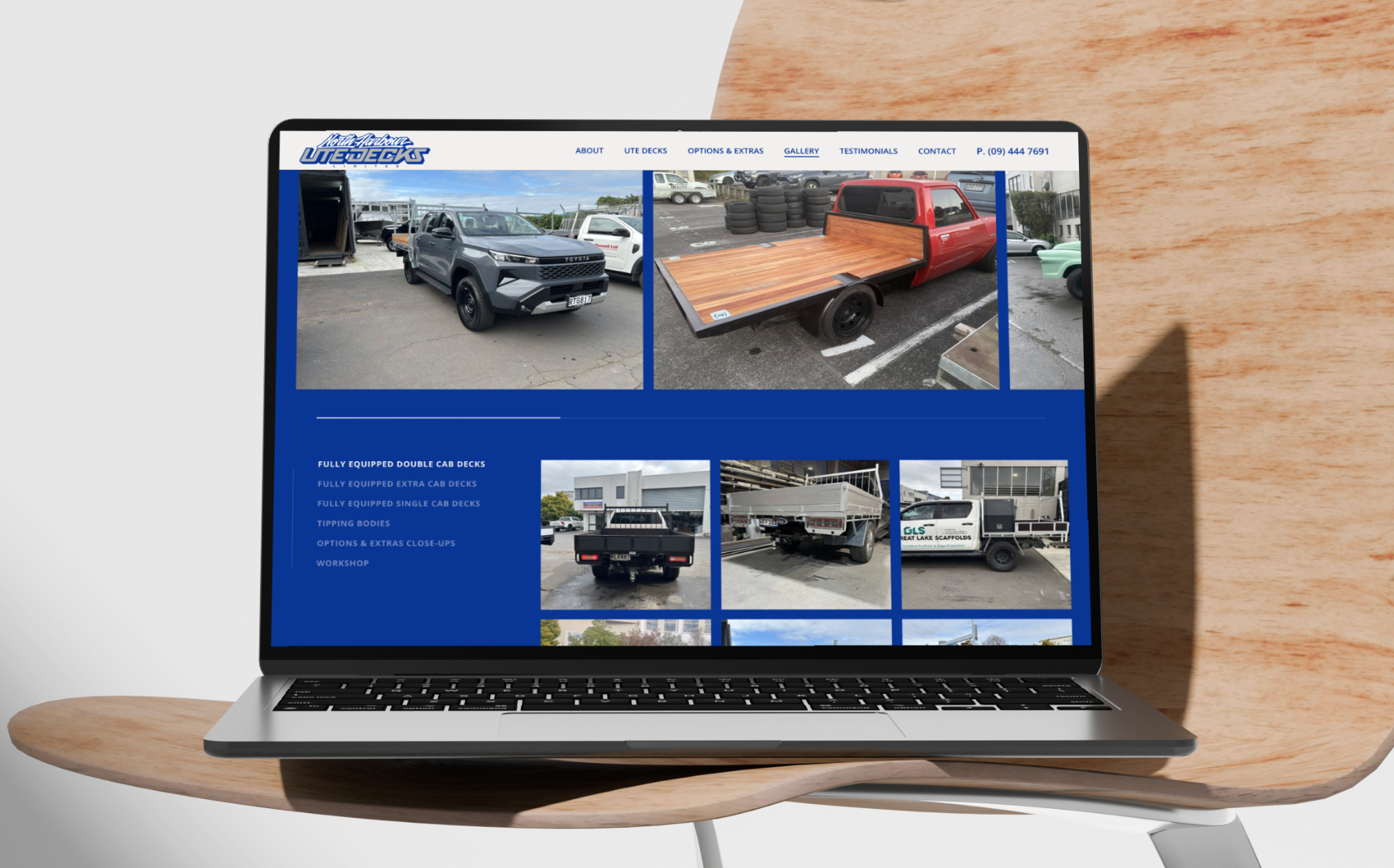
The North Harbour Ute Decks gallery — real photos of completed fabrication work, organised to help customers evaluate quality and find relevant examples before making contact.
Trust signals built in throughout
The 25+ year history, the three-year workmanship guarantee, the breadth of industries served, the customer testimonials — all of these are presented prominently and naturally throughout the site, not as an afterthought on an “About” page that most visitors never reach.
For a business that wins repeat work from dealerships, farmers, and commercial operators on the basis of reputation and quality, making that reputation immediately legible to a new visitor is critical.
Built for the right audience on mobile
A lot of North Harbour Ute Decks’ customers are tradespeople, farmers, and fleet managers — people who are often on-site, in a vehicle, or away from a desktop when they’re searching for a supplier. The new site is designed mobile-first, with the most important information — what they make, where they are, how to call — immediately accessible without scrolling or zooming.
When Does a Custom Build Actually Make Sense?
A custom website isn’t the right answer for every business. Here’s an honest assessment of when the investment makes sense — and when it doesn’t.
A custom build makes sense when:
- Your business has a real product or service range that needs proper structure — not a list compressed into one generic page
- Your gallery or portfolio is a core part of how customers evaluate you — it needs to do real work, not just look decorative
- You serve a specific local market and want to rank for location-specific searches — a custom build lets you bake that in from the start
- Your reputation has been built over years and your website should reflect that — not look like it was set up last week on a template
- You want to be found for specific, specialist searches that a generic template’s SEO foundation won’t help you rank for
- You’re serious about growth and see your website as a business asset, not just a digital business card
The honest version: for most established NZ trade and engineering businesses, a template site is a false economy. It costs less upfront but limits what your website can do for you — in SEO, in conversions, and in the impression it makes on customers who find you for the first time.
What “Custom Built” Actually Means in Practice
It’s worth being clear about what a custom build involves — because “custom” can mean different things depending on who you talk to.
At Sky Media, a custom WordPress build for a trade business typically includes:
- A design built from scratch around your brand, your products, and your audience
- A content structure planned around how your customers research and what Google needs to understand your business
- SEO foundations built in from the start — page titles, meta descriptions, headings, URL structure, local signals
- A gallery or portfolio section designed around your specific product range
- Mobile-first design that works properly on the devices your customers actually use
- Fast load speeds — no bloated plugins or unnecessary code
- A content management system your team can update without needing a developer for every change
- Ongoing support once the site is live
The goal is a website that works as hard as the business behind it — one that a new customer could find, evaluate, and decide to contact without needing to look anywhere else.
Thinking About a New Website for Your Trade Business?
Sky Media builds custom WordPress websites for NZ trade, engineering, and manufacturing businesses — designed to showcase your work properly, rank well in local search, and convert visitors into enquiries.
If your current website isn’t reflecting the quality of your business or bringing in the enquiries it should be, we’re happy to take a look and have an honest conversation about what would actually make a difference. Talk to Sky Media.