SEO Trends

Why Your Business Needs a Dedicated Landing Page | Sky Media

How Landing Pages Boost SEO for NZ Businesses

By Digital Marketing, SEO

Most NZ businesses have a website. A lot of them have a pretty good one. But when it comes to actually capturing customers from Google — whether through SEO or paid ads — there’s often a critical piece missing.

Not more content. Not a bigger budget. A dedicated landing page.

Why Your Business Needs a Dedicated Landing Page | Sky Media

There’s a common assumption that your homepage is your front door — and that directing everyone there is the logical approach. In some situations that’s fine. But for specific services, specific locations, specific audiences, or specific campaigns, a homepage is almost always the wrong destination.

This post explains what a landing page actually is, why it performs differently from a homepage, and how a well-built one can do meaningful work for your business — in both search rankings and conversions. We’ll use a real example from a page we recently built for Bin Inn Timaru to show what this looks like in practice.

Homepage vs Landing Page: What’s the Actual Difference?

Your homepage is designed to serve everyone. It introduces your business, points people toward different parts of your site, and tries to cater to a range of visitors with different needs and intentions. It’s broad by design.

A landing page is built for one specific purpose, one specific audience, and one specific action. Everything on it — the headline, the content, the images, the calls to action — exists to serve that single goal.

The difference in how they perform isn’t subtle. A homepage asks a visitor to make a choice about where to go next. A landing page removes that choice and guides the visitor directly toward the outcome you want — a call, a visit, a form submission, a booking.

A homepage introduces your business. A landing page converts a specific visitor into a specific action.

This distinction matters enormously for two things: SEO and Google Ads. Both reward specificity, relevance, and clarity — and a well-built landing page delivers all three in a way a homepage simply can’t.

Why Landing Pages Work Better for SEO

Google’s job is to match a search query with the most relevant result. When someone searches for something specific — a product, a service, a local business — Google is looking for a page that directly and comprehensively addresses that specific query.

A homepage that covers ten different things is less relevant to any single search than a page built entirely around one topic. This is the core reason dedicated landing pages tend to rank better for specific, targeted searches.

There are several SEO-specific reasons this works:

Keyword focus
A landing page can be built around one keyword cluster — the specific terms your target customers are searching for. When your page title, headings, content, meta description, and URL all consistently reflect that focus, Google has a much clearer signal about what the page is relevant to.

Local signals
For businesses serving a specific town or region, a landing page can include detailed local signals — the suburb, the street address, the surrounding areas, the community context — that a generic homepage often leaves vague. These signals are exactly what Google needs to rank you for local searches.

FAQ content
Well-structured FAQ sections on landing pages are particularly valuable from an SEO perspective. They directly address the specific questions people search for, increase the depth and relevance of the page, and can earn featured snippet placement — the answer boxes that appear at the very top of some search results.

User behaviour signals
Google pays attention to what happens after a click. If someone lands on your page and immediately leaves (a high bounce rate), that signals the page wasn’t relevant. A landing page that’s clearly relevant to the search, loads fast, and gives the visitor exactly what they were looking for produces better engagement signals — which feeds back into rankings.

Why Landing Pages Work Better for Google Ads

When you run a Google Ad, you pay for each click. The quality of the page those clicks land on directly determines whether you get a return on that spend.

Google also measures what they call Quality Score — a rating of how relevant your ad, your keywords, and your landing page are to each other. A higher Quality Score means Google charges you less per click and shows your ad more often. A lower score means you pay more for worse placement.

A dedicated landing page that matches your ad’s message precisely — same service, same location, same promise — earns a higher Quality Score than a homepage that covers everything loosely. That means lower cost per click, better ad placement, and more conversions from the same budget.

The principle is called message match: the searcher’s query, your ad, and your landing page should all tell the same story. When they do, everything improves. When they don’t, you pay more and convert less.

A Real Example: Bin Inn Timaru

Bin Inn Timaru is a locally owned wholefood and specialty grocery store at 18 Dee St in Timaru — bulk bins, organic products, international foods, home brew supplies, and a lot more. Owner Shailesh Modi has been serving the Timaru community for years with the kind of personal, knowledgeable service a supermarket simply doesn’t offer.

Sky Media recently built a dedicated landing page for the store at bininntimaru.co.nz. It’s a WordPress build — no e-commerce, no online shop. The entire purpose of the page is to help people find the store, understand what it sells, and feel confident enough to visit.
Here’s what the page does well — and why each element matters:
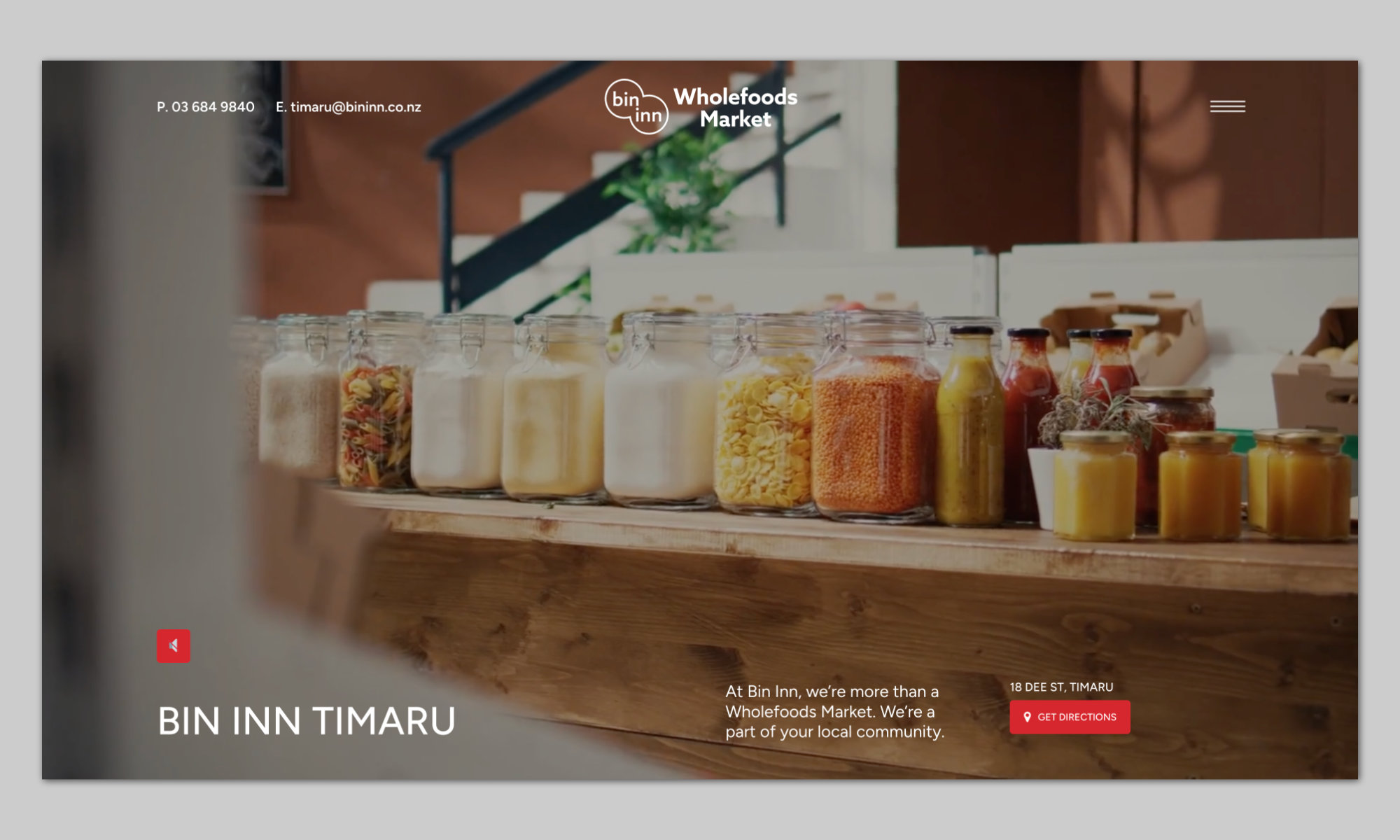
Bin Inn Timaru hero Section

The Bin Inn Timaru landing page built by Sky Media — hero section with video background, address, live opening hours, and directions link visible immediately on load.

Immediate answers above the fold
The first thing a visitor sees — before scrolling at all — is the store name, address, opening hours, and a Get Directions link. There’s also a live indicator that shows whether the store is open right now. For a local business, this is exactly the information a nearby customer needs, delivered instantly.

This matters for SEO too. Google can read and index that structured information clearly, reinforcing the local relevance of the page.

Detailed product range
The page lists Bin Inn Timaru’s product categories in real depth — organic products broken down into specific items, superfoods listed individually, baking ingredients, herbs and spices, international foods, pet supplies, chilled and frozen foods. The breadth and specificity of this content gives Google a comprehensive picture of what the store sells, making it more likely to surface for a wide range of specific product searches beyond just “wholefood store Timaru”.

Someone searching “spirulina Timaru”, “bulk spices Timaru”, “stroopwafels Timaru”, or “home brew supplies South Canterbury” all have a reason to land on this page — and the page gives them exactly what they need to decide whether to visit.
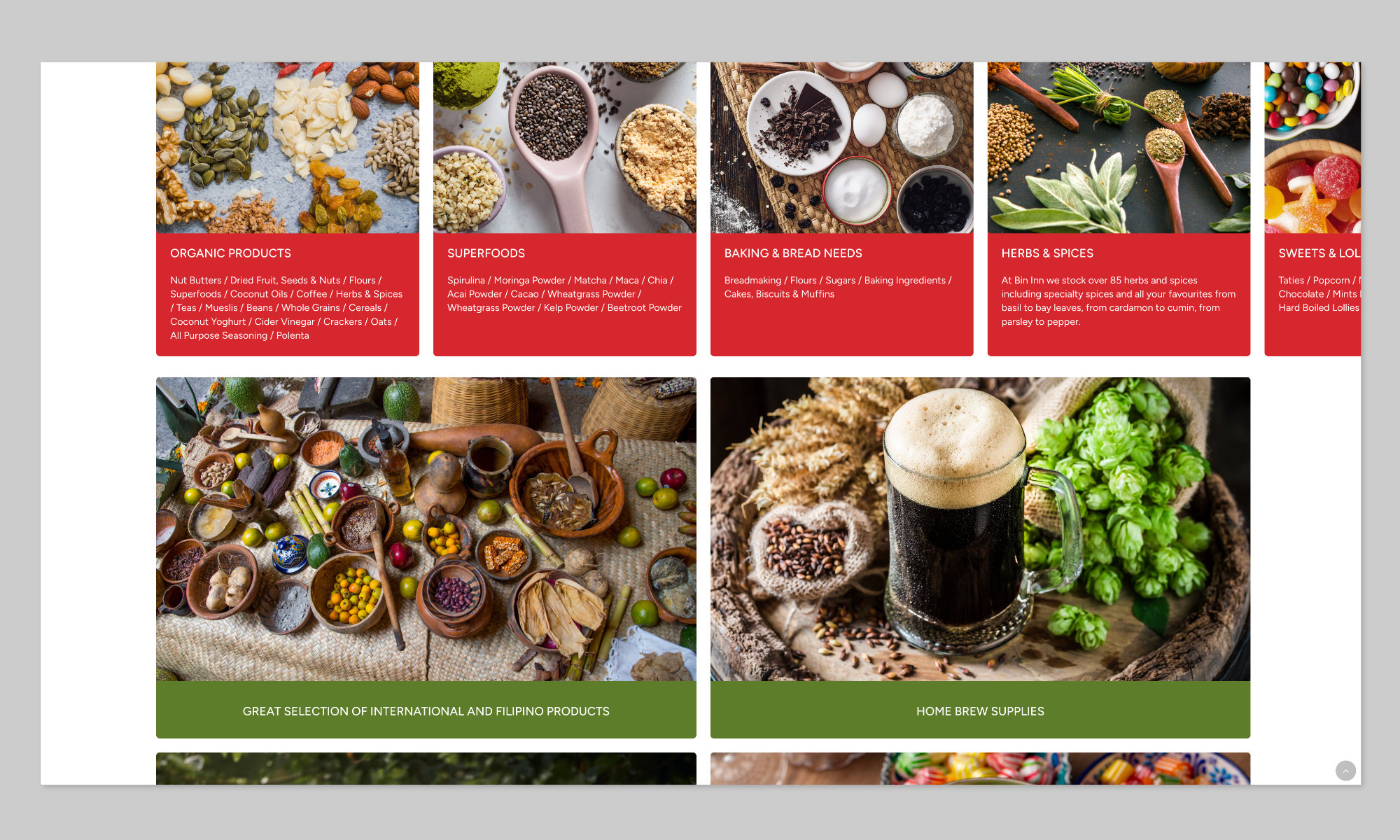
Bin Inn Timaru Product Range Section

The product range section of the Bin Inn Timaru landing page — detailed category listings that help Google match the page to a wide range of specific local searches.

Owner introduction and personal quote
The Meet the Owner section introduces Shailesh Modi with a photo and a direct quote. This isn’t just a nice touch — it’s a trust signal. It tells a potential customer that there’s a real person behind the business who cares about what they do. For local businesses competing against supermarkets and chain stores, that human element is a genuine differentiator.
From an SEO perspective, it also contributes to what Google calls E-E-A-T — Experience, Expertise, Authoritativeness, and Trustworthiness. A page that demonstrates a real person with genuine expertise in their field is viewed more favourably than an anonymous, impersonal page.

FAQ section
The page includes a concise FAQ section answering the questions Bin Inn customers most commonly ask: Can I bring my own containers? Do you stock gluten-free products? Can I buy small quantities? How does the loyalty programme work?
These aren’t just useful for customers — they’re written in the exact language people type into Google. A page that directly answers “can I bring my own containers to Bin Inn” has a strong chance of appearing when someone searches exactly that. FAQ sections are one of the most reliable ways to capture question-based searches, and they’re consistently underused by NZ small businesses.

Loyalty programme explained clearly
The loyalty programme is broken down into a simple four-step process — get your card, shop and collect, reach 15 points, redeem your reward. This kind of structured, action-oriented content gives visitors a concrete reason to visit the store and a clear understanding of the benefit. It converts a passive reader into an active participant.
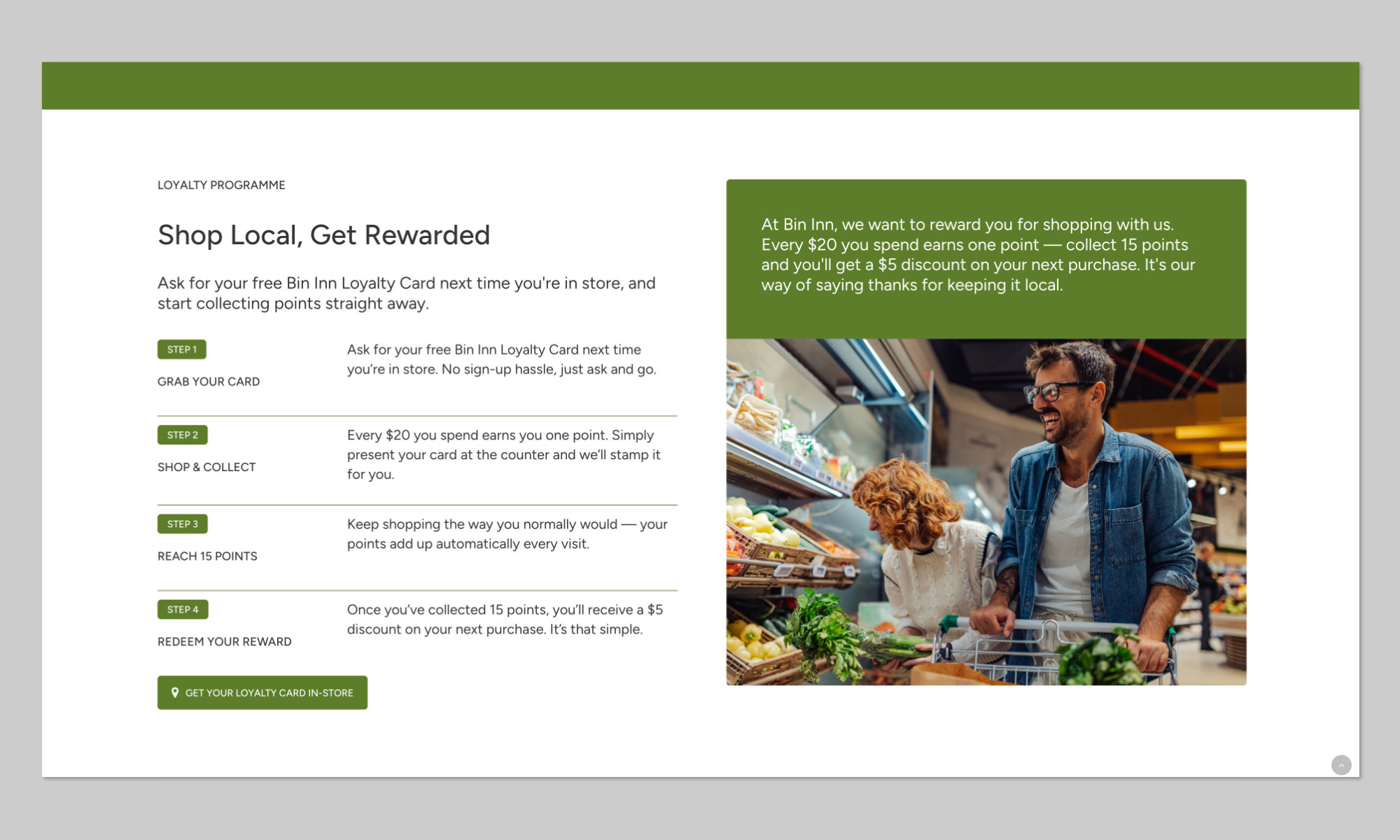
Bin Inn Timaru Loyalty Programme Section

The Bin Inn Timaru loyalty programme section — structured, action-oriented content that gives local customers a clear reason to visit and return.

Community and values section
The page includes a brief but meaningful community section — locally owned and run, supporting local suppliers, treating customers like family. For a business competing on the basis of local identity and personal service, this content reinforces the key differentiators that a supermarket or chain store can’t credibly claim.

It also signals to Google that this is a legitimate, embedded local business — not a generic page created overnight.

What Makes a Landing Page Actually Work

The Bin Inn page illustrates the principles well. Here’s a summary of what separates a landing page that generates results from one that just sits there:

  • One clear purpose — every element on the page serves a single goal (in Bin Inn’s case: get someone to visit the store)
  • Critical information immediately visible — address, phone, hours, directions before any scrolling required
  • Specific, detailed content — not vague descriptions but real products, real services, real specifics that match what people search for
  • Local signals throughout — suburb, city, region named naturally in the content, not stuffed awkwardly
  • A human element — a face, a name, a quote, something that builds trust before the first visit
  • FAQ content — direct answers to the questions your customers actually ask
  • Fast load speed and a clean mobile layout — most local searches happen on a phone
  • One clear call to action — make it obvious what you want the visitor to do next

When Does a Business Need a Dedicated Landing Page?

Not every business needs multiple landing pages — but most businesses could benefit from at least one that’s more focused than their homepage. Here are the situations where a dedicated page typically makes the biggest difference:

  • You serve a specific local area and want to rank for local searches — a landing page built around your location and your service is far more effective than a homepage that mentions your town once in the footer
  • You’re running Google Ads for a specific service or offer — the ad and the page need to match precisely, and a homepage almost never does that well enough
  • You offer a distinct service or product category that deserves its own page — each major service with its own landing page gives you more chances to rank for more specific searches
  • You want to capture a specific audience — tradespeople, families, expats, health-conscious shoppers — a page written directly for that audience converts far better than a generic one
  • You’re a local business competing against national chains or directories — a well-built local landing page is one of the most effective ways to outrank generic national results for specific local searches

For some businesses, a single focused landing page is all they need. For others — particularly those offering multiple services across multiple areas — a set of dedicated pages, each targeting a specific service-location combination, can dramatically increase the range of searches they appear for.

Want a Landing Page That Actually Works for Your Business?

Sky Media designs and builds landing pages for NZ businesses — from single-purpose local pages like Bin Inn Timaru to full multi-page service site builds. Whether you need a page to support a Google Ads campaign, improve your local SEO, or simply give a specific service or location the focused online presence it deserves, we can help.

If you’d like to talk through what a landing page could do for your business, get in touch for a free, no-obligation conversation.


AI search influence on local businesses

Google AI Overviews Are Changing Search But Local NZ Businesses Have an Advantage

By AI, SEO

If you’ve searched on Google lately, you’ve probably noticed something different at the top of the results page — a block of AI-generated text that summarises an answer before you’ve clicked anything. That’s Google’s AI Overview, and it’s one of the biggest changes to search in over a decade.

The headlines around it have been alarming. Traffic is down. Clicks are disappearing. Organic search is dying. For businesses that rely on Google to bring in customers, it sounds like bad news.

But here’s what those headlines tend to miss: the impact of AI Overviews is not the same for every kind of business. And for local NZ businesses: tradies, retailers, professional services, and hospitality the picture is considerably more encouraging than the general panic suggests.

AI search influence on local businesses

This post explains what AI Overviews actually are, what the data shows and, most importantly, why local businesses in New Zealand are in a stronger position than most.

What Is a Google AI Overview?

When someone searches Google for information, they now often see an AI-generated summary sitting above all other results. Google calls this an AI Overview (previously known as Search Generative Experience, or SGE).

Instead of a list of links to websites, the searcher gets a direct answer synthesised from multiple sources with links to those sources on the side or at the bottom. For many queries, users can get what they need without clicking through to any website at all.

This is what’s known as a zero-click search, and it’s grown significantly. Research from SparkToro found that 58% of all Google searches now end without a click to any website. For searches where an AI Overview appears, that figure jumps even higher.

For businesses that built their traffic on informational content such as blog posts answering general questions, how-to guides, and educational articles, this is a genuine challenge. Google is now answering those questions directly, without sending users anywhere.

The Data: How Often Do AI Overviews Actually Appear?

The statistics vary depending on who you ask and how they measure it, but a few things are consistent across multiple large studies in 2025 and early 2026:

~48%

of all tracked Google searches trigger an AI Overview as of early 2026

7.9%

of local searches trigger an AI Overview

99%

of AI Overviews appear on informational queries

+35%

more clicks for sites cited inside an AI Overview

  • ~48% of all tracked Google searches trigger an AI Overview as of early 2026 — up from 31% a year earlier. (BrightEdge, Feb 2026)
  • Only 7.9% of local searches trigger an AI Overview. (Ahrefs, Nov 2025)
  • 99% of AI Overviews appear for informational queries — ‘what’, ‘how’, and ‘why’ questions. (SeoProfy, 2026)

These last two points are the most important for local NZ businesses. AI Overviews are overwhelmingly a phenomenon affecting informational content: research, definitions, explanations, comparisons. They are rarely triggered by the kinds of searches that drive local business enquiries.

Why Local Searches Are Different

Here’s the key distinction: there are two very different types of Google searches, and AI Overviews affect them very differently.

Informational searches are questions with general answers — “how does underfloor heating work”, “what’s the best material for a deck”, “what does an electrician charge per hour”. These are research queries. The searcher isn’t necessarily ready to hire someone; they’re learning. These are the searches AI Overviews dominate.

Local intent searches are queries where someone wants to hire, visit, or buy and they want to do it nearby. “Electrician Auckland”, “plumber Wellington urgent”, “builder Christchurch quote”, “café near me”. These are high-intent searches that drive real business. And AI Overviews almost never appear for them.

According to Ahrefs’ data, only 7.9% of local searches trigger an AI Overview. The local map pack — the three businesses that appear with a map at the top of results — still dominates local intent searches. It works the way it always has, and it’s not going anywhere.

This is very good news for any NZ business whose customers find them by searching for a local service. Your Google Business Profile, your local SEO, your reviews — these still work. The rules haven’t changed for you the way they have for national publishers or information websites.

What Kind of Businesses Are Most Affected?

To understand who needs to be most concerned about AI Overviews, it helps to look at which query types are most affected:

Most affected: Blogs and media sites, educational content, health and how-to guides, financial explainers, recipe sites, general Q&A content, anything built around answering research questions.

Moderately affected: E-commerce sites (Google is beginning to expand AI Overviews into commercial queries, though more slowly), national service providers targeting broad non-local terms.

Least affected: Local businesses with location-specific search intent: trades, hospitality, retail, professional services, healthcare, real estate.

If your business gets most of its enquiries from people searching for a specific local service, and that’s the case for the majority of Sky Media’s clients, you’re in the least affected category.

What Should Local NZ Businesses Actually Do?

The short answer: keep doing what works, and double down on it.
The fundamentals of local SEO haven’t changed. In fact, some of them have become more important:

1. Your Google Business Profile is more valuable than ever

The local map pack is one of the most AI-Overview-resistant parts of Google search. A well-maintained GBP, with accurate details, regular photos, consistent reviews, and active posts, is your strongest asset. If you haven’t invested time here, now is the moment.

2. Reviews remain your most powerful trust signal

Google’s local rankings are heavily influenced by review volume and recency. But there’s a new dimension: AI-generated answers increasingly draw from and reference businesses with strong review profiles. A business with 80 current, detailed reviews is more likely to be surfaced and mentioned in local pack results and, increasingly, in AI-generated responses to relevant queries.

3. Location-specific content on your website still matters

Service pages that clearly name the areas you work in, the specific services you offer, and the kinds of customers you help, this content gives Google the signals it needs to match you to local searches. It also gives AI systems the structured, authoritative information they need to reference you correctly.

4. Your website needs to be technically solid

Page speed, mobile experience, and structured data (schema markup) are all becoming more important, not less. Structured data in particular, the code that tells Google exactly what your business is, what services you offer, and where you operate, helps AI systems understand and reference your site accurately. It’s moved from a nice-to-have to a meaningful ranking signal.

5. Don’t abandon informational content, just be strategic about it

If your website has blog posts or guides answering questions your customers ask, these are still worth having. The approach shifts slightly: rather than writing purely to attract informational traffic, write content that demonstrates your expertise and builds trust with people who are already considering hiring you. Content that’s specific, authoritative, and locally relevant will still perform, and may even be cited by AI systems if it’s structured well.

The Bigger Picture: What’s Actually Changing

It’s worth stepping back from the day-to-day statistics and considering what AI Overviews represent at a bigger level.

Google is moving from being a directory of links to being an answer engine. For queries where the answer is general and informational, it increasingly provides that answer itself. For queries where the answer depends on location, personal preference, or real-world availability: who’s available, who’s nearby, who’s trusted in this area, it still needs to point people to real businesses.

Local businesses are, in many ways, the part of the internet that AI can’t replace. An AI can tell you how roof painting works. It cannot paint your roof. It can explain what a conveyancing lawyer does. It cannot handle your property transaction. The searches that lead to actual local business happen in the part of Google that’s proven the most resistant to AI disruption, and that’s where local businesses live.

A Note on What’s Still Changing

It would be misleading to suggest AI Overviews have zero impact on local businesses or that the landscape is completely stable. A few things worth watching:

  • AI Overviews are expanding into commercial queries. They currently appear in only around 10–18% of commercial searches, but that share is growing. This is worth monitoring, particularly for e-commerce businesses and national service providers.
  • Zero-click behaviour is increasing across all search types. Even without an AI Overview present, users are clicking through to websites slightly less often than they used to. This makes your Google Business Profile which answers many questions (hours, phone, reviews, location) without requiring a click even more important as a standalone conversion tool.
  • AI Mode is a new surface to understand. Google launched AI Mode in 2025 as a dedicated AI search tab with 75 million daily users globally. It’s still a small channel relative to traditional search, but it’s growing and will become more relevant to track over time.

None of these developments are cause for alarm for local NZ businesses right now. But they are worth being aware of and they’re exactly the kind of thing a good SEO partner should be monitoring and acting on for you.

Local SEO Is Still One of the Best Investments a NZ Business Can Make

While the global SEO landscape is shifting in meaningful ways, the fundamentals of local search remain intact, and for NZ businesses that serve a geographic area, the opportunity is as strong as it’s ever been.

The businesses that will come out ahead are the ones that stay consistent with local SEO fundamentals: a well-maintained Google Business Profile, a steady flow of reviews, a fast and mobile-friendly website, and location-specific content that clearly communicates who they serve and where.

If you’d like to understand how your current SEO is performing in this changing environment, or what you should be prioritising, Sky Media offers a free audit that looks at exactly these signals. Request a free SEO audit.

The Latest Industry Trends for SEO

By SEO

In Auckland’s dense digital landscape, keeping your business thriving high online is absolutely key. When it comes to boosting your web presence, Search Engine Optimisation (SEO) is a core component of effective internet marketing. Whether you’re a business owner in Auckland or anywhere else in New Zealand, staying on top of the latest SEO trends is essential for success online. In this blog, we’ll explore the top 12 SEO trends making waves in Auckland and beyond.

1. User Experience (UX)

Google’s algorithm pays close attention to the user experience. A fast-loading, easy-to-navigate website with high-quality content gets first priority. To get selected by Google, make sure your site is user-friendly and provides valuable information to visitors.

2. Core Web Vitals

Google’s Core Web Vitals measure factors like page loading speed, interactivity, and visual stability of your site’s content. To rise to the top, ensure your website meets these criteria and offers an easy-to-use experience for visitors.

3. Mobile-First Indexing

With the majority of web traffic coming from tablets and smartphones, Google focuses on the mobile version of a site’s content for ranking and indexing. To rank, your website must be mobile-friendly. It’s no longer optional—it’s a necessity.

4. Secure Websites (HTTPS)

Security is key. Google favours secure websites with an “https://” prefix as it’s a trust signal for both search engines and users. At Sky Media, we make sure our client’s websites are secure at all times for safety and to optimise their site’s performance on Google.

5. Local SEO Dominance

Local SEO continues to be powerful, especially for brick-and-mortar businesses in Auckland. To get priority treatment from Google, it’s best to ensure your website is optimised for local searches by using location-specific keywords and having an up-to-date Google My Business profile.

6. Featured Snippets at the Top of Google

Appearing at the top of Google as a featured site offers a major boost to your site’s visibility. To get a coveted top-tier position, provide clear and concise answers to common questions people ask with your site’s content.

7. E-A-T (Expertise, Authoritativeness, Trustworthiness)

Google places a premium on content that demonstrates expertise, authoritativeness, and trustworthiness. To scale Page 1, establish your brand as a trusted source in your niche by producing reliable and accurate content people trust.

8. Content Quality Over Quantity

Quality content designed to capture the attention of people in Auckland is the way to SEO success on Google. To be in the lead, focus on producing informative, engaging, and well-researched content that resonates with your target audience.

9. Video Content Growth

Video content is on the rise everywhere, and Auckland is no exception. Incorporating informative videos into your SEO strategy can significantly improve engagement and move your site to the top of Google’s Search Engine Results Page (SERP).

10. Voice Search Optimisation

The rise of voice-activated devices like Siri and Alexa has led to an increase in voice searches. To take advantage of this opportunity, optimise your content for voice search by using simple natural language and answering common questions people ask.

11. Artificial Intelligence (AI)

AI offers a cutting-edge advantage to business owners looking to enhance their SEO rankings. AI technologies can help you generate human-centred SEO content rapidly and optimise your website to rank on Google’s SERP.

12. Sustainable SEO

Ultimately, sustainable SEO involves creating a flexible strategy that responds to ongoing algorithm changes and evolving trends. An adaptive strategy is vital for long-term SEO success.

Staying ahead of the latest SEO trends is crucial for businesses looking for the competitive edge in Auckland. Mobile-first indexing, voice search optimisation, local SEO, and other trends mentioned here are shaping New Zealand’s digital landscape. By embracing these trends and adapting your SEO strategy, you can ensure your business remains at the forefront of the ever-evolving ever-popular world of online search. Keep these trends in mind, and you’ll be on track to success with Google SEO in Auckland and beyond.
