Digital Marketing7

Stay ahead with Sky Media’s latest SEO, web design, and Google Ads tips. Practical advice for Kiwi businesses to boost their online success.

Why Your Business Needs a Dedicated Landing Page | Sky Media

How Landing Pages Boost SEO for NZ Businesses

By Digital Marketing, SEO

Most NZ businesses have a website. A lot of them have a pretty good one. But when it comes to actually capturing customers from Google — whether through SEO or paid ads — there’s often a critical piece missing.

Not more content. Not a bigger budget. A dedicated landing page.

Why Your Business Needs a Dedicated Landing Page | Sky Media

There’s a common assumption that your homepage is your front door — and that directing everyone there is the logical approach. In some situations that’s fine. But for specific services, specific locations, specific audiences, or specific campaigns, a homepage is almost always the wrong destination.

This post explains what a landing page actually is, why it performs differently from a homepage, and how a well-built one can do meaningful work for your business — in both search rankings and conversions. We’ll use a real example from a page we recently built for Bin Inn Timaru to show what this looks like in practice.

Homepage vs Landing Page: What’s the Actual Difference?

Your homepage is designed to serve everyone. It introduces your business, points people toward different parts of your site, and tries to cater to a range of visitors with different needs and intentions. It’s broad by design.

A landing page is built for one specific purpose, one specific audience, and one specific action. Everything on it — the headline, the content, the images, the calls to action — exists to serve that single goal.

The difference in how they perform isn’t subtle. A homepage asks a visitor to make a choice about where to go next. A landing page removes that choice and guides the visitor directly toward the outcome you want — a call, a visit, a form submission, a booking.

A homepage introduces your business. A landing page converts a specific visitor into a specific action.

This distinction matters enormously for two things: SEO and Google Ads. Both reward specificity, relevance, and clarity — and a well-built landing page delivers all three in a way a homepage simply can’t.

Why Landing Pages Work Better for SEO

Google’s job is to match a search query with the most relevant result. When someone searches for something specific — a product, a service, a local business — Google is looking for a page that directly and comprehensively addresses that specific query.

A homepage that covers ten different things is less relevant to any single search than a page built entirely around one topic. This is the core reason dedicated landing pages tend to rank better for specific, targeted searches.

There are several SEO-specific reasons this works:

Keyword focus
A landing page can be built around one keyword cluster — the specific terms your target customers are searching for. When your page title, headings, content, meta description, and URL all consistently reflect that focus, Google has a much clearer signal about what the page is relevant to.

Local signals
For businesses serving a specific town or region, a landing page can include detailed local signals — the suburb, the street address, the surrounding areas, the community context — that a generic homepage often leaves vague. These signals are exactly what Google needs to rank you for local searches.

FAQ content
Well-structured FAQ sections on landing pages are particularly valuable from an SEO perspective. They directly address the specific questions people search for, increase the depth and relevance of the page, and can earn featured snippet placement — the answer boxes that appear at the very top of some search results.

User behaviour signals
Google pays attention to what happens after a click. If someone lands on your page and immediately leaves (a high bounce rate), that signals the page wasn’t relevant. A landing page that’s clearly relevant to the search, loads fast, and gives the visitor exactly what they were looking for produces better engagement signals — which feeds back into rankings.

Why Landing Pages Work Better for Google Ads

When you run a Google Ad, you pay for each click. The quality of the page those clicks land on directly determines whether you get a return on that spend.

Google also measures what they call Quality Score — a rating of how relevant your ad, your keywords, and your landing page are to each other. A higher Quality Score means Google charges you less per click and shows your ad more often. A lower score means you pay more for worse placement.

A dedicated landing page that matches your ad’s message precisely — same service, same location, same promise — earns a higher Quality Score than a homepage that covers everything loosely. That means lower cost per click, better ad placement, and more conversions from the same budget.

The principle is called message match: the searcher’s query, your ad, and your landing page should all tell the same story. When they do, everything improves. When they don’t, you pay more and convert less.

A Real Example: Bin Inn Timaru

Bin Inn Timaru is a locally owned wholefood and specialty grocery store at 18 Dee St in Timaru — bulk bins, organic products, international foods, home brew supplies, and a lot more. Owner Shailesh Modi has been serving the Timaru community for years with the kind of personal, knowledgeable service a supermarket simply doesn’t offer.

Sky Media recently built a dedicated landing page for the store at bininntimaru.co.nz. It’s a WordPress build — no e-commerce, no online shop. The entire purpose of the page is to help people find the store, understand what it sells, and feel confident enough to visit.
Here’s what the page does well — and why each element matters:
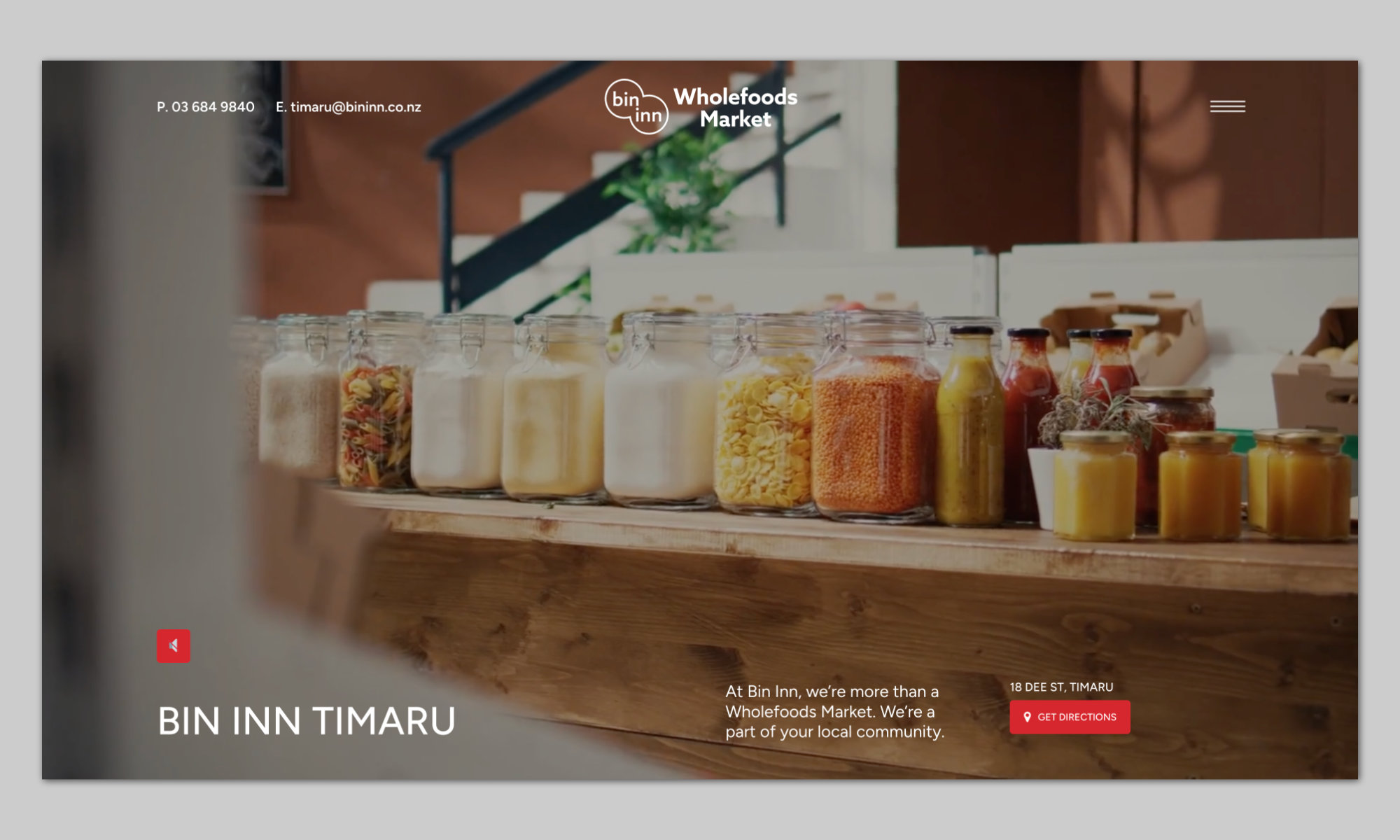
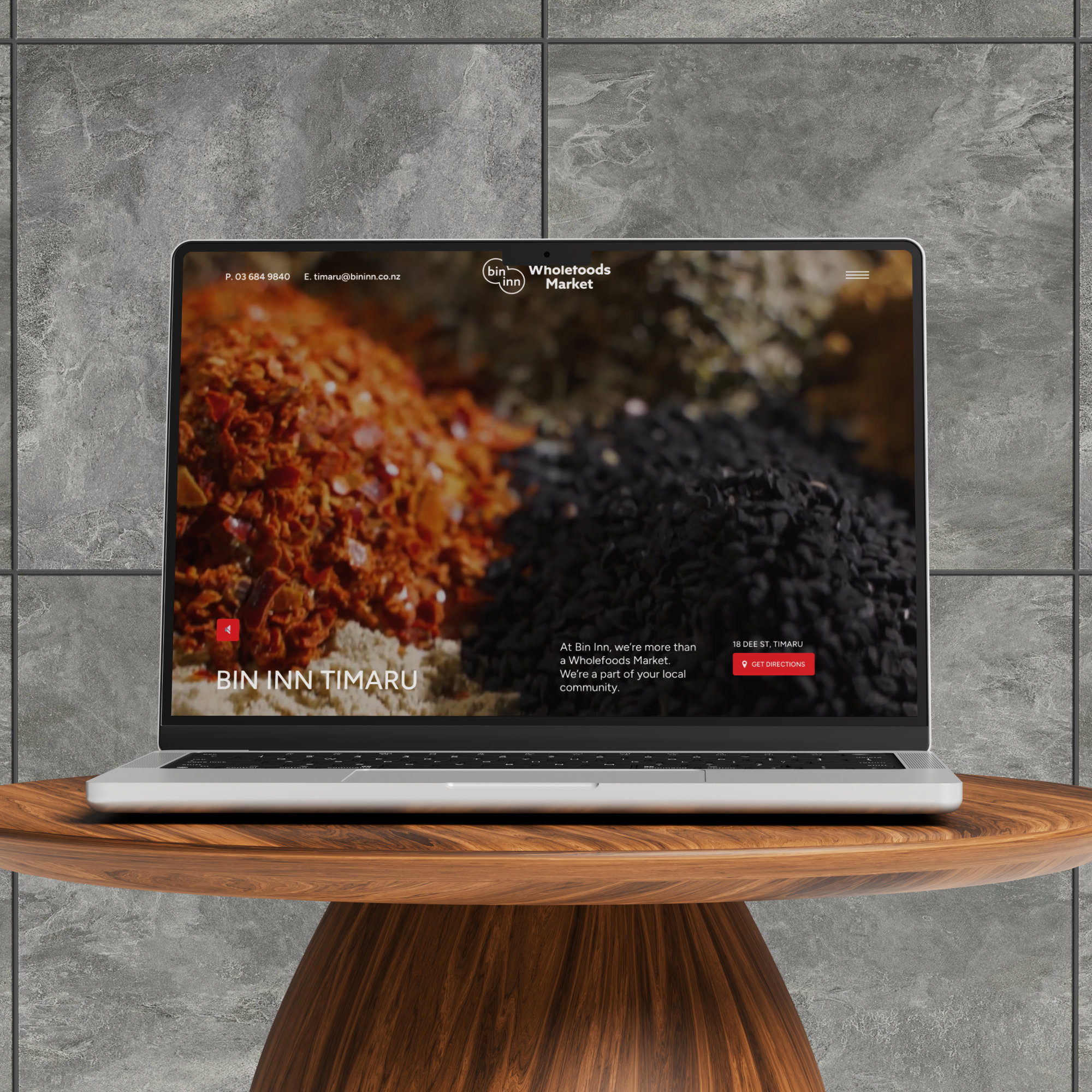
Bin Inn Timaru hero Section

The Bin Inn Timaru landing page built by Sky Media — hero section with video background, address, live opening hours, and directions link visible immediately on load.

Immediate answers above the fold
The first thing a visitor sees — before scrolling at all — is the store name, address, opening hours, and a Get Directions link. There’s also a live indicator that shows whether the store is open right now. For a local business, this is exactly the information a nearby customer needs, delivered instantly.

This matters for SEO too. Google can read and index that structured information clearly, reinforcing the local relevance of the page.

Detailed product range
The page lists Bin Inn Timaru’s product categories in real depth — organic products broken down into specific items, superfoods listed individually, baking ingredients, herbs and spices, international foods, pet supplies, chilled and frozen foods. The breadth and specificity of this content gives Google a comprehensive picture of what the store sells, making it more likely to surface for a wide range of specific product searches beyond just “wholefood store Timaru”.

Someone searching “spirulina Timaru”, “bulk spices Timaru”, “stroopwafels Timaru”, or “home brew supplies South Canterbury” all have a reason to land on this page — and the page gives them exactly what they need to decide whether to visit.
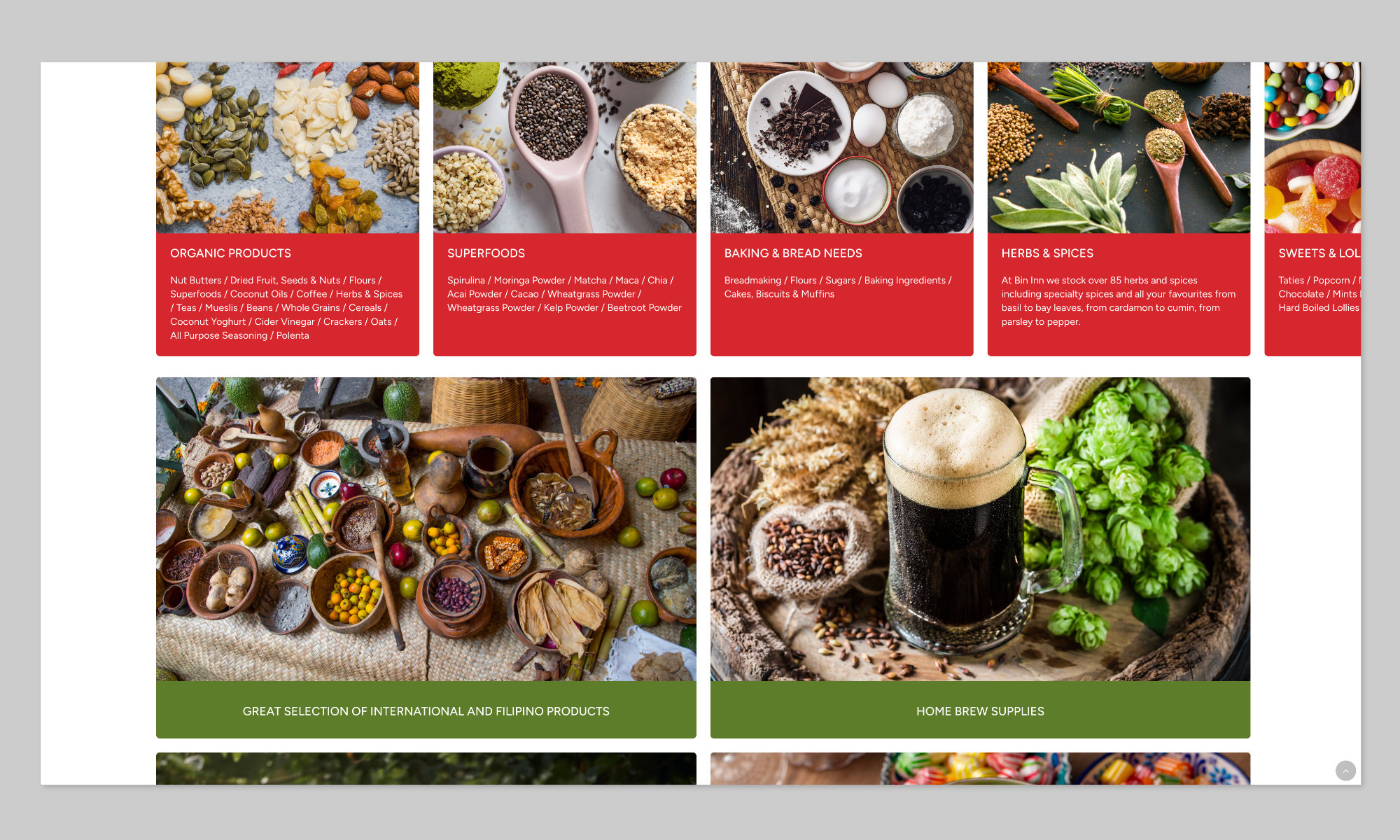
Bin Inn Timaru Product Range Section

The product range section of the Bin Inn Timaru landing page — detailed category listings that help Google match the page to a wide range of specific local searches.

Owner introduction and personal quote
The Meet the Owner section introduces Shailesh Modi with a photo and a direct quote. This isn’t just a nice touch — it’s a trust signal. It tells a potential customer that there’s a real person behind the business who cares about what they do. For local businesses competing against supermarkets and chain stores, that human element is a genuine differentiator.
From an SEO perspective, it also contributes to what Google calls E-E-A-T — Experience, Expertise, Authoritativeness, and Trustworthiness. A page that demonstrates a real person with genuine expertise in their field is viewed more favourably than an anonymous, impersonal page.

FAQ section
The page includes a concise FAQ section answering the questions Bin Inn customers most commonly ask: Can I bring my own containers? Do you stock gluten-free products? Can I buy small quantities? How does the loyalty programme work?
These aren’t just useful for customers — they’re written in the exact language people type into Google. A page that directly answers “can I bring my own containers to Bin Inn” has a strong chance of appearing when someone searches exactly that. FAQ sections are one of the most reliable ways to capture question-based searches, and they’re consistently underused by NZ small businesses.

Loyalty programme explained clearly
The loyalty programme is broken down into a simple four-step process — get your card, shop and collect, reach 15 points, redeem your reward. This kind of structured, action-oriented content gives visitors a concrete reason to visit the store and a clear understanding of the benefit. It converts a passive reader into an active participant.
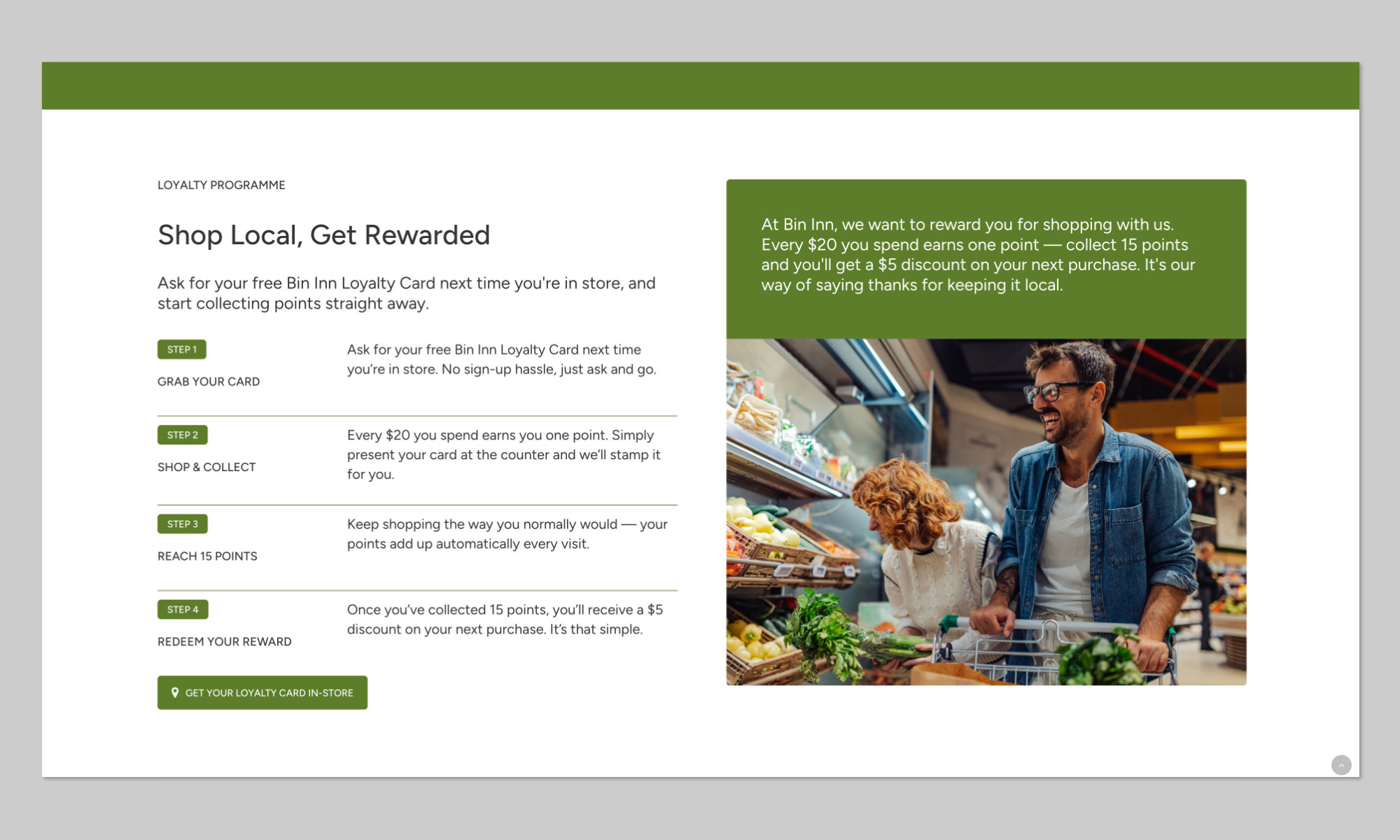
Bin Inn Timaru Loyalty Programme Section

The Bin Inn Timaru loyalty programme section — structured, action-oriented content that gives local customers a clear reason to visit and return.

Community and values section
The page includes a brief but meaningful community section — locally owned and run, supporting local suppliers, treating customers like family. For a business competing on the basis of local identity and personal service, this content reinforces the key differentiators that a supermarket or chain store can’t credibly claim.

It also signals to Google that this is a legitimate, embedded local business — not a generic page created overnight.

What Makes a Landing Page Actually Work

The Bin Inn page illustrates the principles well. Here’s a summary of what separates a landing page that generates results from one that just sits there:

  • One clear purpose — every element on the page serves a single goal (in Bin Inn’s case: get someone to visit the store)
  • Critical information immediately visible — address, phone, hours, directions before any scrolling required
  • Specific, detailed content — not vague descriptions but real products, real services, real specifics that match what people search for
  • Local signals throughout — suburb, city, region named naturally in the content, not stuffed awkwardly
  • A human element — a face, a name, a quote, something that builds trust before the first visit
  • FAQ content — direct answers to the questions your customers actually ask
  • Fast load speed and a clean mobile layout — most local searches happen on a phone
  • One clear call to action — make it obvious what you want the visitor to do next

When Does a Business Need a Dedicated Landing Page?

Not every business needs multiple landing pages — but most businesses could benefit from at least one that’s more focused than their homepage. Here are the situations where a dedicated page typically makes the biggest difference:

  • You serve a specific local area and want to rank for local searches — a landing page built around your location and your service is far more effective than a homepage that mentions your town once in the footer
  • You’re running Google Ads for a specific service or offer — the ad and the page need to match precisely, and a homepage almost never does that well enough
  • You offer a distinct service or product category that deserves its own page — each major service with its own landing page gives you more chances to rank for more specific searches
  • You want to capture a specific audience — tradespeople, families, expats, health-conscious shoppers — a page written directly for that audience converts far better than a generic one
  • You’re a local business competing against national chains or directories — a well-built local landing page is one of the most effective ways to outrank generic national results for specific local searches

For some businesses, a single focused landing page is all they need. For others — particularly those offering multiple services across multiple areas — a set of dedicated pages, each targeting a specific service-location combination, can dramatically increase the range of searches they appear for.

Want a Landing Page That Actually Works for Your Business?

Sky Media designs and builds landing pages for NZ businesses — from single-purpose local pages like Bin Inn Timaru to full multi-page service site builds. Whether you need a page to support a Google Ads campaign, improve your local SEO, or simply give a specific service or location the focused online presence it deserves, we can help.

If you’d like to talk through what a landing page could do for your business, get in touch for a free, no-obligation conversation.
Google Ads vs SEO: Which Should Your NZ Business Invest in First?

By Digital Marketing

It’s one of the most common questions we get asked — and there’s a good reason for that. Both Google Ads and SEO promise the same outcome: more visibility on Google, more traffic, more enquiries. But they work in completely different ways, on completely different timelines, and they’re suited to different situations.

If you’ve got a limited budget and you’re trying to decide where to put it first, this is a genuinely important decision, not just a technical one.

This post breaks down how each one actually works, what the real trade-offs are, and how to figure out which one makes sense for your business right now. In a lot of cases, the answer ends up being both but not necessarily at the same time, or in the same proportions.

The Core Difference, in Plain Terms

Google Ads is rented visibility. You pay for a position at the top of the search results, and the moment you stop paying, that visibility disappears. It’s fast, predictable, and you can turn it on or off whenever you like.

SEO (Search Engine Optimisation) is earned visibility. You invest in your website, content, and authority over time so that Google ranks you organically without paying for each click. It takes longer to build, but once you’re ranking well, that traffic tends to keep coming with far less ongoing cost.

Google Ads is like renting a billboard. SEO is like buying the land it’s standing on.

Neither is better in an absolute sense. They’re suited to different goals, different timelines, and different stages of a business.

Google Ads vs SEO: A Side-by-Side Comparison

Here’s how the two stack up across the factors that matter most when deciding where to invest first:

FactorGoogle AdsSEO
Speed to resultsFast, can generate leads within days of launchingSlow, typically 3 to 6+ months to see meaningful traction
Cost structureOngoing, you pay for every click, every monthUpfront effort, then increasingly free traffic over time
When you stop payingTraffic stops almost immediatelyRankings and traffic persist, with maintenance
Best forImmediate leads, new offers, testing demand, seasonal pushesLong-term, compounding visibility and brand authority
Budget controlVery precise, set and adjust daily budgets directlyHarder to predict ROI early on, but lower cost per lead long-term
Trust & credibilityLower, some searchers actively skip paid adsHigher, organic results are seen as more credible
Risk if you stopHigh, leads dry up the moment you pauseLow, rankings tend to hold for a period after you pause

When Google Ads Should Come First

Google Ads is usually the right starting point when speed matters more than long-term cost efficiency. A few specific situations where Ads makes sense as the first investment:

  • You’re a brand new business with no online presence yet. SEO takes time to build because Google needs to learn to trust your website. If you need leads now, Ads can fill that gap while your SEO foundation is being built in the background.
  • You’re launching a new product, service, or location. If you’ve just added a new service line or opened in a new area, you don’t have existing rankings or reviews to lean on yet. Ads let you generate visibility immediately while your organic presence catches up.
  • You want to test demand before committing further. Not sure if a particular service or offer will actually generate enquiries? Ads let you test quickly. You can have data within days, rather than waiting months to see if an SEO strategy is working.
  • You have seasonal or time-sensitive demand. If you sell something with a short, predictable peak (Christmas, summer outdoor products, tax season for accountants) Ads let you show up exactly when demand spikes, without waiting for SEO to catch up to a narrow seasonal window.
  • Your industry is highly competitive and slow to rank for organically. Some categories are dominated by large, well-established competitors with years of SEO investment. Ads offer a way to compete for visibility immediately, while organic rankings build more gradually in the background.

The common thread: Ads make sense when you need results now, and you’re willing to pay an ongoing cost per lead in exchange for that speed.

When SEO Should Come First

SEO tends to be the smarter first investment in different circumstances — generally when you can afford to play a longer game in exchange for a better long-term return.

  • You’re a local business relying on consistent, ongoing enquiries. If your customers are searching “plumber Hamilton” or “café near me” regularly, ranking organically in the local map pack and search results delivers a steady stream of leads without an ongoing per-click cost.
  • You have a longer runway and want to build a durable asset. SEO compounds. A well-optimised website with strong rankings keeps generating traffic month after month, long after the initial investment. It becomes a genuine business asset rather than an ongoing expense.
  • Your margins don’t comfortably support a high cost-per-click. In some industries, competitive Ads costs can eat heavily into margins. If that’s the case for you, building organic visibility avoids that ongoing tax on every lead.
  • Trust and credibility matter to your customers. Some research shows users are more likely to trust and click organic results over paid ones, particularly for higher-consideration purchases like legal services, healthcare, or large home improvement projects.
  • You’re already established but invisible online. If you’ve got a great reputation and word-of-mouth business but minimal online visibility, SEO often delivers the best return — you’re not starting from zero, you’re catching your digital presence up to your real-world reputation.

The common thread: SEO makes sense when you can invest patiently for a return

A Simple Way to Decide

If you’re still unsure, ask yourself these three questions:

1. How urgently do you need leads?

If the answer is “now” or “within the next few weeks”, Ads should be part of your starting strategy. If you can comfortably wait three to six months for results to build, SEO can lead.

2. What does your budget actually allow?

Ads require an ongoing monthly spend that scales with how much traffic you want. SEO requires upfront investment in your website and content, with a lower (but not zero) ongoing cost to maintain and build on it. If cash flow is tight month to month, SEO’s lower ongoing cost may suit you better once the initial work is done.

3. Is your website actually ready for either?

This is the one most businesses overlook. If your website is slow, outdated, or doesn’t clearly communicate what you do, both Ads and SEO will underperform — you’ll be sending traffic (paid or organic) to a page that doesn’t convert it. In many cases, the real first investment should be your website itself, before either channel.

Why “Both, But Sequenced” Is Often the Smartest Answer

For a lot of NZ businesses, the most effective approach isn’t choosing one over the other — it’s sequencing them deliberately.

A common and effective pattern looks like this:

  • Start with Ads to generate leads immediately while your SEO foundation — your website, your content, your Google Business Profile — is being built and optimised in the background.
  • Let SEO build over months as your organic rankings start to gain traction, your reliance on paid traffic for the same keywords gradually decreases.
  • Shift Ads budget toward gaps SEO doesn’t cover once your organic presence is solid for your core services, reallocate Ads spend toward new services, new locations, or competitive terms that are harder to rank for organically.

This way, you’re never waiting in a gap with no traffic, and you’re not paying indefinitely for visibility that you could eventually earn for free.

What Most NZ Businesses Get Wrong

The most common mistake isn’t choosing the wrong channel, it’s underinvesting in whichever one they choose.

A Google Ads campaign with a budget too small to gather meaningful data, or an SEO strategy treated as a one-off blog post rather than an ongoing programme, will underdeliver regardless of which channel it is. Both Ads and SEO reward sustained, properly resourced effort. Half-measures in either tend to produce disappointing results that lead businesses to wrongly conclude “that channel doesn’t work for us”, when the real issue was the level of investment.

The second most common mistake is sending good traffic either paid or organic to a website that isn’t built to convert it. This is worth repeating: no amount of traffic fixes a website that doesn’t clearly communicate what you do, doesn’t build trust, and doesn’t make it easy to get in touch.

Not Sure Where to Start? We Can Help You Figure It Out

Sky Media manages both Google Ads campaigns and SEO strategy for NZ businesses which means our advice isn’t shaped by only being able to offer one of them. We look at your situation, your budget, your timeline, and your industry, and recommend the approach (or sequence) that actually makes sense for you.

If you’d like an honest assessment of where to start, we offer a free audit covering your website, your current visibility, and where the biggest opportunities are.

How to deal with bad Google reviews

What to Do When Someone Leaves Your Business a Bad Google Review

By Digital Marketing, Tips and Guides

You’re checking your Google Business Profile and there it is — a one-star review. Maybe it’s detailed and angry. Maybe it’s vague and unfair. Maybe it’s from someone you genuinely can’t place.

Whatever the circumstances, the first thought is either fire back or pretend it isn’t there. Neither of those is the right move.

A bad review is not the end of the world, and in many cases, how you respond to a negative review actually matters more to prospective customers than the review itself. This guide walks through exactly what to do, step by step, including when you can get a review removed and when you can’t.

How to deal with bad Google reviews

First: Don’t React Immediately

The worst responses to negative reviews are written in the first five minutes when the sting is fresh and the temptation to defend yourself is strongest.

Before you write a single word, give yourself time to cool down. Read the review again the next morning with fresh eyes. Ask a trusted colleague to read it too.

This matters because your response isn’t just for the person who left the review. It’s for every future customer who reads it, and they will read it. Research consistently shows that prospective customers pay close attention to how businesses handle negative feedback. A calm, professional response to a bad review can actually increase trust. A defensive or aggressive one does the opposite.

Step 1: Understand What You’re Actually Dealing With

Not all negative reviews are the same, and your approach should depend on what kind you’re dealing with. There are broadly three types:

A genuine complaint from a real customer
The experience they describe happened. They felt let down. Whether the situation was entirely in your control or not, their frustration is real. This is the most common kind, and the most important to handle well.

An exaggerated or unfair review from a real customer
Something did happen, but the review significantly overstates it, leaves out important context, or characterises the situation in a way that feels unfair. These are frustrating because there’s a kernel of truth buried in something that reads as far worse than it was.

A fake or mistaken review
The reviewer describes an experience that never happened, names the wrong business, or appears to be left by a competitor. These are less common but they do happen, and Google has a process for flagging them.

Step 2: Respond Publicly and The Right Way

For genuine complaints and unfair reviews alike, a public response is almost always the right move. Silence reads as indifference. A good response demonstrates accountability, professionalism, and that there’s a real human behind the business.

Here’s what a strong response looks like:

  1. Acknowledge. Start by recognising the customer’s experience. Don’t argue about the facts in your opening line. “We’re sorry to hear your experience didn’t meet expectations” costs nothing and immediately sets a constructive tone.
  2. Take responsibility where it’s warranted.  If something genuinely went wrong on your end, own it. Customers respect honesty far more than deflection. You don’t need to air every detail publicly, but acknowledging fault where it exists disarms the review.
  3. Provide context, briefly. If there’s something important a reader wouldn’t know from the review alone such as an unusual circumstance, a policy that applies here, a miscommunication, you can mention it. Keep it short and non-confrontational.
  4. Offer to resolve it offline.  Invite the customer to continue the conversation directly. Include a name and contact method. This shows you’re serious about fixing things and moves the difficult conversation out of the public eye.
  5. Keep it short. Three to five sentences is usually enough. Long responses can feel defensive. Short ones feel confident.

Here’s an example of how that plays out in practice:

Hi [Name], thank you for taking the time to share your feedback. We’re sorry to hear the project didn’t meet the standard you expected — that’s not the experience we aim to deliver. We’d genuinely like to understand what happened and make it right. Please feel free to contact us directly at [email/phone] and we’ll prioritise getting this resolved.
— [Your name], [Business name]

Notice what that response does: it’s calm, it acknowledges the complaint without admitting specific fault, it offers a path forward, and it’s signed personally. It reads as trustworthy which is the goal.

What NOT to do

  • Don’t argue the facts point-by-point in your response. It looks defensive to everyone reading.
  • Don’t apologise excessively. One genuine acknowledgement is enough.
  • Don’t copy-paste the same generic response to every review. It reads as automated and impersonal.
  • Don’t name-call, challenge the reviewer’s honesty, or suggest they’re lying, even if they are.
  • Don’t offer refunds or compensation publicly. You can do that in a private conversation.

Step 3: Try to Resolve It Privately

Once you’ve posted your public response, reach out to the customer directly if you have their contact details. A genuine attempt to fix the problem, not just a token gesture, often leads to one of two outcomes: either the customer updates or removes their review, or the situation gets resolved and they feel heard, even if the review stays.

A personal phone call goes much further than an email. It signals that you take the situation seriously enough to have a real conversation, not just fire off a template.

What you’re not trying to do is pressure someone into removing a review. That’s both ineffective and counterproductive. What you are doing is giving a real customer a genuine chance to feel heard and have their problem solved. That’s just good business, and the review outcome is a side effect, not the goal.

Step 4: Know When (and How) to Flag a Review for Removal

Google will remove reviews but only in specific circumstances, and it’s not a quick process.
You can flag a review for removal if:

  • It is clearly fake. It describes an experience that never happened, from someone who was never a customer.
  • It is from a competitor or someone with a clear conflict of interest.
  • It contains hate speech, explicit threats, or discriminatory language.
  • It includes personal information (phone numbers, addresses).
  • It is spam or was posted multiple times.
  • It is for the wrong business. Sometimes people confuse similar business names.

To flag a review, go to your Google Business Profile, find the review, click the three dots next to it, and select “Report review”. You’ll be asked to select a violation category.

Important: Google does not remove reviews simply because they are negative, unfair, or even factually incorrect. A one-star review from a real customer who had a genuinely bad experience, even one you disagree with, will not be removed on those grounds alone.

If your flag is rejected and you believe the review violates Google’s policies, you can appeal through the Google Business Profile support team. This takes longer and isn’t always successful, but it’s available as an option.

Step 5: Bury It With Better Reviews

Here’s the honest truth: if you have 60 reviews averaging 4.7 stars and one angry one-star review, most people will barely notice it. In fact, a small number of negative reviews within an otherwise strong profile can actually increase credibility. They signal that your reviews are real, not manufactured.

The best long-term response to a bad review isn’t a clever reply. It’s an ongoing system for collecting positive ones.

A few simple things that work for NZ businesses:

  • Ask every happy customer directly the moment after a job well done, or the end of a positive service interaction.
  • Send a follow-up text or email with a direct link to your Google review page and make it one click.
    Ask customers to mention the specific service or location in their review. It helps your SEO and makes the review more useful to future readers.
  • Respond to positive reviews too. It shows you’re engaged and grateful, not just reactive when things go wrong.

A steady flow of genuine, recent reviews does more to protect your reputation than anything else. A bad review from three months ago looks very different when it’s surrounded by many positive ones from the last few weeks.

What If the Review Is Genuinely Unfair?

This is the hardest scenario, when you know the review is exaggerated, out of context, or simply not accurate, but it doesn’t meet Google’s removal criteria. The temptation is to say so publicly. Resist it.

A response that effectively says “this reviewer is wrong” rarely lands well, even when it’s true. Other readers don’t have the context to judge who’s right, and a business that publicly disputes customer accounts tends to look worse, not better.

Instead, use your public response to tell your side of the story without arguing. Something like:

We take all feedback seriously and we’re sorry this was your experience. Our standard process is [X], and we’d welcome the opportunity to discuss this further at [contact].
— [Your name], [Business name]

That response tells the next reader: this business has good processes, they’re open to conversation, and there may be more to this story than one person’s account. That’s the best you can do, and it’s often enough.

The Bigger Picture: Your Review Profile Is Part of Your Business

Your Google reviews are public-facing and permanent. They show up on your Google Business Profile, in Google Maps, in search results, and, increasingly, in AI-generated summaries that Google surfaces when people search for businesses like yours.

How you handle criticism is part of your brand. A business that responds professionally to a bad review tells potential customers: these people are accountable. They take their work seriously. If something goes wrong, they’ll deal with it like adults.

That’s a far more powerful signal than any marketing copy you write about yourself.
The businesses that manage their review profiles well, actively collecting positive reviews, responding promptly to every review good or bad, and handling complaints with professionalism consistently outperform those that don’t, both in Google rankings and in customer trust.

Quick Reference: Bad Review Response Checklist

  1. Wait before responding. Don’t write your reply in the heat of the moment.
  2. Identify the type: genuine complaint, unfair/exaggerated, or fake.
  3. Write a calm, brief public response: acknowledge, contextualise, offer to resolve offline.
  4. Don’t argue, don’t over-apologise, don’t copy-paste generic responses.
  5. Follow up privately to genuinely resolve the issue if possible.
  6. Flag for removal only if it violates Google’s policies, not just because it’s negative.
  7. Double down on collecting positive reviews to shift the overall picture.

Need Help Managing Your Google Reviews and Local SEO?

Your Google Business Profile, including how your reviews look and how consistently you respond to them, is one of the strongest signals Google uses for local search rankings. It’s also one of the first things a prospective customer sees.

Sky Media helps NZ businesses build and maintain the kind of online presence that earns trust before the first call. If you’d like a second set of eyes on your GBP, your review profile, or your overall local SEO, we offer a free audit.

Digital Marketing for Tradies: How NZ Builders, Plumbers & Electricians Get More Leads Online

By Digital Marketing, Tips and Guides

Word of mouth used to be enough. For a long time, it was. But for most NZ tradies today, referrals alone don’t fill the calendar, especially if you’re growing, branching into new areas, or trying to reduce the slow periods that come every year.

The tradies consistently winning new work are the ones who’ve figured out how to be visible online when someone picks up their phone and searches “electrician near me” or “builder Wellington quote”. That search happens hundreds of times a day across New Zealand, and right now, someone is getting that job, and it might not be you.

This guide is a plain-language breakdown of what actually works for tradies online

Why Digital Marketing Works Differently for Tradies

Tradies have a natural advantage in digital marketing that a lot of industries don’t: you serve a specific local area, and Google is built to reward that.

When someone searches for a tradie, they’re not browsing, they have a problem right now, and they need it fixed. That’s called high-intent search, and it’s the best kind of traffic you can get. These are people who are actively looking to hire, often with urgency.

The challenge is making sure you show up, and making sure that when you do, your online presence is good enough to earn the call over the other options on the page.

The Four Things That Drive Tradie Leads Online

You don’t need to do everything. But there are four areas where most tradie businesses see the biggest return:

1. Your Google Business Profile

If you only do one thing from this entire article, make it this: set up and optimise your Google Business Profile (GBP).

Your GBP is what appears in Google Maps and the map pack. The three businesses that show up at the top of local search results. It’s free, it’s visible, and for trades work, it’s often the first thing a potential customer sees.

A well-optimised GBP for a tradie should have:

  • Your correct trade category (e.g. “Plumber”, “Electrician”, “Builder” — be specific)
  • Your service area clearly defined
  • At least 10 real photos, for example your van, your team, completed jobs
  • A steady flow of Google reviews from happy customers
  • Your services listed individually (e.g. “Hot water cylinder replacement”, “Bathroom rewiring”, “Deck building”)
  • Regular posts and a quick-response habit for reviews and questions

The trades businesses that dominate local search in NZ aren’t doing anything complicated. They’ve just taken the time to fill out and maintain their GBP properly.

2. A Website That Works as a Sales Tool

A lot of tradie websites look like they were built ten years ago and haven’t been touched since. They load slowly, they’re impossible to navigate on a phone, and they give a potential customer no real reason to choose you over anyone else.

Your website is your digital shopfront. If someone clicks through from Google, whether that’s from your GBP, an ad, or an organic result, your website is where they decide whether to call you or hit the back button.

For tradies, the most important things a website needs to do are:

  • Load fast on mobile. Most people searching for trades are on their phone. If your site takes more than a few seconds to load, they’ll leave before they see anything.
  • Show your phone number immediately. It should be at the top of the page, clickable, and visible without scrolling. Don’t make people hunt for it.
  • List your services clearly. Each main service you offer should have its own page or section. This helps customers, and it helps Google understand what you do.
  • Include real photos. Before and after shots, completed jobs, your team at work. Real photos build more trust than anything else on the page.
  • Show social proof. Your Google rating, a few short testimonials, or logos of organisations you’re certified with (e.g. Master Electricians, Licensed Building Practitioners).
  • Have a clear call to action. Whether it’s a quote form or a phone number, make it obvious what you want them to do next.

A good tradie website doesn’t need to be complicated. It needs to be clear, fast, and trustworthy.

3. Google Ads (When You Want Leads Now)

SEO and your Google Business Profile take time to build momentum. Google Ads can fill the gap.

For tradies, Google Ads work particularly well because you can target people who are actively searching for your specific service in your area right now. When someone searches “emergency plumber Auckland” at 8pm on a Tuesday, a well-set-up Google Ad puts you in front of that person at exactly the right moment.

A few things that matter for tradie Google Ads:

  • Search ads only. For most tradies, search ads (text ads that appear above organic results) are the right format. You’re reaching people with immediate intent.
  • Target your actual service area. Don’t pay for clicks from people outside the area you work in. Set your targeting to cover your real coverage zone.
  • Send traffic to a dedicated page. Not your homepage but a page that matches exactly what the ad promised. If your ad says “Registered Electrician Auckland — Free Quote”, the page should open with those words.
  • Track your calls. Google Ads can track which calls came from which ads. Without this, you’re flying blind on what’s working.

Done right, Google Ads can deliver a consistent flow of qualified leads with a measurable cost per enquiry. Done wrong, they burn through budget fast with nothing to show for it which is why getting the setup right matters.

4. Reviews Are Your Most Powerful Marketing Asset

Think about the last time you hired a tradie you’d never used before. Chances are you checked their reviews first.

Your potential customers do exactly the same thing. Reviews are the single most persuasive element of your online presence, more than your website copy, more than your ads, more than your social media.

For tradies, the goal is a steady, ongoing stream of genuine reviews — not a one-off burst.

Here’s what works:

  • After every completed job, ask the customer directly: “Would you mind leaving us a quick Google review? It really helps us out.”
  • Follow up with a text or email that includes a direct link to your Google review page, make it one tap, not a process.
  • Ask customers to mention the specific job and location in their review (e.g. “bathroom renovation in Papakura”); these details help your local SEO.
  • Respond to every review, good and bad. It shows professionalism and signals to Google that you’re active.

A builder with 60 solid reviews will consistently win more work than one with 5, even if the quality of work is identical. Reviews are trust at scale.

Here’s an example from one of our clients — Tasman Sparkies, a Nelson-based electrical business. Their website is built to convert visitors into calls.

A conversion-focused homepage Sky Media designed for Tasman Sparkies, showing clear services infomation, location, and a prominent call-to-action.

The social proof section of the Tasman Sparkies website, displaying Google reviews to build trust with potential customers.

What About Facebook and Instagram?

Social media comes up a lot in these conversations, so it’s worth addressing directly.

For tradies, social media can work, particularly for brand awareness and showcasing your work. Before and after photos on Facebook or Instagram can do well, especially in local community groups.

But for most trades businesses, social media is a secondary channel. The reason: people don’t usually scroll Facebook when their hot water is broken or they need a new circuit board. They go to Google.

If you have the time and enjoy it, posting your work on social is worthwhile. But if you’re choosing where to invest your energy first, Google (your GBP, your website, and Ads) will almost always deliver a better return for trades businesses.

A Realistic Starting Point

If you’re not sure where to begin, here’s a practical order:

  • Step 1: Claim and optimise your Google Business Profile. It’s free and often the fastest win.
  • Step 2: Make sure your website is up to date and has clear information, call to action and phone number.
  • Step 3: Start asking every happy customer for a Google review and make it a habit.
  • Step 4: Once your profile and website are solid, consider Google Ads to accelerate leads in specific services or areas.

You don’t need to do all of this overnight. Each step compounds on the next, for example: a better GBP leads to more calls, more calls lead to more reviews, more reviews improve your ranking, and a well-built website converts more of those visitors into jobs.

Quick-Reference: Tradie Digital Marketing Checklist

Google Business Profile claimed, complete, and active

  • Service area and categories set correctly
  • At least 10 real photos uploaded
  • Consistent flow of Google reviews being collected
  • All reviews replied to
  • Website is up to date
  • Phone number visible and tappable at the top of every page
  • Each main service has its own page or section
  • Real job photos on the website
  • Google Ads considered once foundation is in place
  • Website and GBP details consistent (name, address, phone)

The One Mistake Most Tradies Make Online

The most common mistake we see is treating online presence as a set-and-forget thing.

A website built three years ago that hasn’t been touched. A Google Business Profile claimed but never updated. A handful of reviews from 2022. No recent photos.

Google pays attention to freshness and activity and so do customers. A profile or website that looks dormant signals uncertainty — is this business still operating? Are they any good? Do they actually work in my area?

The tradies getting the most leads online are the ones treating their digital presence like a tool that needs to be maintained, not a box they ticked once.

Need Help Getting More Work Through Your Website and Google?

Sky Media works with NZ trade businesses on everything from website design to Google Ads management and local SEO, building the kind of online presence that consistently fills the calendar.

Whether you’re starting from scratch or want to improve what you’ve already got, we can help you figure out where the biggest opportunities are and what to do about them. Talk to Sky Media about Tradie Marketing.

Business owner reviewing website performance metrics and analytics on a laptop screen

Is Your Website Actually Working? 7 Simple Ways to Measure Website Performance

By Digital Marketing, Web Design

Many businesses invest in a website and then treat it like a digital brochure, something that simply exists online. But a good website should do more than look professional. It should help your business grow. It should attract visitors, guide them toward the right information, and turn interest into enquiries or sales.

Business owner reviewing website performance metrics and analytics on a laptop screen

The challenge is that many business owners don’t know how to tell whether their website is performing well. They might hear about analytics, SEO metrics, or technical performance scores, but those can feel overwhelming and overly technical.

The good news is that measuring website performance doesn’t have to be complicated. You don’t need to be a developer or data analyst to understand whether your site is helping your business.

Here are seven practical ways to measure how well your website is really performing and what to look for if something needs improvement.

1. Are You Getting the Right Visitors?

One of the most basic measures of website performance is traffic: how many people are visiting your site.

But the number alone doesn’t tell the whole story. What matters more is whether the right people are finding your website.

For example, a landscaping company in Christchurch doesn’t benefit much from hundreds of visitors in other countries. What matters is attracting homeowners in the local area who are looking for landscaping services.

Tools like Google Analytics can show where your visitors come from, which pages they land on, and how they found you: through Google searches, social media, referrals, or direct visits.

If your traffic is growing and the majority of visitors are coming from relevant sources, that’s a positive signal your website is reaching the right audience.

If traffic is low or coming from unrelated places, it may mean your SEO, content strategy, or marketing channels need adjustment.

Google Analytics dashboard showing website traffic, visitor behaviour, and the pages people view most often.

Google Analytics dashboard showing website traffic, visitor behaviour, and the pages people view most often.

2. Are Visitors Staying or Leaving Immediately?

Another useful indicator is how long visitors stay on your site.

If people arrive and leave within a few seconds, it often suggests something is wrong. Perhaps the page didn’t match what they expected, the message wasn’t clear, or the website felt confusing.

This is often referred to as a bounce rate – the percentage of visitors who leave after viewing only one page.

A high bounce rate isn’t always bad. For example, someone might visit a contact page, get the phone number, and leave. But if visitors consistently leave your homepage or key service pages quickly, it may indicate that your introduction section isn’t doing its job.

Clear messaging, simple navigation, and strong headlines can make a big difference here.

3. Are Visitors Taking the Next Step?

Ultimately, the purpose of most business websites is to encourage action.

That action might be:

  • Filling out a contact form
  • Booking a consultation
  • Calling your business
  • Downloading a guide
  • Purchasing a product

These actions are known as conversions.

If your website attracts plenty of visitors but very few enquiries, the issue may not be traffic, it may be the way the site guides visitors toward the next step.

Simple improvements can often increase conversions significantly. Clear call-to-action buttons, well-structured service pages, and trust signals like testimonials or reviews help visitors feel confident taking action.

4. Are Your Most Important Pages Being Viewed?

Not every page on your website carries the same importance.

For many businesses, a few key pages do most of the work:

  • Homepage
  • Main service pages
  • Pricing pages
  • Contact page
  • Key blog articles

Looking at which pages people visit most often can reveal whether visitors are finding the information that matters.

If your service pages receive very little traffic, it could mean visitors are struggling to navigate the site or search engines aren’t ranking those pages well.

On the other hand, if certain blog articles attract consistent traffic, they may be worth expanding or linking to more prominently.

Understanding which pages perform well helps guide future improvements.

5. How Fast Does Your Website Load?

Speed has become an important part of the online experience.

Most people expect websites to load quickly. If a page takes too long, many visitors will leave before it finishes loading.

Page speed affects not only user experience but also search engine visibility. Search engines prefer fast websites because they provide a better experience for users.

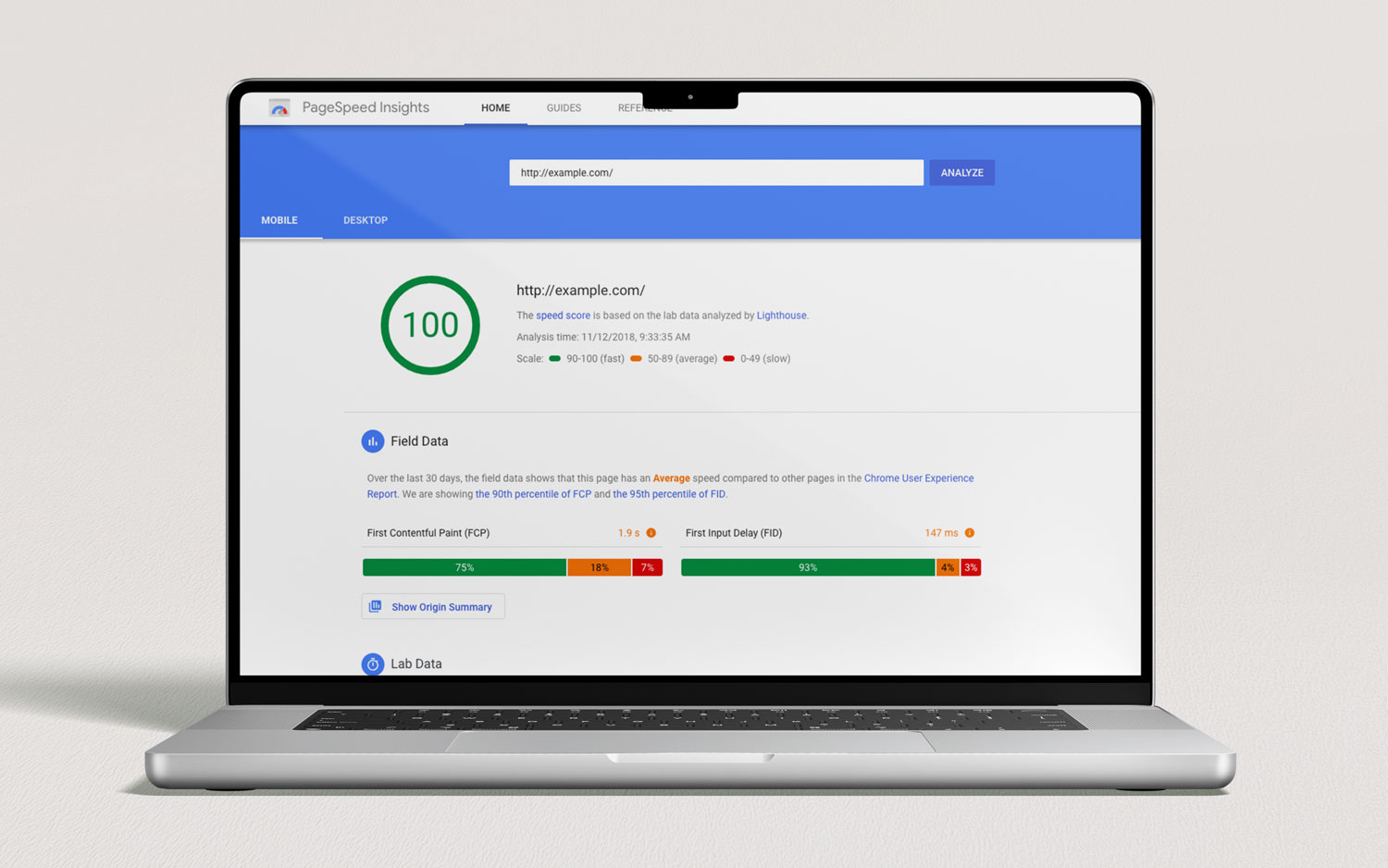
There are simple tools, such as Google PageSpeed Insights, that can give you a rough idea of how fast your site loads.

You don’t need to understand every technical detail, but it’s helpful to know whether your website performs well on mobile devices and whether any obvious issues are slowing it down.

Common causes of slow websites include very large images, unnecessary scripts, or outdated hosting.

Google PageSpeed Insights helps evaluate how fast your website loads and highlights opportunities to improve performance.

Google PageSpeed Insights helps evaluate how fast your website loads and highlights opportunities to improve performance.

6. Are People Finding You Through Search Engines?

For many businesses, search engines remain one of the most valuable sources of website visitors.

If someone searches for services you offer, for example, “house renovation Christchurch” or “accountant for small business”, ideally your website should appear somewhere in those results.

You can measure this by checking whether visitors are arriving through organic search (Google or other search engines).

Google Search Console is a helpful tool that shows which keywords people are searching for when they discover your site. It can also reveal which pages appear in search results most often.

If your website rarely appears in search results, improving SEO, through clearer service pages, helpful blog content, and technical improvements, can make a significant difference over time.

Google Search Console dashboard showing how your website appears in search results and which queries bring visitors to your site.

Google Search Console dashboard showing how your website appears in search results and which queries bring visitors to your site.

7. Are Visitors Using Your Website Easily?

One of the most overlooked measures of website performance is usability.

Ask yourself:

  • Is it easy to find key information?
  • Are important pages only one or two clicks away?
  • Does the site work smoothly on mobile devices?
  • Is the next step obvious?

A website might technically function well but still frustrate users if navigation is confusing or content is difficult to scan.

One of the simplest ways to evaluate usability is to watch how real people interact with your site. Ask a colleague or customer to try finding a service or booking a consultation and observe what happens.

If they hesitate, get lost, or ask questions like “Where do I click?”, that’s valuable feedback.

Good website design should feel intuitive — visitors shouldn’t need instructions.

Why Measuring Website Performance Matters

A website is never truly finished.

Just like a physical business location evolves over time, your website should continue improving as you learn how people use it.

By regularly checking a few simple indicators: traffic, engagement, conversions, page performance, search visibility, speed, and usability, you gain a clearer picture of whether your website is helping your business or holding it back.

The goal isn’t to obsess over numbers. It’s to understand whether your website is guiding visitors toward becoming customers.

Final Thoughts

Your website should be one of the hardest-working tools in your business. But without measuring performance, it’s difficult to know whether it’s doing its job.

The good news is that you don’t need complex analytics dashboards to get started. Paying attention to a handful of key indicators can reveal a lot about how well your site performs.

Small improvements, such as clearer messaging, faster loading pages, stronger calls to action, can often make a significant difference.

Over time, those improvements compound into better visibility, more enquiries, and a stronger online presence.

Would like a Free Website Audit?

If you’re not sure how well your website is performing, we can help.

Send us your website link and we’ll review it from a usability, design, and performance perspective, highlighting practical improvements that can help turn more visitors into enquiries.

2025 Wrapped: A Year of Stories, Strategy & Sky-High Results

By Digital Marketing, Web Design

At Sky Media, years aren’t just measured in months, but in milestones. In the stories we’ve helped tell, the brands we’ve helped amplify, and the digital landscapes we’ve transformed. As we step into 2026, we’re pausing to look back on a year of incredible partnerships, creative breakthroughs, and results that have left a lasting mark.

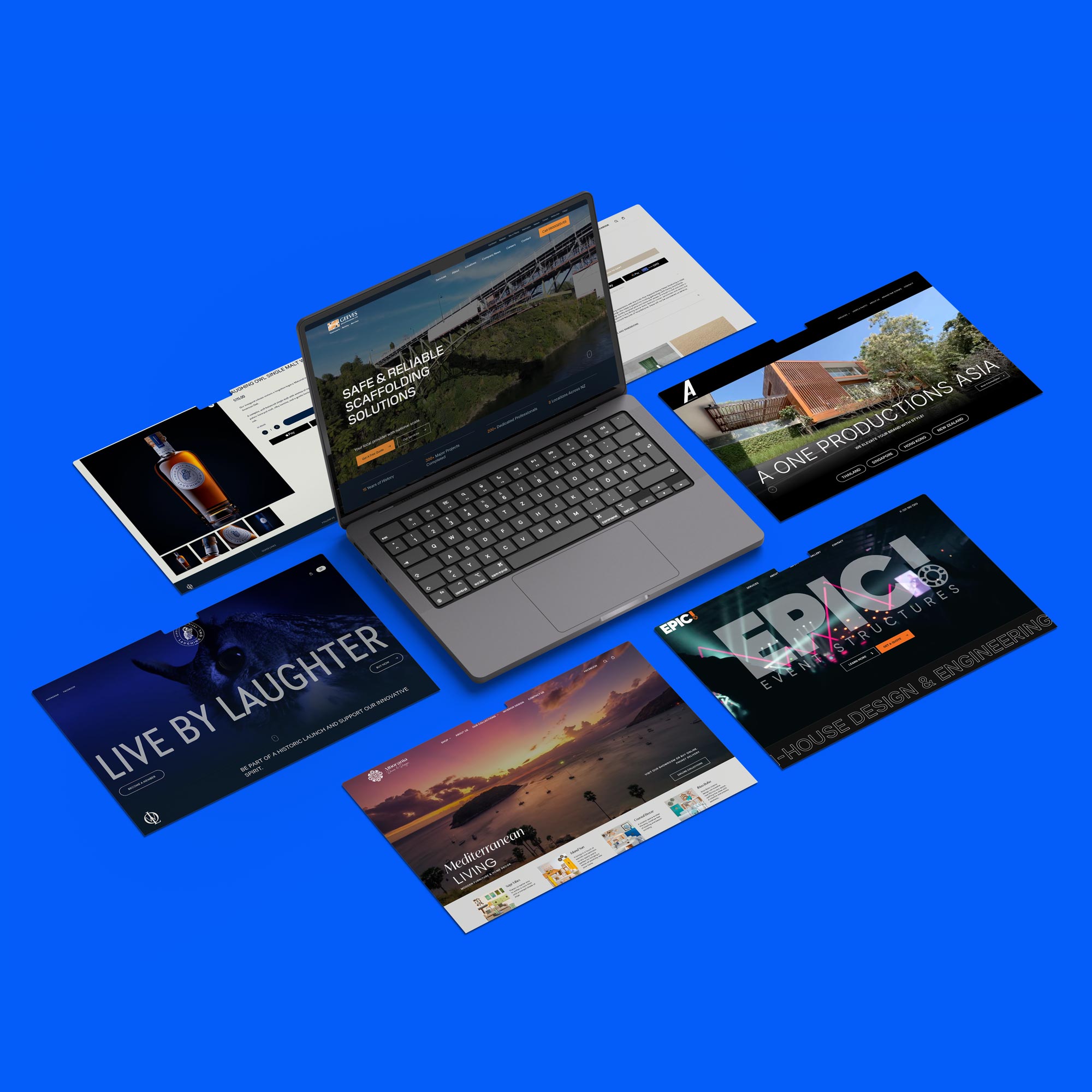
This isn’t just our year in review—it’s a celebration of our clients’ vision and the tangible impact of aligning bold ideas with bulletproof strategy. From the high-stakes world of construction to the refined realm of single malt whisky, here are the projects that defined our 2025.

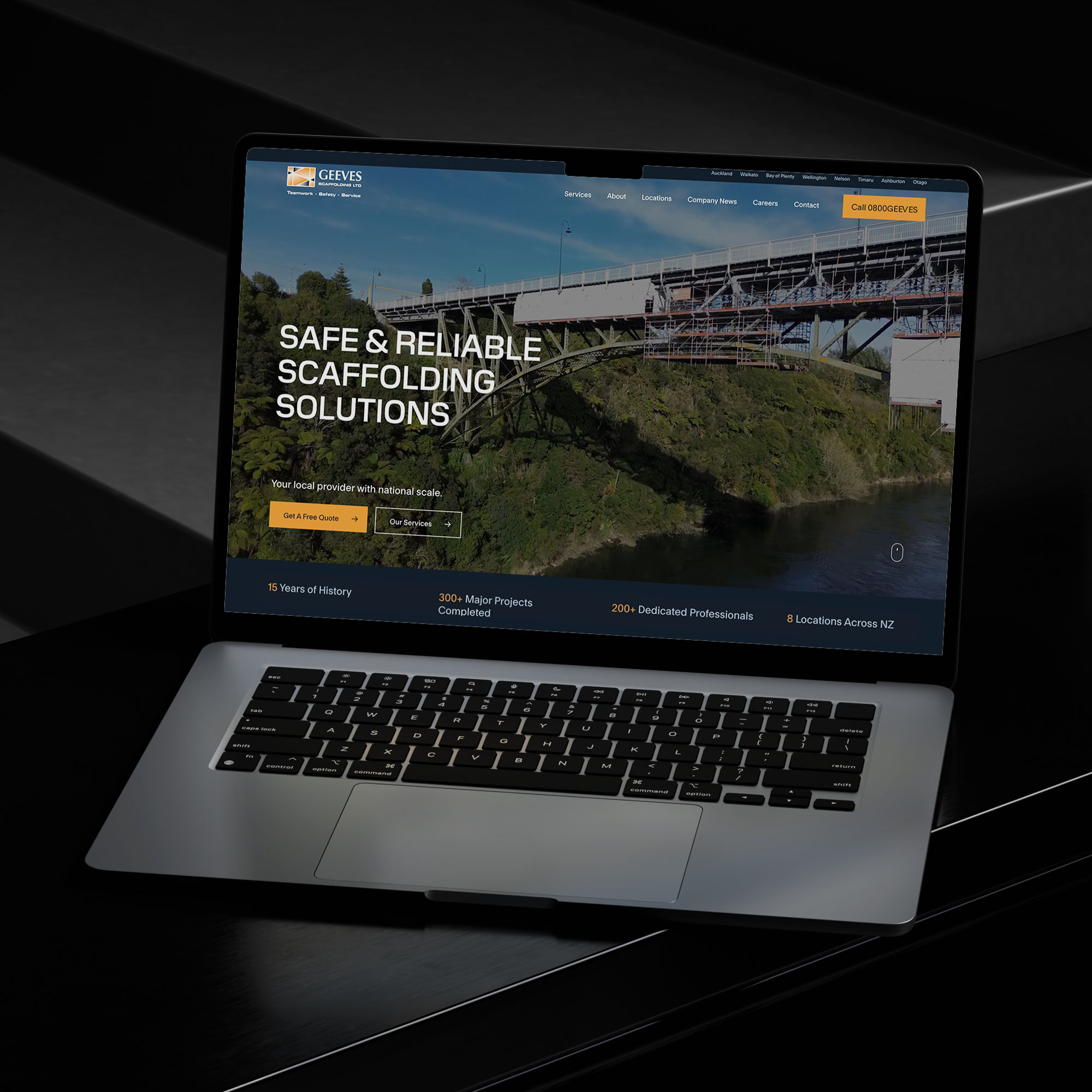
Geeves Scaffolding – Building a Digital Framework for Safety & Trust

The Challenge: In an industry built on physical safety and reliability, Geeves Scaffolding’s online presence wasn’t reflecting their market-leading stature. Their digital facade needed a complete rebuild to inspire the confidence of commercial clients and project managers.

Our 2025 Playbook: We approached this like a precision construction project. Our strategy was built on a foundation of trust and authority.

  • Creating a Industry-Leading Site: We designed a new website that was robust, user-friendly, and safety-first in its messaging. Clean lines, intuitive navigation, and powerful visuals of their projects in action replaced generic stock imagery.
  • Content that Holds Weight: We developed a content strategy focused on thought leadership — blog posts on compliance updates, case studies of complex projects, and guides on scaffold selection. This positioned Geeves not as a supplier, but as an essential partner in successful project planning.
  • Targeted Lead Generation: Through strategic Google Ads targeting high-value commercial construction keywords and Facebook campaigns aimed at project managers and tradies, we built a pipeline of qualified leads, not just clicks.

The Sky-High Result: Significant increase in qualified lead generation from digital channels, and a website that now serves as a 24/7 testament to their professionalism, directly contributing to new contract wins. We didn’t just build a website; we built a digital flagship.

Geeves Scaffolding Website Design

Epic Event Structures – Engineering the Foundations for Unforgettable Moments

The Challenge: Epic creates stages for New Zealand’s biggest events — from concert platforms to grandstand seating. However, their online presence wasn’t fully showcasing the engineering excellence, safety innovation, and creative design that sets them apart. They were being seen as a supplier of parts, not the strategic partner who builds the event’s foundational canvas.

Our 2025 Playbook: We shifted the narrative from simply listing services to showcasing masterful event infrastructure. Our strategy was built on demonstrating how their temporary structures are the critical, unseen hero of every successful event.

  • Showcasing the Scale & Precision: We transformed their digital portfolio into a showcase of engineering artistry. Using detailed case studies, we highlighted the process from initial design to on-site execution, emphasising their in-house engineering certification.
  • Content Built on Authority: We developed content that positioned Epic as thought leaders in event safety and logistics. This included guides on event planning compliance, insights into managing complex sites, and highlighting their nationwide reach with 16 branches, assuring clients they have the resources for any event, anywhere.
  • Targeting the Decision-Makers: Through strategic Google Ads campaigns and content aimed at event producers, festival directors, and commercial brand managers, we focused on the key concerns: safety, reliability, innovation, and creating that “wow factor” within budget.

The Sky-High Result: Website engagement from targeted commercial and event management sectors increased significantly, with time spent on key service pages doubling. Most importantly, inbound inquiries evolved from basic price requests to detailed consultations for custom, large-scale projects, reflecting the established position as premium partners for event infrastructure.

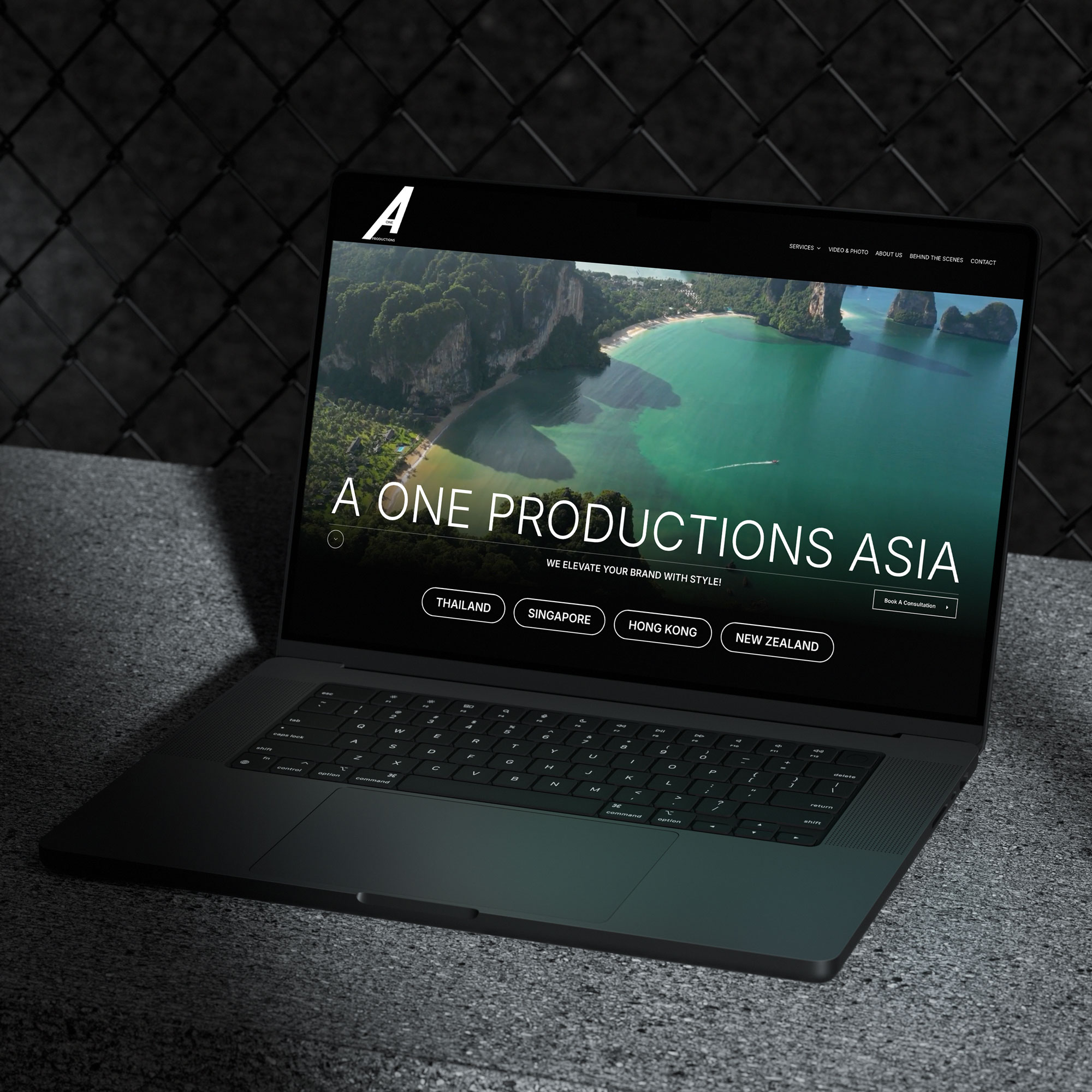
AOne Productions – Orchestrating Visual Narratives from Phuket to the World

The Challenge: AOne Productions, our esteemed client from Phuket, Thailand, possesses masterful talent across photography, videography, aerial and drone videos, and post-production. However, their diverse services were presented as separate offerings rather than a cohesive visual storytelling suite, making it difficult for international resorts, brands, and agencies to see them as a single, premier source for end-to-end visual production.

Our 2025 Playbook: Our mission was to harmonize their offerings into a compelling brand story that showcased Phuket-based excellence with world-class appeal, targeting an international clientele seeking premium visual content.

  • Unifying the Visual & Verbal Brand: We refined their messaging to present “Photography. Videography. Storytelling.” as interconnected chapters of one service. We developed a sleek, portfolio-focused website that showcased their stunning work—from cinematic resort promos and dynamic aerial footage of Thai landscapes to event videos —demonstrating seamless quality across all mediums.
  • The “Global Visual Partner” Pitch: We repositioned AOne not as a local vendor, but as a strategic visual partner for international clients. Our content strategy highlighted their unique advantage: the ability to produce high-quality visuals with the efficiency, local knowledge, and breathtaking backdrop of Phuket and Southeast Asia.
  • Strategic International Showcasing: We optimised their digital presence for global discovery, using targeted SEO for keywords like “international video production Thailand” and “premium aerial photography Asia.” Facebook and Instagram campaigns were strategically aimed at marketing directors of luxury hospitality brands, international ad agencies, and global corporations looking for stunning visual content from the region.

The Sky-High Result: AOne Productions brand is now clearly positioned as a top-tier, one-stop visual production house, successfully translating their Phuket-based talent into a powerful global value proposition.

AOne Productions Website Design

Alborania Decor & Design – Curating a Digital Showroom of Dreams

The Challenge: Alborania, a promising startup from Thailand, sells exquisite, custom-made decor with immense global appeal. However, their potential was locked behind a logistical barrier: without a direct-to-consumer sales channel, reaching their potential customers was complex and fragmented. They needed more than a digital brochure; they required a fully-functional, luxurious e-commerce platform that could seamlessly translate the artistry of their pieces into a trustworthy and convenient shopping experience.

Our 2025 Playbook: Our mission was to engineer a complete digital retail ecosystem. We moved beyond building a brand to building a sales engine, designing an online store that married inspirational storytelling with intuitive, E-Commerce functionality.

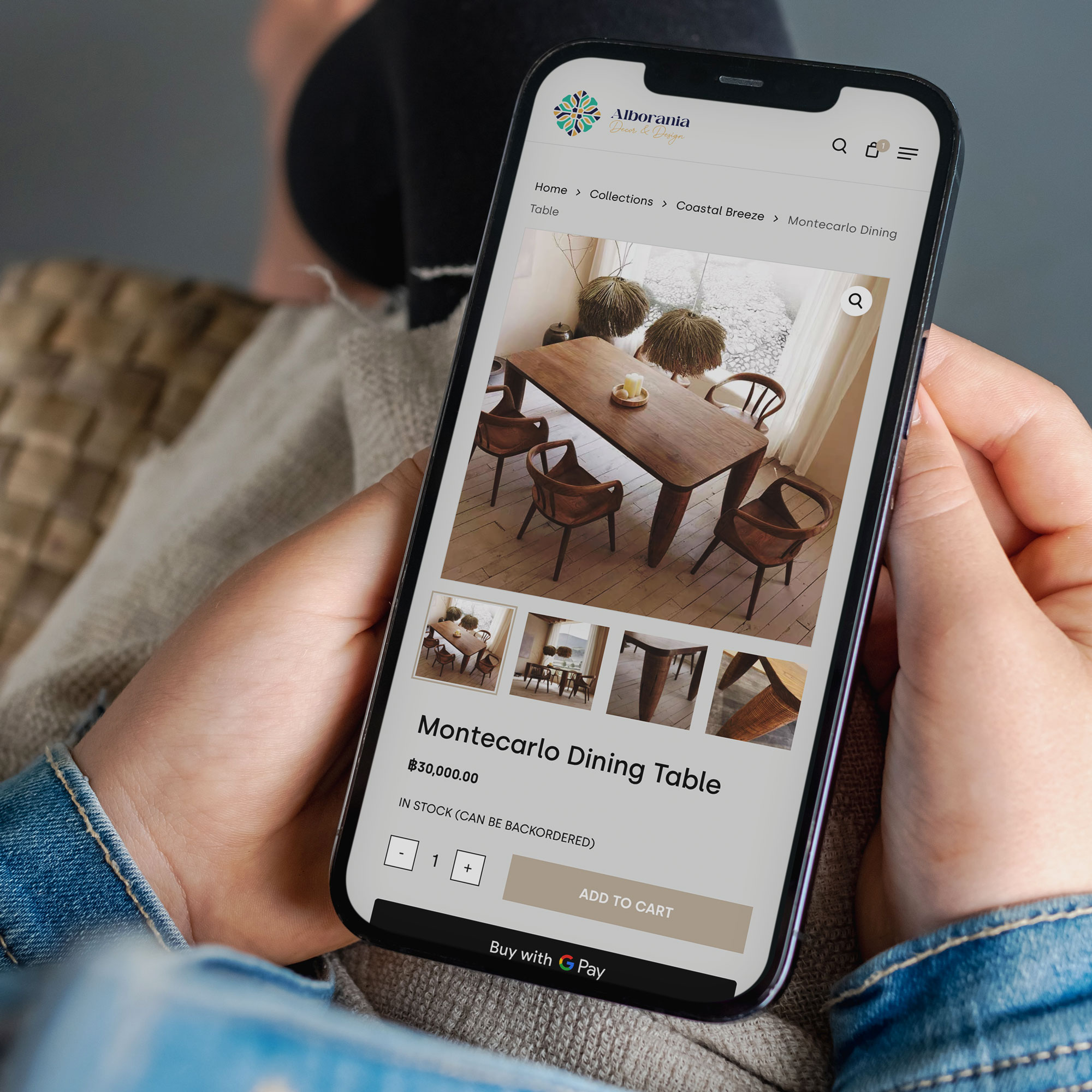
  • Designing a Conversion-Focused Experience: We architected the website as a premium digital boutique. The user journey was meticulously crafted: from immersive, high-fidelity product galleries with zoom functionality and lifestyle videos, to a streamlined checkout process with transparent shipping calculators. Every element was designed to build confidence and reduce purchase friction.
  • Product Narratives that Convert: We embedded powerful storytelling directly into the product pages. Each item’s description was crafted as a mini-narrative, detailing the artisan techniques, material provenance, and cultural inspiration behind the piece. This transformed product listings from simple specifications into compelling stories that justified value and fostered an emotional connection, directly encouraging purchase decisions.
  • Driving Direct Sales Through Paid Traffic: With a beautiful storefront built, we launched targeted social media campaigns. We used visually stunning carousels on Facebook and Instagram, targeting demographics interested in luxury interior design, artisanal goods, and Asian aesthetics, with a clear call-to-action driving traffic directly to product pages.The Sky-High Result: Alborania successfully transacted its first orders within weeks of launch. The platform established a direct, profitable sales channel, eliminating intermediary barriers.

The Sky-High Result: From a standing start, Alborania’s digital showroom generated significant traffic and high-intent inquiries within the first quarter of launch. Facebook and Instagram became their primary discovery channels, directly driving a sales pipeline.

Alborania Website Design

Laughing Owl Whisky – Distilling a Legacy in the Digital Age

The Challenge: Launching a premium spirits brand in a saturated global market is a monumental task. Laughing Owl Whisky needed to establish a legacy from day one – to tell a story so compelling it would justify a premium price point and cultivate a loyal following of connoisseurs and curious drinkers alike.

Our 2025 Playbook: We crafted a launch strategy steeped in legend, locality, and luxury. Every element was designed to bottle the essence of their story.

  • Story as the Spirit’s Soul: We built the entire brand narrative around the enigmatic Laughing Owl (Whēkau), its haunting call, and its connection to the untamed spirit of Aotearoa. This wasn’t just whisky; it was a liquid story.
  • E-Commerce Engineered for Exclusivity: The launch campaign was integrated directly into a high-conversion website. We built advanced e-commerce functionality including limited-release product queues, real-time inventory counters, and a robust waiting list system to manage high demand and create scarcity. The checkout process was optimised for clarity, with detailed information on regional shipping.
  • E-Commerce Engineered for Exclusivity: The “Parliament” membership is the central e-commerce feature. This copy-driven strategy creates digital scarcity and community, encouraging immediate action. The website copy, from the evocative product description (“Mānuka smoke… Mānuka wood… uniquely bold flavour”) to the clear “Buy Now” and “Become a Member” calls-to-action, is designed to guide visitors from story to sale without external media.The Sky-High Result: Launch day delivered extraordinary demand, with the first wave of inventory moving swiftly and driving immediate, high-value sales through the new platform. The launch established Laughing Owl not as another whisky, but as a coveted New Zealand icon in the making.

The Sky-High Result: The platform’s launch generated powerful initial sales momentum and has sustained significant, ongoing demand. The strategic copywriting and “Parliament” membership model successfully converted brand story into commercial action, building a robust waitlist of engaged customers.

Wrapping Up a Year of Transformative Partnerships

2025 at Sky Media reaffirmed a core belief: powerful digital marketing is never just about clicks and conversions. It’s about understanding the soul of a business.

These five highlights are a testament to the collaborative spirit we share with our clients. Here’s to the stories we told, the challenges we tackled, and the results we achieved together. As we look to the horizon, we’re excited to write the next chapter of innovation and impact.

Ready to make 2026 your brand’s most impactful year yet? Let’s talk about your business.

Checklist showing the connection between UX design and SEO success

Is Your Website’s Design Hurting Your Google Ranking? Here’s How to Tell.

By Digital Marketing, SEO

When most business owners think about getting found online, they think of Search Engine Optimisation (SEO)—keywords, backlinks, and content. And when they think about their website, they focus on design: colours, layouts, and beautiful images.

It’s common to see these as two separate projects: one for the marketing team and one for the web designer. But what if we told you that this separation is the very thing holding your website back?

Checklist showing the connection between UX design and SEO success

The truth is, your website’s design and its SEO performance are deeply intertwined. Google doesn’t just see a collection of pretty pictures and text. It “experiences” your website much like a human visitor does. A well-designed website doesn’t just look good; it functions in a way that search engines love.

In this post, we’ll demystify the technical jargon and show you, the business owner, how the core elements of your website’s design directly affect your search engine rankings. Understanding this connection is the first step to building a website that not only wins customers but also wins good rankings in Google search.

1. Site Architecture & Navigation: Building a Roadmap for Users and Google

Think of your website like a physical store. If a customer walks in and can’t find what they’re looking for because the aisles are a maze, they’ll leave frustrated. The same goes for your website.

Site architecture is the structure and hierarchy of your website’s pages. A clean, logical structure is crucial for both user experience (UX) and SEO.

How it Affects Users: Visitors should be able to find any piece of information within three clicks. A clear menu, a logical flow from general (Home > Services) to specific (Services > Renovations), and a helpful footer are essential.

How it Affects SEO: Google’s bots (called “crawlers”) navigate your website by following links. A messy, deep, or illogical structure makes it hard for them to discover and index all your important pages. If Google can’t find a page, it can’t rank it.

Actionable Tip: Create a simple, flat site structure. Use broad categories in your main navigation and use internal links to connect related pages (e.g., link from your “Renovations” service page to your “Completed Projects” page).

2. Mobile-First Design: No Longer an Option, but a Necessity

You’ve likely heard that your website needs to be mobile-friendly. But the concept has evolved. We’re now in the era of “mobile-first indexing”.

This means that Google primarily uses the mobile version of your website’s content for indexing and ranking. If your desktop site is perfect but your mobile site is slow, clunky, or poorly formatted, you are at a significant ranking disadvantage.

How it Affects Users: Over half of all web traffic comes from mobile devices. A non-responsive design forces users to pinch, zoom, and scroll horizontally, leading to a terrible experience and a high bounce rate (people leaving your site quickly).

How it Affects SEO: Google is explicitly prioritising the mobile experience. A slow or unresponsive mobile site will be penalised in search results. Furthermore, a poor mobile experience increases your bounce rate, which is a negative ranking signal.

Actionable Tip: Use Google’s free Mobile-Friendly Test tool. Ensure your website uses a “responsive” design, meaning it automatically adapts its layout to fit any screen size.

3. Page Speed & Performance: The Need for Speed

In our fast-paced world, patience for slow-loading websites is zero. A delay of just a few seconds can kill your conversions. But speed is also a direct Google ranking factor.

How it Affects Users: Slow loading times lead to frustration and abandonment. Think of it as a slow-loading checkout line in a supermarket—people will simply leave their cart and go elsewhere.

How it Affects SEO: Google’s Core Web Vitals are a set of specific metrics related to speed, responsiveness, and visual stability. Websites that perform well on these metrics are rewarded with better rankings. A fast site also gets crawled more efficiently by Google’s bots, meaning your new content can be indexed faster.

Actionable Tip: Compress and optimise your images (don’t upload massive, high-res files directly from your camera). Work with your developer to minimise code and leverage browser caching. Tools like Google PageSpeed Insights can give you a detailed report.

4. Content Layout & Readability: Making Your Content Scannable

You could have the most insightful, valuable content on the internet, but if it’s presented as a giant, intimidating “wall of text,” no one will read it—including Google.

How it Affects Users: Online readers don’t read word-for-word; they scan. They look for headings, bullet points, bold text, and short paragraphs. A clean, scannable layout respects the user’s time and helps them find the information they need quickly, keeping them on the page longer.

How it Affects SEO: When users stay on your page (a metric known as “dwell time”), it signals to Google that your content is valuable. Furthermore, using proper HTML heading tags (H1, H2, H3) to structure your content acts as a roadmap for search engines, helping them understand the context and hierarchy of your information.

Actionable Tip: Break up your text! Use a clear H1 for the main title, H2s for main section headings, and H3s for sub-sections. Employ bulleted lists, bold key phrases, and keep paragraphs to 2-3 sentences.

5. Secure & Accessible Website (HTTPS): The Foundation of Trust

Security is no longer just for E-Commerce sites handling payments. It’s a basic requirement for every website.

How it Affects Users: A secure site (indicated by a padlock icon in the address bar) assures visitors that their connection to your site is encrypted and safe. This builds trust, which is essential for any business hoping to generate leads or sales.

How it Affects SEO: Google has confirmed that HTTPS is a lightweight ranking signal. More importantly, browsers like Chrome now explicitly mark non-HTTPS sites as “Not Secure,” which can severely damage your credibility and increase your bounce rate.

Actionable Tip: Ensure your website has an SSL certificate installed, meaning your URL begins with https:// instead of http://.

6. Image Optimisation: The Hidden Power of Pictures

Images make your website visually engaging, but if not handled correctly, they can be a major drag on performance and a missed SEO opportunity.

How it Affects Users: Unoptimised, large images slow down your page speed, creating a poor user experience as discussed earlier.

How it Affects SEO: Slow loading is an SEO negative. However, properly optimised images present a fantastic SEO opportunity through Alt Text. Alt text is a written description of an image that is read aloud by screen readers for the visually impaired and is also crawled by search engines. It helps your images appear in Google Image Search, driving additional traffic.

Actionable Tip: Always compress images before uploading. When adding an image, describe it concisely in the alt text field, using relevant keywords naturally (e.g., alt=”Bathroom renovation before and after showing outdated pink tiles transformed into a modern walk-in shower” instead of just “image12345.jpg”).

7. Internal Linking: Weaving Your Website Together

Internal links are hyperlinks that point to another page on your own website. They are the glue that holds your site architecture together.

How it Affects Users: Internal links help visitors discover more relevant content, keeping them engaged and on your site longer. For example, you can link from a blog post about your new completed construction project to your service page for “New Builds”.

How it Affects SEO: Internal links help spread “link equity” (ranking power) throughout your site. They establish a hierarchy on your website, showing Google which pages you deem most important. They also help crawlers discover new pages more efficiently.

Actionable Tip: Don’t just use “click here” as link text. Use descriptive anchor text that tells the user and Google what the linked page is about (e.g., “Learn more about our renovation services”).

Bringing It All Together: The Synergy of Design and SEO

As you can see, web design is not a superficial layer on top of your SEO strategy. The elements we’ve discussed, from site structure to image optimisation, are fundamental to how both users and search engines interact with your website.

A beautiful website that is slow, confusing, and insecure will fail to rank and fail to convert visitors. Conversely, a technically perfect but ugly and hard-to-use website will also struggle to meet business goals.

The goal is a harmonious balance: a website that is visually appealing, intuitively easy to use, and built on a technically sound foundation. This is the sweet spot where user experience and search engine optimisation meet, creating a powerful asset that drives sustainable growth for your business.

Conclusion: Your Website is Your Hard-Working Employee

Think of your website as your business’s hard-working, 24/7 sales and marketing employee. For this employee to perform at its best, it needs the right tools and environment. The design elements we’ve covered are exactly that – the tools that allow your website to communicate effectively, build trust, and provide a seamless experience for every visitor.

By prioritising an SEO-friendly design from the very beginning, you’re not just building a website; you’re building a powerful engine for online visibility and business growth.

Is your current website designed for success? The team at Sky Media specialises in creating beautiful, high-performing websites that are built to rank. Contact us today for a free, no-obligation website and SEO audit to see how you can improve your online presence.