SEO New Zealand

AI search influence on local businesses

Google AI Overviews Are Changing Search But Local NZ Businesses Have an Advantage

By AI, SEO

If you’ve searched on Google lately, you’ve probably noticed something different at the top of the results page — a block of AI-generated text that summarises an answer before you’ve clicked anything. That’s Google’s AI Overview, and it’s one of the biggest changes to search in over a decade.

The headlines around it have been alarming. Traffic is down. Clicks are disappearing. Organic search is dying. For businesses that rely on Google to bring in customers, it sounds like bad news.

But here’s what those headlines tend to miss: the impact of AI Overviews is not the same for every kind of business. And for local NZ businesses: tradies, retailers, professional services, and hospitality the picture is considerably more encouraging than the general panic suggests.

AI search influence on local businesses

This post explains what AI Overviews actually are, what the data shows and, most importantly, why local businesses in New Zealand are in a stronger position than most.

What Is a Google AI Overview?

When someone searches Google for information, they now often see an AI-generated summary sitting above all other results. Google calls this an AI Overview (previously known as Search Generative Experience, or SGE).

Instead of a list of links to websites, the searcher gets a direct answer synthesised from multiple sources with links to those sources on the side or at the bottom. For many queries, users can get what they need without clicking through to any website at all.

This is what’s known as a zero-click search, and it’s grown significantly. Research from SparkToro found that 58% of all Google searches now end without a click to any website. For searches where an AI Overview appears, that figure jumps even higher.

For businesses that built their traffic on informational content such as blog posts answering general questions, how-to guides, and educational articles, this is a genuine challenge. Google is now answering those questions directly, without sending users anywhere.

The Data: How Often Do AI Overviews Actually Appear?

The statistics vary depending on who you ask and how they measure it, but a few things are consistent across multiple large studies in 2025 and early 2026:

~48%

of all tracked Google searches trigger an AI Overview as of early 2026

7.9%

of local searches trigger an AI Overview

99%

of AI Overviews appear on informational queries

+35%

more clicks for sites cited inside an AI Overview

  • ~48% of all tracked Google searches trigger an AI Overview as of early 2026 — up from 31% a year earlier. (BrightEdge, Feb 2026)
  • Only 7.9% of local searches trigger an AI Overview. (Ahrefs, Nov 2025)
  • 99% of AI Overviews appear for informational queries — ‘what’, ‘how’, and ‘why’ questions. (SeoProfy, 2026)

These last two points are the most important for local NZ businesses. AI Overviews are overwhelmingly a phenomenon affecting informational content: research, definitions, explanations, comparisons. They are rarely triggered by the kinds of searches that drive local business enquiries.

Why Local Searches Are Different

Here’s the key distinction: there are two very different types of Google searches, and AI Overviews affect them very differently.

Informational searches are questions with general answers — “how does underfloor heating work”, “what’s the best material for a deck”, “what does an electrician charge per hour”. These are research queries. The searcher isn’t necessarily ready to hire someone; they’re learning. These are the searches AI Overviews dominate.

Local intent searches are queries where someone wants to hire, visit, or buy and they want to do it nearby. “Electrician Auckland”, “plumber Wellington urgent”, “builder Christchurch quote”, “café near me”. These are high-intent searches that drive real business. And AI Overviews almost never appear for them.

According to Ahrefs’ data, only 7.9% of local searches trigger an AI Overview. The local map pack — the three businesses that appear with a map at the top of results — still dominates local intent searches. It works the way it always has, and it’s not going anywhere.

This is very good news for any NZ business whose customers find them by searching for a local service. Your Google Business Profile, your local SEO, your reviews — these still work. The rules haven’t changed for you the way they have for national publishers or information websites.

What Kind of Businesses Are Most Affected?

To understand who needs to be most concerned about AI Overviews, it helps to look at which query types are most affected:

Most affected: Blogs and media sites, educational content, health and how-to guides, financial explainers, recipe sites, general Q&A content, anything built around answering research questions.

Moderately affected: E-commerce sites (Google is beginning to expand AI Overviews into commercial queries, though more slowly), national service providers targeting broad non-local terms.

Least affected: Local businesses with location-specific search intent: trades, hospitality, retail, professional services, healthcare, real estate.

If your business gets most of its enquiries from people searching for a specific local service, and that’s the case for the majority of Sky Media’s clients, you’re in the least affected category.

What Should Local NZ Businesses Actually Do?

The short answer: keep doing what works, and double down on it.
The fundamentals of local SEO haven’t changed. In fact, some of them have become more important:

1. Your Google Business Profile is more valuable than ever

The local map pack is one of the most AI-Overview-resistant parts of Google search. A well-maintained GBP, with accurate details, regular photos, consistent reviews, and active posts, is your strongest asset. If you haven’t invested time here, now is the moment.

2. Reviews remain your most powerful trust signal

Google’s local rankings are heavily influenced by review volume and recency. But there’s a new dimension: AI-generated answers increasingly draw from and reference businesses with strong review profiles. A business with 80 current, detailed reviews is more likely to be surfaced and mentioned in local pack results and, increasingly, in AI-generated responses to relevant queries.

3. Location-specific content on your website still matters

Service pages that clearly name the areas you work in, the specific services you offer, and the kinds of customers you help, this content gives Google the signals it needs to match you to local searches. It also gives AI systems the structured, authoritative information they need to reference you correctly.

4. Your website needs to be technically solid

Page speed, mobile experience, and structured data (schema markup) are all becoming more important, not less. Structured data in particular, the code that tells Google exactly what your business is, what services you offer, and where you operate, helps AI systems understand and reference your site accurately. It’s moved from a nice-to-have to a meaningful ranking signal.

5. Don’t abandon informational content, just be strategic about it

If your website has blog posts or guides answering questions your customers ask, these are still worth having. The approach shifts slightly: rather than writing purely to attract informational traffic, write content that demonstrates your expertise and builds trust with people who are already considering hiring you. Content that’s specific, authoritative, and locally relevant will still perform, and may even be cited by AI systems if it’s structured well.

The Bigger Picture: What’s Actually Changing

It’s worth stepping back from the day-to-day statistics and considering what AI Overviews represent at a bigger level.

Google is moving from being a directory of links to being an answer engine. For queries where the answer is general and informational, it increasingly provides that answer itself. For queries where the answer depends on location, personal preference, or real-world availability: who’s available, who’s nearby, who’s trusted in this area, it still needs to point people to real businesses.

Local businesses are, in many ways, the part of the internet that AI can’t replace. An AI can tell you how roof painting works. It cannot paint your roof. It can explain what a conveyancing lawyer does. It cannot handle your property transaction. The searches that lead to actual local business happen in the part of Google that’s proven the most resistant to AI disruption, and that’s where local businesses live.

A Note on What’s Still Changing

It would be misleading to suggest AI Overviews have zero impact on local businesses or that the landscape is completely stable. A few things worth watching:

  • AI Overviews are expanding into commercial queries. They currently appear in only around 10–18% of commercial searches, but that share is growing. This is worth monitoring, particularly for e-commerce businesses and national service providers.
  • Zero-click behaviour is increasing across all search types. Even without an AI Overview present, users are clicking through to websites slightly less often than they used to. This makes your Google Business Profile which answers many questions (hours, phone, reviews, location) without requiring a click even more important as a standalone conversion tool.
  • AI Mode is a new surface to understand. Google launched AI Mode in 2025 as a dedicated AI search tab with 75 million daily users globally. It’s still a small channel relative to traditional search, but it’s growing and will become more relevant to track over time.

None of these developments are cause for alarm for local NZ businesses right now. But they are worth being aware of and they’re exactly the kind of thing a good SEO partner should be monitoring and acting on for you.

Local SEO Is Still One of the Best Investments a NZ Business Can Make

While the global SEO landscape is shifting in meaningful ways, the fundamentals of local search remain intact, and for NZ businesses that serve a geographic area, the opportunity is as strong as it’s ever been.

The businesses that will come out ahead are the ones that stay consistent with local SEO fundamentals: a well-maintained Google Business Profile, a steady flow of reviews, a fast and mobile-friendly website, and location-specific content that clearly communicates who they serve and where.

If you’d like to understand how your current SEO is performing in this changing environment, or what you should be prioritising, Sky Media offers a free audit that looks at exactly these signals. Request a free SEO audit.

Digital Marketing for Tradies: How NZ Builders, Plumbers & Electricians Get More Leads Online

By Digital Marketing, Tips and Guides

Word of mouth used to be enough. For a long time, it was. But for most NZ tradies today, referrals alone don’t fill the calendar, especially if you’re growing, branching into new areas, or trying to reduce the slow periods that come every year.

The tradies consistently winning new work are the ones who’ve figured out how to be visible online when someone picks up their phone and searches “electrician near me” or “builder Wellington quote”. That search happens hundreds of times a day across New Zealand, and right now, someone is getting that job, and it might not be you.

This guide is a plain-language breakdown of what actually works for tradies online

Why Digital Marketing Works Differently for Tradies

Tradies have a natural advantage in digital marketing that a lot of industries don’t: you serve a specific local area, and Google is built to reward that.

When someone searches for a tradie, they’re not browsing, they have a problem right now, and they need it fixed. That’s called high-intent search, and it’s the best kind of traffic you can get. These are people who are actively looking to hire, often with urgency.

The challenge is making sure you show up, and making sure that when you do, your online presence is good enough to earn the call over the other options on the page.

The Four Things That Drive Tradie Leads Online

You don’t need to do everything. But there are four areas where most tradie businesses see the biggest return:

1. Your Google Business Profile

If you only do one thing from this entire article, make it this: set up and optimise your Google Business Profile (GBP).

Your GBP is what appears in Google Maps and the map pack. The three businesses that show up at the top of local search results. It’s free, it’s visible, and for trades work, it’s often the first thing a potential customer sees.

A well-optimised GBP for a tradie should have:

  • Your correct trade category (e.g. “Plumber”, “Electrician”, “Builder” — be specific)
  • Your service area clearly defined
  • At least 10 real photos, for example your van, your team, completed jobs
  • A steady flow of Google reviews from happy customers
  • Your services listed individually (e.g. “Hot water cylinder replacement”, “Bathroom rewiring”, “Deck building”)
  • Regular posts and a quick-response habit for reviews and questions

The trades businesses that dominate local search in NZ aren’t doing anything complicated. They’ve just taken the time to fill out and maintain their GBP properly.

2. A Website That Works as a Sales Tool

A lot of tradie websites look like they were built ten years ago and haven’t been touched since. They load slowly, they’re impossible to navigate on a phone, and they give a potential customer no real reason to choose you over anyone else.

Your website is your digital shopfront. If someone clicks through from Google, whether that’s from your GBP, an ad, or an organic result, your website is where they decide whether to call you or hit the back button.

For tradies, the most important things a website needs to do are:

  • Load fast on mobile. Most people searching for trades are on their phone. If your site takes more than a few seconds to load, they’ll leave before they see anything.
  • Show your phone number immediately. It should be at the top of the page, clickable, and visible without scrolling. Don’t make people hunt for it.
  • List your services clearly. Each main service you offer should have its own page or section. This helps customers, and it helps Google understand what you do.
  • Include real photos. Before and after shots, completed jobs, your team at work. Real photos build more trust than anything else on the page.
  • Show social proof. Your Google rating, a few short testimonials, or logos of organisations you’re certified with (e.g. Master Electricians, Licensed Building Practitioners).
  • Have a clear call to action. Whether it’s a quote form or a phone number, make it obvious what you want them to do next.

A good tradie website doesn’t need to be complicated. It needs to be clear, fast, and trustworthy.

3. Google Ads (When You Want Leads Now)

SEO and your Google Business Profile take time to build momentum. Google Ads can fill the gap.

For tradies, Google Ads work particularly well because you can target people who are actively searching for your specific service in your area right now. When someone searches “emergency plumber Auckland” at 8pm on a Tuesday, a well-set-up Google Ad puts you in front of that person at exactly the right moment.

A few things that matter for tradie Google Ads:

  • Search ads only. For most tradies, search ads (text ads that appear above organic results) are the right format. You’re reaching people with immediate intent.
  • Target your actual service area. Don’t pay for clicks from people outside the area you work in. Set your targeting to cover your real coverage zone.
  • Send traffic to a dedicated page. Not your homepage but a page that matches exactly what the ad promised. If your ad says “Registered Electrician Auckland — Free Quote”, the page should open with those words.
  • Track your calls. Google Ads can track which calls came from which ads. Without this, you’re flying blind on what’s working.

Done right, Google Ads can deliver a consistent flow of qualified leads with a measurable cost per enquiry. Done wrong, they burn through budget fast with nothing to show for it which is why getting the setup right matters.

4. Reviews Are Your Most Powerful Marketing Asset

Think about the last time you hired a tradie you’d never used before. Chances are you checked their reviews first.

Your potential customers do exactly the same thing. Reviews are the single most persuasive element of your online presence, more than your website copy, more than your ads, more than your social media.

For tradies, the goal is a steady, ongoing stream of genuine reviews — not a one-off burst.

Here’s what works:

  • After every completed job, ask the customer directly: “Would you mind leaving us a quick Google review? It really helps us out.”
  • Follow up with a text or email that includes a direct link to your Google review page, make it one tap, not a process.
  • Ask customers to mention the specific job and location in their review (e.g. “bathroom renovation in Papakura”); these details help your local SEO.
  • Respond to every review, good and bad. It shows professionalism and signals to Google that you’re active.

A builder with 60 solid reviews will consistently win more work than one with 5, even if the quality of work is identical. Reviews are trust at scale.

Here’s an example from one of our clients — Tasman Sparkies, a Nelson-based electrical business. Their website is built to convert visitors into calls.

A conversion-focused homepage Sky Media designed for Tasman Sparkies, showing clear services infomation, location, and a prominent call-to-action.

The social proof section of the Tasman Sparkies website, displaying Google reviews to build trust with potential customers.

What About Facebook and Instagram?

Social media comes up a lot in these conversations, so it’s worth addressing directly.

For tradies, social media can work, particularly for brand awareness and showcasing your work. Before and after photos on Facebook or Instagram can do well, especially in local community groups.

But for most trades businesses, social media is a secondary channel. The reason: people don’t usually scroll Facebook when their hot water is broken or they need a new circuit board. They go to Google.

If you have the time and enjoy it, posting your work on social is worthwhile. But if you’re choosing where to invest your energy first, Google (your GBP, your website, and Ads) will almost always deliver a better return for trades businesses.

A Realistic Starting Point

If you’re not sure where to begin, here’s a practical order:

  • Step 1: Claim and optimise your Google Business Profile. It’s free and often the fastest win.
  • Step 2: Make sure your website is up to date and has clear information, call to action and phone number.
  • Step 3: Start asking every happy customer for a Google review and make it a habit.
  • Step 4: Once your profile and website are solid, consider Google Ads to accelerate leads in specific services or areas.

You don’t need to do all of this overnight. Each step compounds on the next, for example: a better GBP leads to more calls, more calls lead to more reviews, more reviews improve your ranking, and a well-built website converts more of those visitors into jobs.

Quick-Reference: Tradie Digital Marketing Checklist

Google Business Profile claimed, complete, and active

  • Service area and categories set correctly
  • At least 10 real photos uploaded
  • Consistent flow of Google reviews being collected
  • All reviews replied to
  • Website is up to date
  • Phone number visible and tappable at the top of every page
  • Each main service has its own page or section
  • Real job photos on the website
  • Google Ads considered once foundation is in place
  • Website and GBP details consistent (name, address, phone)

The One Mistake Most Tradies Make Online

The most common mistake we see is treating online presence as a set-and-forget thing.

A website built three years ago that hasn’t been touched. A Google Business Profile claimed but never updated. A handful of reviews from 2022. No recent photos.

Google pays attention to freshness and activity and so do customers. A profile or website that looks dormant signals uncertainty — is this business still operating? Are they any good? Do they actually work in my area?

The tradies getting the most leads online are the ones treating their digital presence like a tool that needs to be maintained, not a box they ticked once.

Need Help Getting More Work Through Your Website and Google?

Sky Media works with NZ trade businesses on everything from website design to Google Ads management and local SEO, building the kind of online presence that consistently fills the calendar.

Whether you’re starting from scratch or want to improve what you’ve already got, we can help you figure out where the biggest opportunities are and what to do about them. Talk to Sky Media about Tradie Marketing.

SEO Costs in New Zealand: What You Should Pay in 2025

By SEO

Search Engine Optimisation (SEO) is one of the most powerful long-term growth strategies for Kiwi businesses. Whether you’re a start-up café in Ponsonby, a professional service in Wellington, or a construction company in Christchurch, SEO ensures your business is visible when people search online.

But one of the first questions most businesses ask is: “How much should I pay for SEO services?”

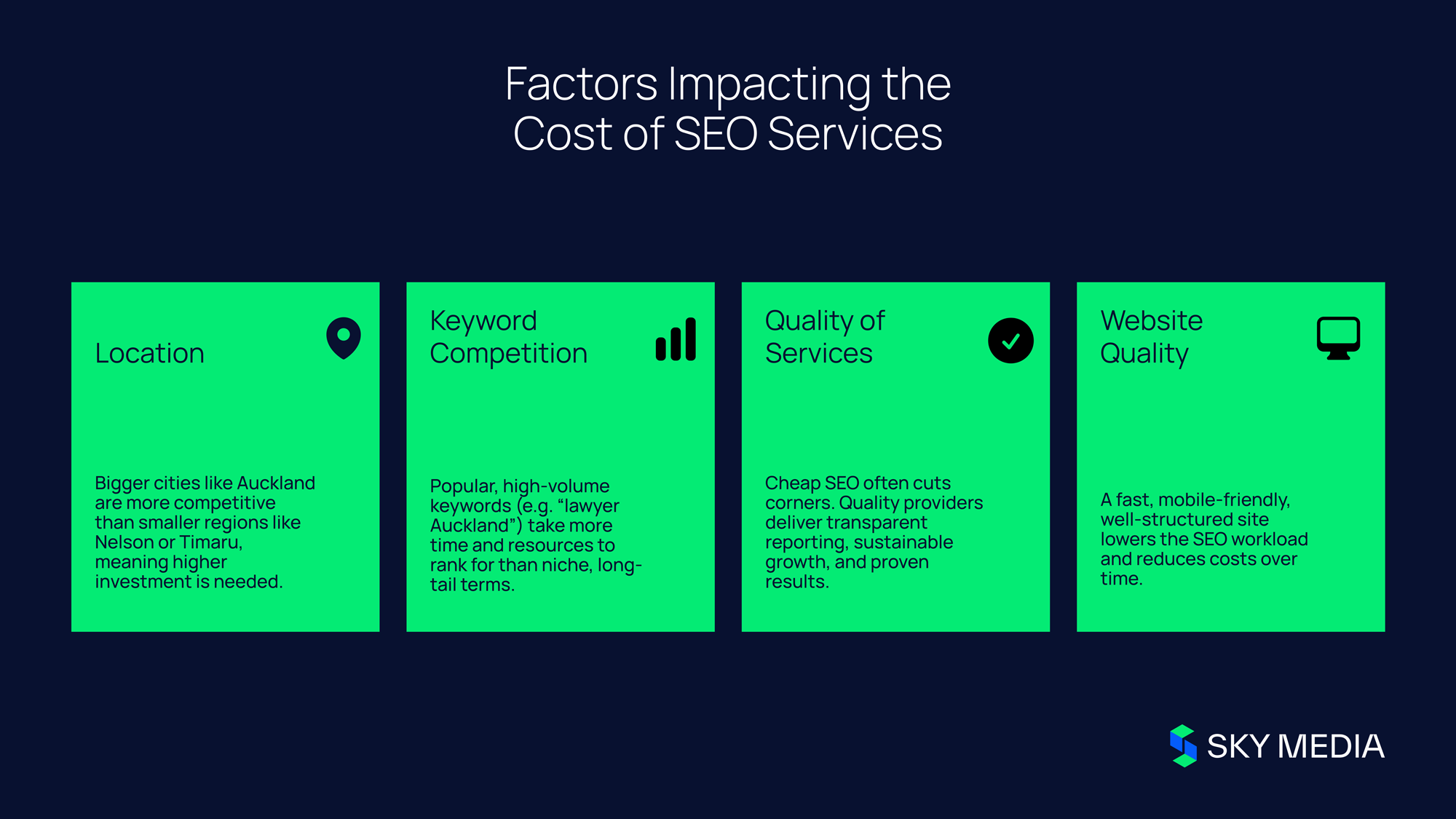
The answer depends on a mix of factors—your target location, the competitiveness of your keywords, the quality of service you’re choosing, and even how well your website has been designed. In this guide, we’ll unpack the key elements that influence SEO pricing in New Zealand, weaving in local examples (SEO Auckland, SEO Wellington, SEO Christchurch) and why pairing SEO with a trusted web design agency makes such a big difference.

1. The Scope of Your Target Market: Why Location Drives Cost

Not all locations are created equal when it comes to SEO competition.

  • SEO Auckland: New Zealand’s largest city is home to thousands of businesses across industries, all vying for visibility. Ranking for keywords like “construction company Auckland” or “Auckland plumber” is highly competitive and usually requires more content, stronger backlinks, and higher monthly investment.
  • SEO Wellington & SEO Christchurch: These cities are smaller but still competitive. Businesses in Lower Hutt, Petone, or Riccarton often face less competition than those in the CBD, meaning SEO budgets stretch further.
  • Regional SEO (Nelson, Timaru, Tauranga, Dunedin): In smaller markets, SEO is often more affordable. With fewer competitors targeting local keywords, smaller campaigns can achieve strong visibility with less investment.

NZ Stat Snapshot: 96% of Kiwis use the internet, and over 90% use Google as their preferred search engine. With nearly 88.5% of users browsing on mobile, local search visibility is no longer optional—it’s essential.

2. Keyword Difficulty & Competition: Understanding the Playing Field

Keywords are the foundation of SEO, but some are harder—and more expensive—to rank for.

  • High-competition keywords: Terms like “renovations Auckland” or “Christchurch lawyer” have hundreds of businesses competing for visibility. To win, you’ll need consistent blogging, link building, and advanced technical SEO.
  • Moderate competition: Keywords like “Wellington property management agency” or “Hamilton builders” may be easier to target, though still competitive in their industries.
  • Low-competition opportunities: Long-tail keywords such as “affordable plumbing company in Nelson” can deliver quick wins with less cost, while still driving valuable leads.

Smart SEO strategies combine short-term quick wins with long-term high-value goals.

3. The Quality of SEO Services: You Get What You Pay For

SEO services vary widely in quality, and that directly impacts cost.

  • Cheap SEO ($500–$1,200/month): Often limited to basic on-page fixes, minimal link building, and maybe a blog or two. This can work for very small businesses in low-competition areas, but results are limited.
  • Mid-tier SEO ($1,500–$6,000/month): Includes keyword strategy, on-page SEO for multiple pages, Google Business Profile optimisation, ongoing content creation, and consistent link building. Ideal for SMEs in larger NZ cities.
  • Enterprise SEO ($7,000–$10,000+/month): Comprehensive campaigns covering multiple locations nationwide, advanced content marketing, CRO testing, and high-authority backlinks. Necessary for nationwide brands and industries like law, finance, or real estate.

Sky Media’s packages reflect these tiers:

  • Sky Lift ($499+GST/month): Great for small local businesses with 5 keywords.
  • Sky Climb ($899+GST/month): Adds 10 keywords, local citations, and monthly blogs.
  • Sky Orbit ($2,900+GST/month): Expands to 50 national keywords, advanced link building, and monthly strategy calls.
  • Sky Galaxy ($4,500+GST/month): A full-scale national SEO campaign, custom content, and high-authority link outreach.

Tip: Always ask for transparent reporting, clear deliverables, and case studies. With Sky Media, 96% of clients stay with us because we prioritise results and accountability.

SEO services cost New Zealand Summary Inforagraphic

4. The Role of Web Design in SEO: Building on the Right Foundation

Even the best SEO strategy can’t succeed if your website isn’t built properly. Google rewards websites that are fast, mobile-friendly, and user-focused.

  • Mobile-first: Nearly 90% of NZ internet users browse on mobile. If your site isn’t responsive, you’ll lose rankings and customers.
  • Speed & Core Web Vitals: With NZ mobile internet averaging 91 Mbps and fixed broadband at 180 Mbps, users expect sites to load quickly. A slow site increases bounce rates and decreases conversions.
  • Clean structure: Search engines need a clear, logical hierarchy to crawl. Websites with messy coding, missing headings, or no internal linking require extra SEO work (and cost more to optimise).

That’s why many businesses choose a web design agency in Auckland, Wellington, or Christchurch that also offers SEO. A properly designed site reduces SEO costs in the long run and makes optimisation much easier.

Pro tip: If your website is outdated, consider a redesign before committing to a full SEO campaign. It may increase upfront costs but will save significantly on wasted SEO spend later.

5. Content & Link Building: The Fuel of SEO

SEO success hinges on two things: content and links.

  • Content: High-quality blog posts, guides, and service pages demonstrate expertise and keep your site fresh. Local content like “Top Cafés in Te Aro” or “Building Regulations in Christchurch” helps capture regional traffic.
  • Links: Backlinks are still one of Google’s strongest ranking signals. Getting high-authority links from NZ media outlets, directories, and partner businesses shows Google your site is trustworthy.

Example:

  • Sky Climb ($899+GST) includes monthly blogs and local citations.
  • Sky Orbit ($2,900+GST) scales to 4 blogs per month and advanced link building.

The more content and authority links you produce, the higher the costs—but the payoff is exponential in rankings and leads.

6. Why Cheap SEO Usually Costs More

Cheap SEO might seem appealing, but it often leads to:

  • Spammy backlinks that harm your domain authority
  • Minimal reporting with no clear ROI
  • Short-lived rankings that collapse with Google algorithm updates
  • Penalties that can tank your website visibility for months

On the other hand, investing in ethical, white-hat SEO pays off like compounding interest. The longer you run high-quality SEO, the stronger your authority, traffic, and lead flow become.

Final Thoughts: How Much Should You Pay?

There’s no universal price tag for SEO—it depends on your:

  • Location (SEO Auckland vs SEO Timaru)
  • Industry (finance vs hospitality)
  • Website quality (modern vs outdated)
  • Ambition (local presence vs nationwide dominance)

For some, $500–$900/month may be enough to establish a local foothold. For others targeting Auckland, Wellington, and Christchurch simultaneously, a realistic budget is $2,900–$4,500/month.

The key is choosing a partner who understands your goals and market. With proven success across SEO Auckland, SEO Wellington, and SEO Christchurch, and integrated web design services nationwide, Sky Media delivers SEO that builds businesses—not just rankings.

Benefits of Long-tail Keywords for Google SEO

By SEO

At Sky Media we make SEO (search engine optimisation) easy to understand. You may not know all about SEO, but you’re probably using it everyday. If you’ve ever typed, ‘Restaurant near me,’ ‘Best builder in Christchurch,’ or ‘Makeup artist Auckland,’ into Google, then you’ve used SEO.

Our team sees the benefits of SEO in business everyday and we know that Long-tail SEO Keywords can provide powerful results for anyone selling products, or services people want, or need.

Are you wanting to see heaps of people visiting your website? Are you looking for ways to increase revenue for your business? Are you wanting enquiries, bookings and purchases from people who want what you’ve got? Well, your website needs Long-tail SEO.

A Quick Overview of SEO

Search Engine Optimisation (SEO) is the most cost-effective way to ensure your business’s website makes its way to Google’s 1st Page, where everyone’s shopping nowadays. Everyone? Well, 75% of all Google users only shop on the 1st Page, while the other 25% stop at the 2nd Page. That means, if you’re Page 3, or beyond, you’re not getting found by anyone.

Our Google SEO ensures your business is front and centre on Page 1 where it belongs. One of the fastest and most effective ways to do this is Long-tail SEO Keywords, and that just means the Keywords are longer than Short-Tail SEO, for example:

  • Short-tail SEO – Builder Auckland
  • Long-tail SEO – Bathroom Renovations in the North Shore

Typically, it’s easier to get on Google’s 1st Page and get traffic coming your way, when you use Long‐tail SEO Keywords. They’re much more specific and therefore highly targeted to your ideal audience. It means that when people land on your website (and many will, when you’re on Page 1), it’s much more likely that they’ll want what you’ve got.

Long-Tail SEO – One of Two Ways, or Both?

Long-tail SEO can be done one of two ways (or both), depending on your business goals. You can go niche and specific, or take the large-scale big blast approach. In many cases, the businesses that can afford to do so, do both.

For many businesses niche specific Long-tail SEO Keywords like – ‘Custom kitchen installations in Christchurch,’ can actually be quite valuable. These SEO Keywords are worth going after, even though they may have a small volume of Keyword searches each month, because it’s highly likely these people want exactly what you’ve got. If only 12 people search that term in Christchurch each month, but 3 of them end up purchasing from you, that’s a big conversion, that’s a win.

Benefits of Niche and Specific Long-Tail SEO:

  • High Conversions – These searchers will probably convert into buyers.
  • Low Competition – These niche Keywords aren’t used by a lot of sites, yet.

The Key to Niche Search Terms for Your Business

  • Choose Long-tail SEO Keywords specific to your business or industry e.g “Back waxing for men in Merivale, CHCH.”
  • Choose Long-Tail SEO Keywords that will convert into sales e.g the terms match exactly what you have for sale in the location you expect to sell it, for the people you plan to sell it to e.g back waxing (service) for men (target audience) in Merivale, CHCH (location).
  • Choose very low-competition Long-Tail SEO Keywords, because that means you can get your site to Page 1 of Google quickly and easily.

You don’t need to be targeting all the Long-tail SEO Keywords you can think of, but simply speak to us to brainstorm the ones that are likely to be beneficial. Our SEO Experts will conduct research to confirm the top-performing SEO Keywords for your market, then we’ll look at targeting the services you’d prefer to target.

With Sky Media’s approach to SEO, it’s highly likely your website will see results in less than 90 days, especially for Keywords with long tails. Speak to our team to get your free Google WOF Report, where you’ll find exactly where your site’s positioned for SEO Keywords that are specific to your industry.