SEO16

Stay ahead with Sky Media’s latest SEO, web design, and Google Ads tips. Practical advice for Kiwi businesses to boost their online success.

Why Your Business Needs a Dedicated Landing Page | Sky Media

How Landing Pages Boost SEO for NZ Businesses

By Digital Marketing, SEO

Most NZ businesses have a website. A lot of them have a pretty good one. But when it comes to actually capturing customers from Google — whether through SEO or paid ads — there’s often a critical piece missing.

Not more content. Not a bigger budget. A dedicated landing page.

Why Your Business Needs a Dedicated Landing Page | Sky Media

There’s a common assumption that your homepage is your front door — and that directing everyone there is the logical approach. In some situations that’s fine. But for specific services, specific locations, specific audiences, or specific campaigns, a homepage is almost always the wrong destination.

This post explains what a landing page actually is, why it performs differently from a homepage, and how a well-built one can do meaningful work for your business — in both search rankings and conversions. We’ll use a real example from a page we recently built for Bin Inn Timaru to show what this looks like in practice.

Homepage vs Landing Page: What’s the Actual Difference?

Your homepage is designed to serve everyone. It introduces your business, points people toward different parts of your site, and tries to cater to a range of visitors with different needs and intentions. It’s broad by design.

A landing page is built for one specific purpose, one specific audience, and one specific action. Everything on it — the headline, the content, the images, the calls to action — exists to serve that single goal.

The difference in how they perform isn’t subtle. A homepage asks a visitor to make a choice about where to go next. A landing page removes that choice and guides the visitor directly toward the outcome you want — a call, a visit, a form submission, a booking.

A homepage introduces your business. A landing page converts a specific visitor into a specific action.

This distinction matters enormously for two things: SEO and Google Ads. Both reward specificity, relevance, and clarity — and a well-built landing page delivers all three in a way a homepage simply can’t.

Why Landing Pages Work Better for SEO

Google’s job is to match a search query with the most relevant result. When someone searches for something specific — a product, a service, a local business — Google is looking for a page that directly and comprehensively addresses that specific query.

A homepage that covers ten different things is less relevant to any single search than a page built entirely around one topic. This is the core reason dedicated landing pages tend to rank better for specific, targeted searches.

There are several SEO-specific reasons this works:

Keyword focus
A landing page can be built around one keyword cluster — the specific terms your target customers are searching for. When your page title, headings, content, meta description, and URL all consistently reflect that focus, Google has a much clearer signal about what the page is relevant to.

Local signals
For businesses serving a specific town or region, a landing page can include detailed local signals — the suburb, the street address, the surrounding areas, the community context — that a generic homepage often leaves vague. These signals are exactly what Google needs to rank you for local searches.

FAQ content
Well-structured FAQ sections on landing pages are particularly valuable from an SEO perspective. They directly address the specific questions people search for, increase the depth and relevance of the page, and can earn featured snippet placement — the answer boxes that appear at the very top of some search results.

User behaviour signals
Google pays attention to what happens after a click. If someone lands on your page and immediately leaves (a high bounce rate), that signals the page wasn’t relevant. A landing page that’s clearly relevant to the search, loads fast, and gives the visitor exactly what they were looking for produces better engagement signals — which feeds back into rankings.

Why Landing Pages Work Better for Google Ads

When you run a Google Ad, you pay for each click. The quality of the page those clicks land on directly determines whether you get a return on that spend.

Google also measures what they call Quality Score — a rating of how relevant your ad, your keywords, and your landing page are to each other. A higher Quality Score means Google charges you less per click and shows your ad more often. A lower score means you pay more for worse placement.

A dedicated landing page that matches your ad’s message precisely — same service, same location, same promise — earns a higher Quality Score than a homepage that covers everything loosely. That means lower cost per click, better ad placement, and more conversions from the same budget.

The principle is called message match: the searcher’s query, your ad, and your landing page should all tell the same story. When they do, everything improves. When they don’t, you pay more and convert less.

A Real Example: Bin Inn Timaru

Bin Inn Timaru is a locally owned wholefood and specialty grocery store at 18 Dee St in Timaru — bulk bins, organic products, international foods, home brew supplies, and a lot more. Owner Shailesh Modi has been serving the Timaru community for years with the kind of personal, knowledgeable service a supermarket simply doesn’t offer.

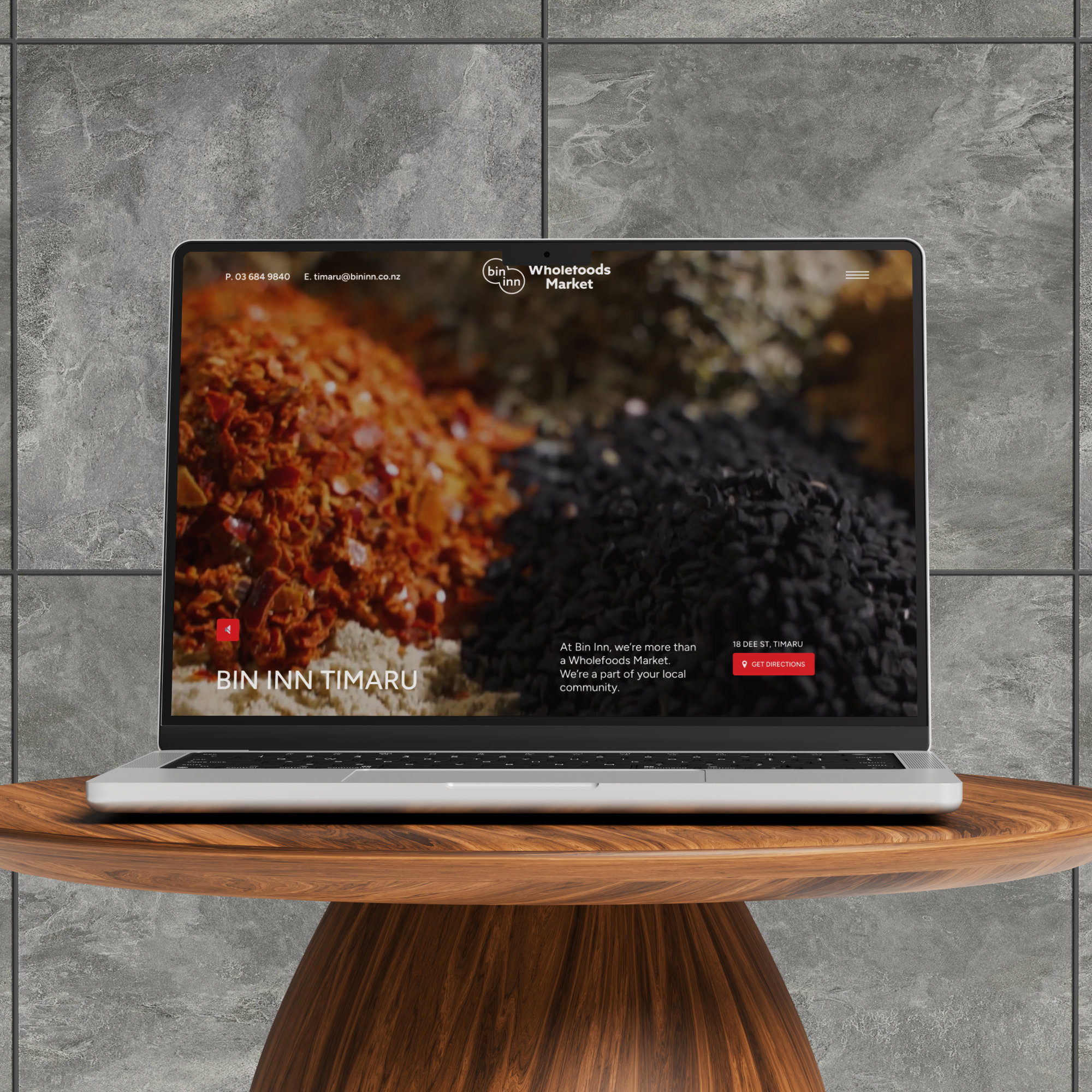
Sky Media recently built a dedicated landing page for the store at bininntimaru.co.nz. It’s a WordPress build — no e-commerce, no online shop. The entire purpose of the page is to help people find the store, understand what it sells, and feel confident enough to visit.
Here’s what the page does well — and why each element matters:
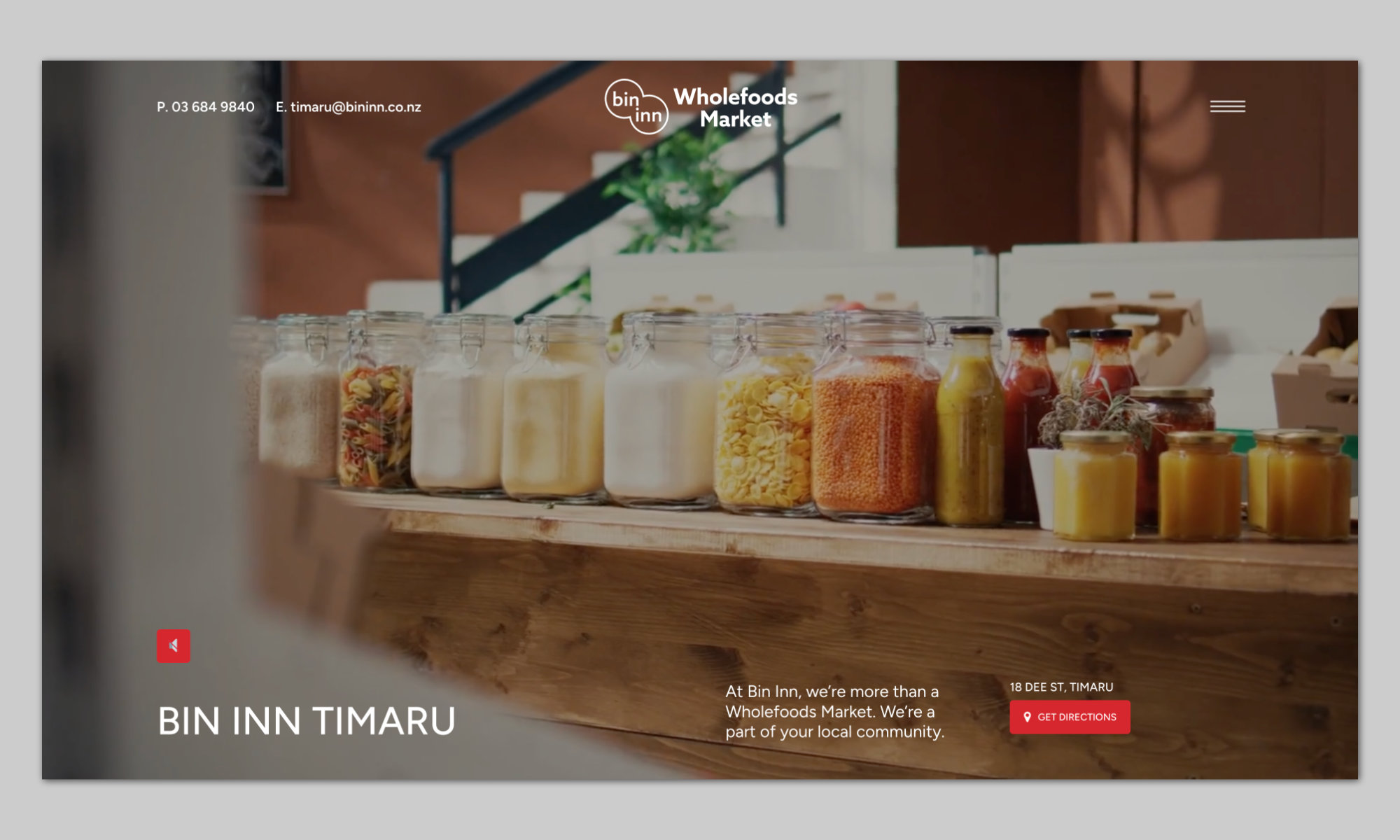
Bin Inn Timaru hero Section

The Bin Inn Timaru landing page built by Sky Media — hero section with video background, address, live opening hours, and directions link visible immediately on load.

Immediate answers above the fold
The first thing a visitor sees — before scrolling at all — is the store name, address, opening hours, and a Get Directions link. There’s also a live indicator that shows whether the store is open right now. For a local business, this is exactly the information a nearby customer needs, delivered instantly.

This matters for SEO too. Google can read and index that structured information clearly, reinforcing the local relevance of the page.

Detailed product range
The page lists Bin Inn Timaru’s product categories in real depth — organic products broken down into specific items, superfoods listed individually, baking ingredients, herbs and spices, international foods, pet supplies, chilled and frozen foods. The breadth and specificity of this content gives Google a comprehensive picture of what the store sells, making it more likely to surface for a wide range of specific product searches beyond just “wholefood store Timaru”.

Someone searching “spirulina Timaru”, “bulk spices Timaru”, “stroopwafels Timaru”, or “home brew supplies South Canterbury” all have a reason to land on this page — and the page gives them exactly what they need to decide whether to visit.
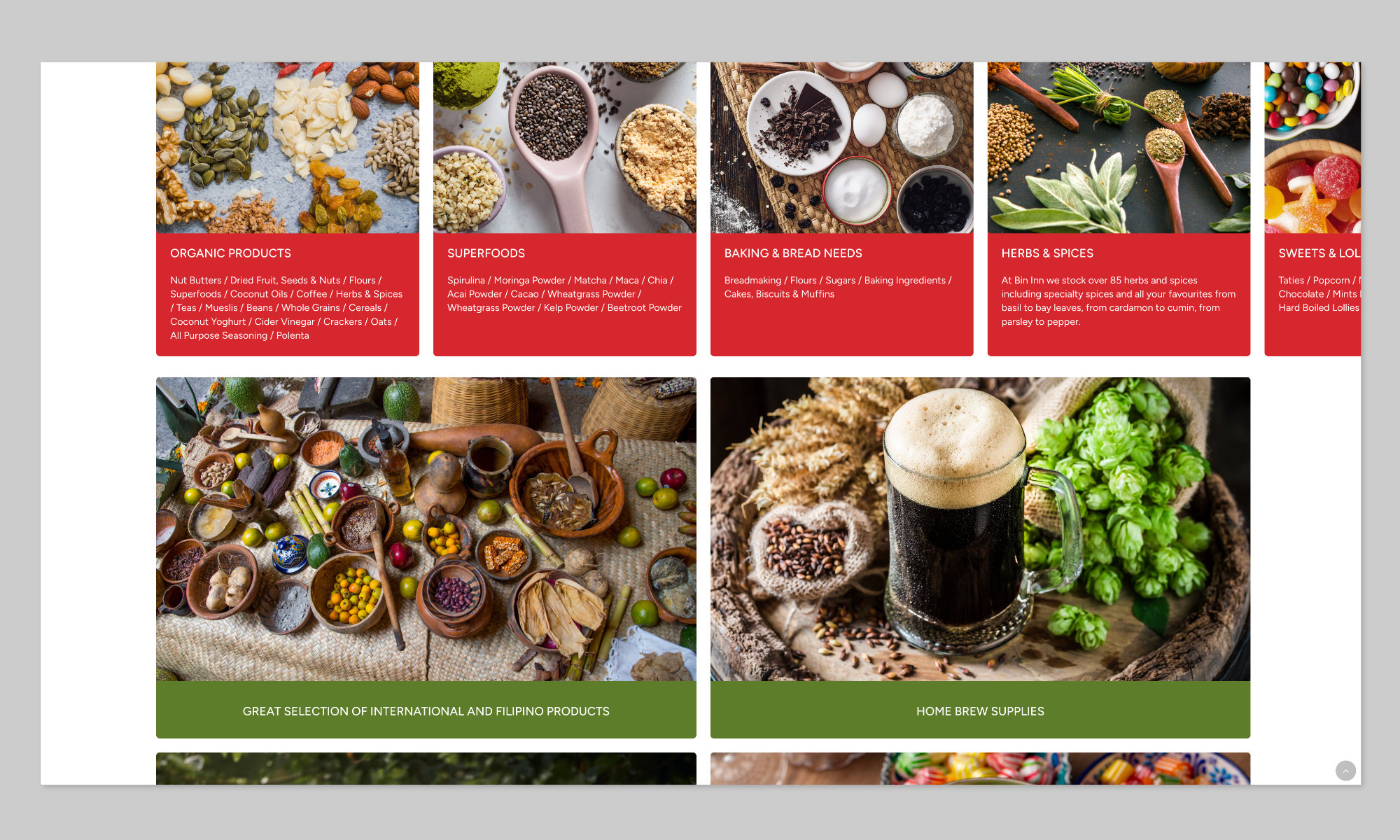
Bin Inn Timaru Product Range Section

The product range section of the Bin Inn Timaru landing page — detailed category listings that help Google match the page to a wide range of specific local searches.

Owner introduction and personal quote
The Meet the Owner section introduces Shailesh Modi with a photo and a direct quote. This isn’t just a nice touch — it’s a trust signal. It tells a potential customer that there’s a real person behind the business who cares about what they do. For local businesses competing against supermarkets and chain stores, that human element is a genuine differentiator.
From an SEO perspective, it also contributes to what Google calls E-E-A-T — Experience, Expertise, Authoritativeness, and Trustworthiness. A page that demonstrates a real person with genuine expertise in their field is viewed more favourably than an anonymous, impersonal page.

FAQ section
The page includes a concise FAQ section answering the questions Bin Inn customers most commonly ask: Can I bring my own containers? Do you stock gluten-free products? Can I buy small quantities? How does the loyalty programme work?
These aren’t just useful for customers — they’re written in the exact language people type into Google. A page that directly answers “can I bring my own containers to Bin Inn” has a strong chance of appearing when someone searches exactly that. FAQ sections are one of the most reliable ways to capture question-based searches, and they’re consistently underused by NZ small businesses.

Loyalty programme explained clearly
The loyalty programme is broken down into a simple four-step process — get your card, shop and collect, reach 15 points, redeem your reward. This kind of structured, action-oriented content gives visitors a concrete reason to visit the store and a clear understanding of the benefit. It converts a passive reader into an active participant.
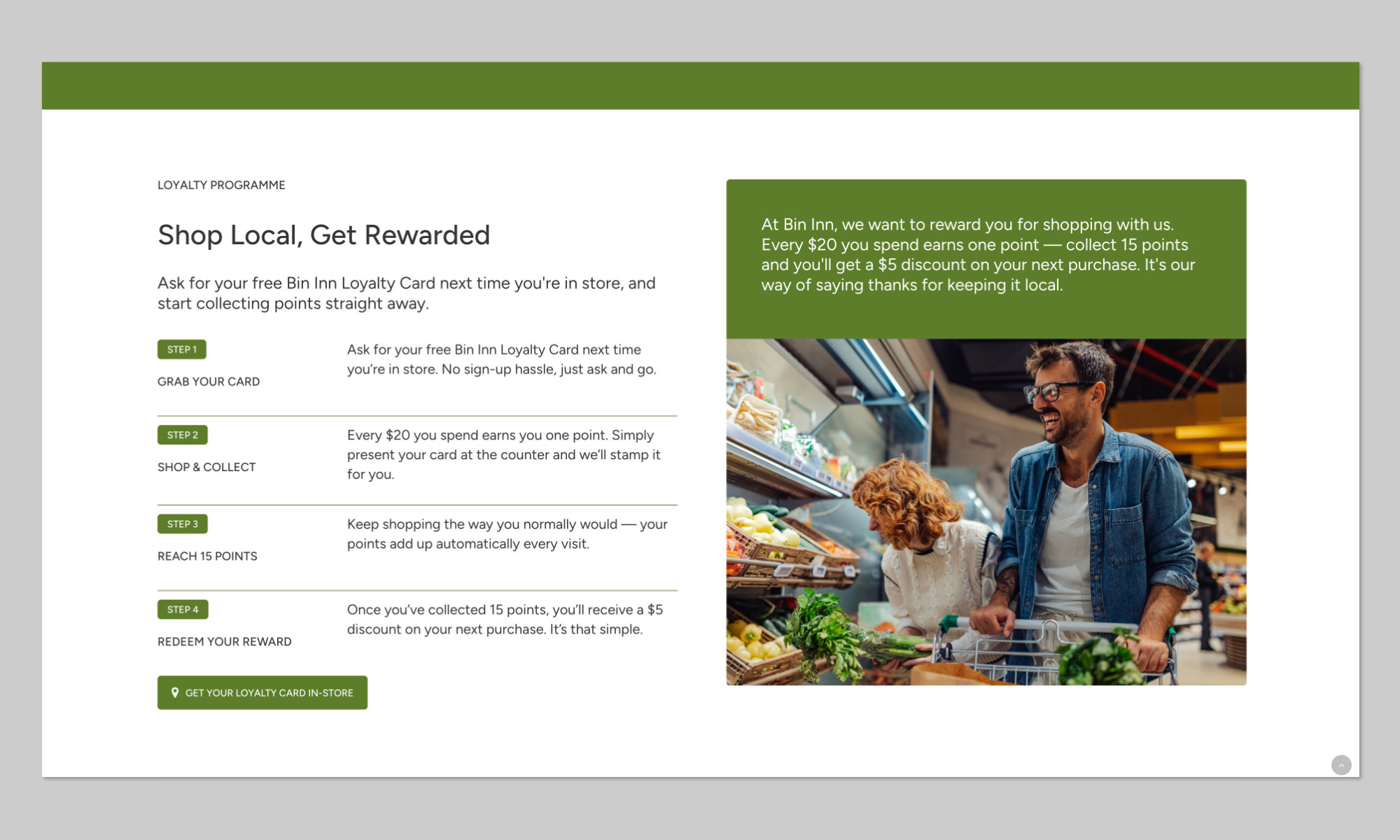
Bin Inn Timaru Loyalty Programme Section

The Bin Inn Timaru loyalty programme section — structured, action-oriented content that gives local customers a clear reason to visit and return.

Community and values section
The page includes a brief but meaningful community section — locally owned and run, supporting local suppliers, treating customers like family. For a business competing on the basis of local identity and personal service, this content reinforces the key differentiators that a supermarket or chain store can’t credibly claim.

It also signals to Google that this is a legitimate, embedded local business — not a generic page created overnight.

What Makes a Landing Page Actually Work

The Bin Inn page illustrates the principles well. Here’s a summary of what separates a landing page that generates results from one that just sits there:

  • One clear purpose — every element on the page serves a single goal (in Bin Inn’s case: get someone to visit the store)
  • Critical information immediately visible — address, phone, hours, directions before any scrolling required
  • Specific, detailed content — not vague descriptions but real products, real services, real specifics that match what people search for
  • Local signals throughout — suburb, city, region named naturally in the content, not stuffed awkwardly
  • A human element — a face, a name, a quote, something that builds trust before the first visit
  • FAQ content — direct answers to the questions your customers actually ask
  • Fast load speed and a clean mobile layout — most local searches happen on a phone
  • One clear call to action — make it obvious what you want the visitor to do next

When Does a Business Need a Dedicated Landing Page?

Not every business needs multiple landing pages — but most businesses could benefit from at least one that’s more focused than their homepage. Here are the situations where a dedicated page typically makes the biggest difference:

  • You serve a specific local area and want to rank for local searches — a landing page built around your location and your service is far more effective than a homepage that mentions your town once in the footer
  • You’re running Google Ads for a specific service or offer — the ad and the page need to match precisely, and a homepage almost never does that well enough
  • You offer a distinct service or product category that deserves its own page — each major service with its own landing page gives you more chances to rank for more specific searches
  • You want to capture a specific audience — tradespeople, families, expats, health-conscious shoppers — a page written directly for that audience converts far better than a generic one
  • You’re a local business competing against national chains or directories — a well-built local landing page is one of the most effective ways to outrank generic national results for specific local searches

For some businesses, a single focused landing page is all they need. For others — particularly those offering multiple services across multiple areas — a set of dedicated pages, each targeting a specific service-location combination, can dramatically increase the range of searches they appear for.

Want a Landing Page That Actually Works for Your Business?

Sky Media designs and builds landing pages for NZ businesses — from single-purpose local pages like Bin Inn Timaru to full multi-page service site builds. Whether you need a page to support a Google Ads campaign, improve your local SEO, or simply give a specific service or location the focused online presence it deserves, we can help.

If you’d like to talk through what a landing page could do for your business, get in touch for a free, no-obligation conversation.
How NZ Retailers Can Compete With Big Chains Online

How NZ Retailers Can Compete With the Big Chains Online

By SEO, Tips and Guides, Web Design

Bunnings. Harvey Norman. Mitre 10. The Warehouse. Farmers. These are businesses with enormous marketing budgets, national brand recognition, and hundreds of thousands of dollars invested in their digital presence.

How NZ Retailers Can Compete With Big Chains Online

Competing with them online can feel impossible, especially for an independent NZ retailer managing everything from one store or a small group of them. But here’s what those big names can’t do: they can’t have your local knowledge, your specialist expertise, your relationships with the community you serve, or your ability to pivot quickly and serve customers in ways a national chain simply isn’t built for.

The businesses that thrive alongside the big chains aren’t trying to beat them at their own game. They’re playing a different game entirely, one that independent retailers are actually set up to win.

The Playing Field Is More Level Than It Looks

It’s easy to assume that a bigger budget means better Google rankings. For some things, that’s true. But local search doesn’t work that way, and local search is where independent NZ retailers have a genuine structural advantage.

When someone in Napier searches “outdoor furniture store Napier” or “running shoes near me”, Google isn’t necessarily showing the biggest national retailer. It’s surfacing the most relevant local option. A well-optimised independent retailer with a strong Google Business Profile, local reviews, and a website that clearly signals its location and speciality can consistently outrank national chains for those high-intent local searches.

Harvey Norman’s national SEO budget doesn’t help them win a local search in your city if your profile and website are better tuned to that specific geography. That’s the fundamental opportunity.

Where Independent NZ Retailers Have the Edge

Before getting into the practical digital strategy, it’s worth naming the real advantages you have because your online strategy should be built around them, not in spite of them.

AdvantageBig chainIndependent NZ retailer
Local knowledgeGeneric, national-level contentKnows the local market, customers, and community
Personal serviceCall centres, chatbots, long wait timesReal people, fast responses, genuine relationships
Niche expertiseBroad product ranges, shallow knowledgeDeep expertise in a specific category
FlexibilityRigid pricing, slow to respond to trendsCan pivot fast, offer custom solutions
Community trustSeen as a corporate chainEmbedded in local community
Google local searchHard to rank locally as a national chainLocal stores naturally rank for nearby searches

Strategy 1: Win Local Search Before Anything Else

Local SEO is your highest-leverage starting point. Most independent retailers are significantly underinvesting here which means there’s low-hanging fruit available right now.

Your Google Business Profile

This is non-negotiable. Your GBP is what determines whether you appear in the local map pack, the three businesses shown at the top of local search results, above everything else.
For a local retailer, a well-maintained GBP should include:

Your correct business category — be specific (“Outdoor Furniture Store”, not just “Furniture Store”)

  • Every product category and service you offer listed individually
  • Real photos of your shopfront, interior, products, and team updated regularly
  • Opening hours kept accurate, including public holidays
  • A steady flow of Google reviews from real customers
  • Posts announcing new stock, promotions, or seasonal ranges

The big chains have GBPs too but they’re often managed centrally and inconsistently at the local level. An owner-operated store that actively maintains its profile has a real advantage here.

Location-specific pages on your website

Your website needs to clearly and repeatedly signal where you are and what you sell. This sounds obvious, but most small retailer websites are vague about both.

A page that says “quality homewares at great prices” tells Google almost nothing. A page that says “homeware store in Tauranga including kitchenware, linen, and décor for Tauranga homes” gives Google the signals it needs to rank you for local searches in that market.

Strategy 2: Use Google Shopping to Get Your Products in Front of Buyers

Google Shopping is the row of product images with prices that appears at the top of search results when someone searches for something to buy “cordless drill”, “queen duvet”, “kids mountain bike”.

This is a channel where independent retailers can genuinely compete with the big chains and in some cases, beat them, because Google Shopping surfaces products, not brands. A shopper searching for a specific product doesn’t necessarily see the biggest retailer first. They see the most relevant listing, at a competitive price, from a store Google trusts.

Getting set up

Google Shopping runs through Google Merchant Center, which connects your product catalogue to Google’s ad ecosystem. If your website is on Shopify, WooCommerce, or most major e-commerce platforms, the integration is straightforward and your products sync automatically and appear in Shopping results.

There are two ways to appear in Shopping results:

  • Free product listings.  Google introduced free Shopping listings in 2020, meaning your products can appear in the Shopping tab and sometimes in the main results without paying for ads. Getting your Merchant Center feed set up correctly and keeping it healthy is the foundation.
  • Google Shopping Ads. Paid listings that appear more prominently and more consistently. For retailers with products that have good margins and clear demand, Shopping Ads can deliver an excellent return because you only pay when someone clicks through to your product.

Where smaller retailers can win

Big chains often have messy, poorly optimised product feeds: thousands of products managed at scale, with generic titles and minimal detail. An independent retailer with 50-200 products who takes the time to write clear, specific product titles, accurate descriptions, and high-quality images will often outperform larger competitors in Shopping results.

An example of product title optimisation

The second title matches far more specific searches, signals local availability, and gives a buyer the information they need to click with confidence.

Generic title (big chain approach)

Garden Chair
Model GC44

Optimised title (independent retailer)

Outdoor Folding Garden Chair
Weatherproof Aluminium
NZ Stock.
Seat Height 45cm

Strategy 3: Build a Website That Converts Local Shoppers

A lot of independent retailer websites are effectively digital brochures. They show what the store sells, but they don’t actively work to turn browsers into buyers or visitors into in-store customers.

Your website needs to do three things well for local retail:

1. Make it easy to find and visit you

This sounds basic but it’s frequently done poorly. Your address, phone number, and opening hours should be immediately visible, not buried in a footer. Adding Google Map directions links helps as well. If you have a car park or are open during the weekends, say so.

2. Show your stock and specialisation clearly

Independent retailers often have a depth of range in their niche that chains can’t match. Lead with that. If you’re a hardware store that specialises in trade-quality tools, say so explicitly. If you’re a baby goods store that carries brands the big chains don’t stock, name them.

Specificity builds confidence and differentiates you from generic competitors.
Even if you don’t sell online, a well-organised product catalogue on your website with photos, descriptions, and pricing where possible lets customers research before they visit. And customers who research before visiting are far more likely to buy.

A real example: Donco Services, Christchurch

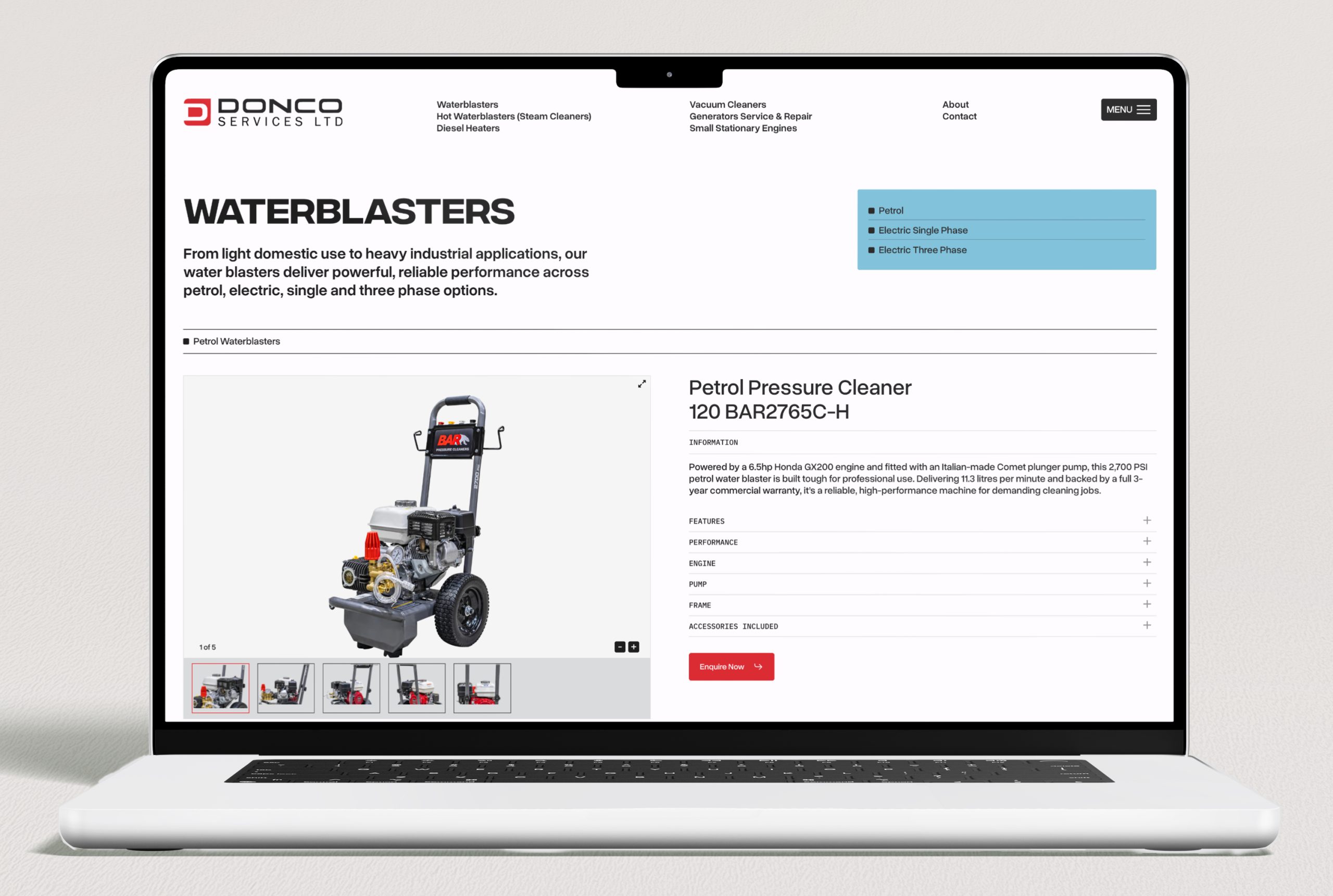
Donco Services is a Christchurch-based supplier and servicer of industrial equipment — water blasters, steam cleaners, diesel heaters, vacuum cleaners, generators, and small stationary engines — with over 30 years in the industry.

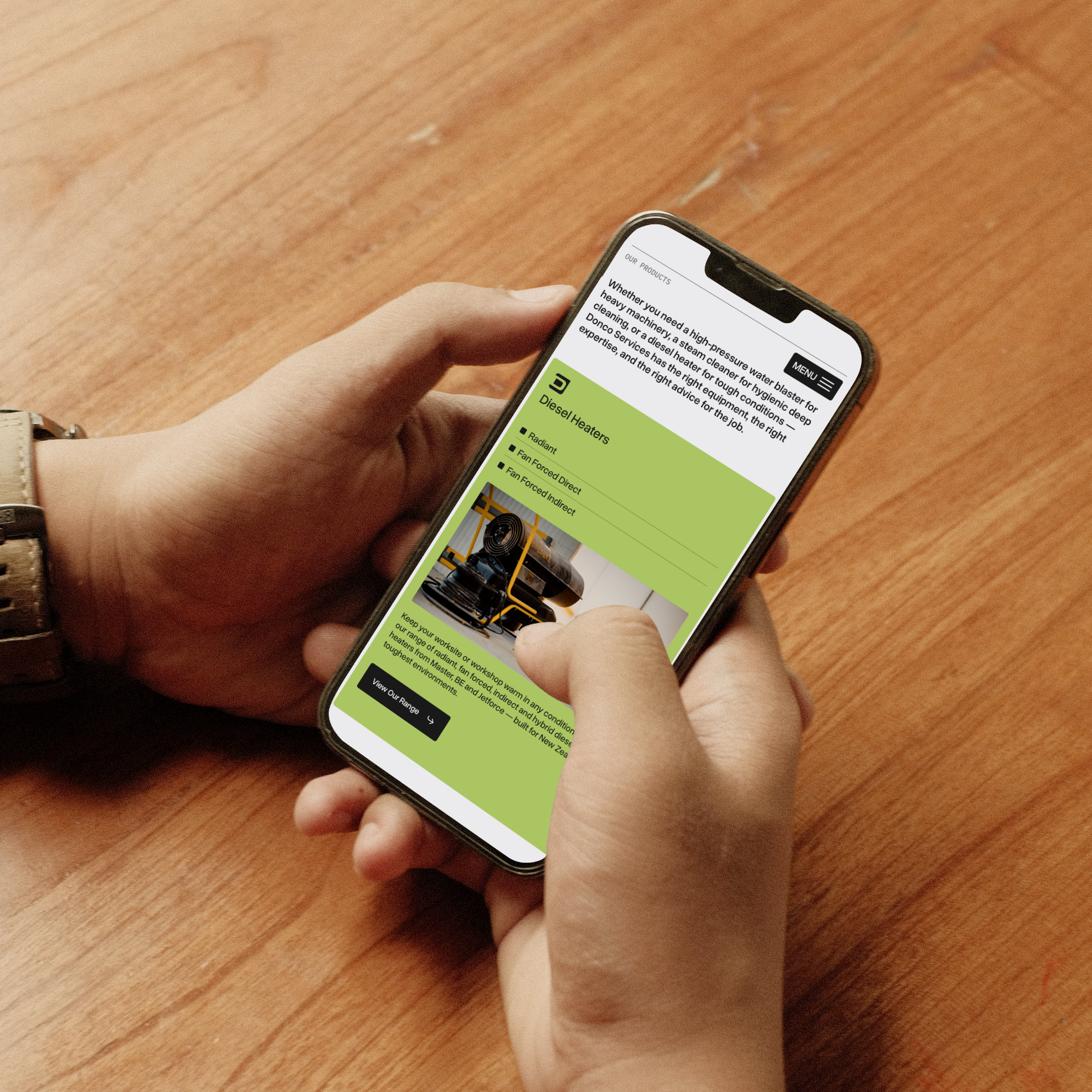
They don’t sell online. But their website does the pre-visit research job exceptionally well. Each product category is broken down in detail — waterblasters split into petrol, electric single phase, and electric three phase; diesel heaters separated into radiant, fan forced direct, and fan forced indirect — with clear descriptions, specifications, and guidance on what each option is suited for. A customer trying to figure out which water blaster is right for their operation can get most of the way to a decision before they’ve spoken to anyone.

That level of detail does several things at once: it builds confidence in Donco’s expertise, it saves time for both the customer and the sales team, and it signals to Google exactly what the business stocks and who it serves — helping Donco rank for specific, high-intent searches that a generic product page never would.

Sky Media built the Donco website on WordPress, designed around their product range and the way their customers actually research and buy. You can see it at donco.co.nz.

Donco Services WordPress website built by Sky Media, showing categorised industrial equipment catalogue with detailed product descriptions and specifications.

The Donco Services website built by Sky Media, a detailed product catalogue that helps customers research and self-qualify before visiting the Christchurch showroom.

3. Make it fast and easy on mobile

Most local shopping searches happen on a phone, often while someone is already out and about. If your website loads slowly, is hard to navigate on a small screen, or makes it difficult to find your phone number or address, you’re losing customers at the moment of highest intent.

A customer who searches “outdoor furniture store open now near me”, clicks your website, and immediately finds your address and phone number in a tap-to-call format will call you. The same customer who clicks your website and has to wait four seconds for it to load, then scroll through a full-screen homepage banner to find your contact details, will click back and try the next result.

Strategy 4: Use Reviews as a Competitive Weapon

Here’s something the big chains genuinely can’t replicate: authentic, personal, relationship-driven reviews from real local customers.

Bunnings has thousands of reviews but they’re national, generic, and largely about parking and wait times. An independent outdoor furniture store in Hamilton with 85 reviews that mention specific staff members by name, comment on the quality of advice they received, and describe what they bought and why. That review profile tells a completely different story, one that no chain can manufacture.

Reviews matter for three reasons in this context:

  • Local SEO rankings. Google’s local algorithm weights review volume and recency as a significant ranking signal and having more good reviews means better map pack placement.
  • Click-through rate. In a row of local search results, a business with 95 reviews and 4.8 stars will get more clicks than one with 12 reviews and 4.1 stars, even if both appear in the same position.
  • Conversion. Reviews that describe specific products, specific advice, and specific staff members are extraordinarily persuasive. They do the sales job before the customer has even walked in the door.

Build a system for collecting reviews consistently: ask every happy customer, send a direct link, and make it a part of the post-sale or post-visit routine. A steady stream of fresh reviews is one of the biggest advantages a local retailer has over a national chain.

Strategy 5: Create the Content Your Competitors Ignore

Large chains produce generic content at scale. They don’t have time to go deep on local topics, niche product knowledge, or the specific questions that your particular customers ask. That’s a gap you can fill and it builds SEO value over time.

A few examples of content that works well for independent NZ retailers:

  • Buying guides for your niche. “How to choose the right outdoor furniture for a NZ coastal property”, “The difference between entry-level and trade-grade power tools”, “What to look for when buying a kids bike for NZ terrain”. These attract research-phase buyers and position you as the expert.
  • Local-angle content. “Best plants for Canterbury gardens”, “Outdoor furniture built for NZ summers”, “Why NZ homes need [specific product]”. This content ranks for searches big chains simply won’t write about.
  • New arrivals and brand spotlights. Regular posts about new stock, new brands, or seasonal ranges keep your site fresh, give Google new content to index, and give customers a reason to come back.

You don’t need to publish constantly. Four to six well-written, genuinely useful posts per year will compound in value over time far more than a dozen thin pieces.

Strategy 6: Be Findable for “Near Me” and Same-Day Searches

One of the clearest advantages local retailers have over online-only big chains is physical presence, and Google increasingly rewards this for shoppers who want something now.

Searches like “outdoor chairs near me open now”, “power tools Christchurch same day”, and “baby clothes store open Saturday” are high-intent queries that independent retailers are uniquely positioned to win. The person searching isn’t looking for the cheapest price or the biggest range instead they want it today, locally.

To capture these searches:

  • Keep your Google Business Profile hours scrupulously accurate, including public holidays
  • Enable the “In-store pickup” and “Visit in store” attributes on your GBP if applicable
  • Use the Products section of your GBP to show what you carry as this feeds into Google’s local inventory-style results
  • If you have real-time inventory, platforms like Shopify can sync stock to Google Merchant Center, letting Google show whether a product is in-store right now

This last point is genuinely powerful. A local customer who can see that the specific item they want is in stock at a store two kilometres away will drive there before they’ll wait for delivery from an online retailer.

Putting It Together: Where to Start

If you’re an independent NZ retailer and this all feels like a lot, the priority order is straightforward:

  1. Get your Google Business Profile complete and actively maintained. This is your highest-leverage, lowest-cost starting point.
  2. Make sure your website loads fast on mobile, shows your location and hours immediately, and clearly describes your specialisation.
  3. Build a system for collecting Google reviews consistently.
  4. If you sell online or want to, set up Google Merchant Center and get your products into free Shopping listings.
  5. Consider Google Shopping Ads for your best-margin products once your feed is clean and optimised.
  6. Start producing local, niche content that the chains won’t write.

None of these require a massive budget but they require consistency and attention which independent retailers, by their nature, are better positioned to deliver than a national chain managing hundreds of locations.

Ready to Compete More Effectively Online?

Sky Media works with NZ retailers on the full picture: website design and development, local SEO, Google Shopping setup, and digital marketing strategy. Whether you’re starting from scratch or want to get more from what you’ve already built, we can help you figure out where the biggest opportunities are.

If you’d like a straight-talking assessment of where your current online presence is leaving opportunities on the table, get in touch.

AI search influence on local businesses

Google AI Overviews Are Changing Search But Local NZ Businesses Have an Advantage

By AI, SEO

If you’ve searched on Google lately, you’ve probably noticed something different at the top of the results page — a block of AI-generated text that summarises an answer before you’ve clicked anything. That’s Google’s AI Overview, and it’s one of the biggest changes to search in over a decade.

The headlines around it have been alarming. Traffic is down. Clicks are disappearing. Organic search is dying. For businesses that rely on Google to bring in customers, it sounds like bad news.

But here’s what those headlines tend to miss: the impact of AI Overviews is not the same for every kind of business. And for local NZ businesses: tradies, retailers, professional services, and hospitality the picture is considerably more encouraging than the general panic suggests.

AI search influence on local businesses

This post explains what AI Overviews actually are, what the data shows and, most importantly, why local businesses in New Zealand are in a stronger position than most.

What Is a Google AI Overview?

When someone searches Google for information, they now often see an AI-generated summary sitting above all other results. Google calls this an AI Overview (previously known as Search Generative Experience, or SGE).

Instead of a list of links to websites, the searcher gets a direct answer synthesised from multiple sources with links to those sources on the side or at the bottom. For many queries, users can get what they need without clicking through to any website at all.

This is what’s known as a zero-click search, and it’s grown significantly. Research from SparkToro found that 58% of all Google searches now end without a click to any website. For searches where an AI Overview appears, that figure jumps even higher.

For businesses that built their traffic on informational content such as blog posts answering general questions, how-to guides, and educational articles, this is a genuine challenge. Google is now answering those questions directly, without sending users anywhere.

The Data: How Often Do AI Overviews Actually Appear?

The statistics vary depending on who you ask and how they measure it, but a few things are consistent across multiple large studies in 2025 and early 2026:

~48%

of all tracked Google searches trigger an AI Overview as of early 2026

7.9%

of local searches trigger an AI Overview

99%

of AI Overviews appear on informational queries

+35%

more clicks for sites cited inside an AI Overview

  • ~48% of all tracked Google searches trigger an AI Overview as of early 2026 — up from 31% a year earlier. (BrightEdge, Feb 2026)
  • Only 7.9% of local searches trigger an AI Overview. (Ahrefs, Nov 2025)
  • 99% of AI Overviews appear for informational queries — ‘what’, ‘how’, and ‘why’ questions. (SeoProfy, 2026)

These last two points are the most important for local NZ businesses. AI Overviews are overwhelmingly a phenomenon affecting informational content: research, definitions, explanations, comparisons. They are rarely triggered by the kinds of searches that drive local business enquiries.

Why Local Searches Are Different

Here’s the key distinction: there are two very different types of Google searches, and AI Overviews affect them very differently.

Informational searches are questions with general answers — “how does underfloor heating work”, “what’s the best material for a deck”, “what does an electrician charge per hour”. These are research queries. The searcher isn’t necessarily ready to hire someone; they’re learning. These are the searches AI Overviews dominate.

Local intent searches are queries where someone wants to hire, visit, or buy and they want to do it nearby. “Electrician Auckland”, “plumber Wellington urgent”, “builder Christchurch quote”, “café near me”. These are high-intent searches that drive real business. And AI Overviews almost never appear for them.

According to Ahrefs’ data, only 7.9% of local searches trigger an AI Overview. The local map pack — the three businesses that appear with a map at the top of results — still dominates local intent searches. It works the way it always has, and it’s not going anywhere.

This is very good news for any NZ business whose customers find them by searching for a local service. Your Google Business Profile, your local SEO, your reviews — these still work. The rules haven’t changed for you the way they have for national publishers or information websites.

What Kind of Businesses Are Most Affected?

To understand who needs to be most concerned about AI Overviews, it helps to look at which query types are most affected:

Most affected: Blogs and media sites, educational content, health and how-to guides, financial explainers, recipe sites, general Q&A content, anything built around answering research questions.

Moderately affected: E-commerce sites (Google is beginning to expand AI Overviews into commercial queries, though more slowly), national service providers targeting broad non-local terms.

Least affected: Local businesses with location-specific search intent: trades, hospitality, retail, professional services, healthcare, real estate.

If your business gets most of its enquiries from people searching for a specific local service, and that’s the case for the majority of Sky Media’s clients, you’re in the least affected category.

What Should Local NZ Businesses Actually Do?

The short answer: keep doing what works, and double down on it.
The fundamentals of local SEO haven’t changed. In fact, some of them have become more important:

1. Your Google Business Profile is more valuable than ever

The local map pack is one of the most AI-Overview-resistant parts of Google search. A well-maintained GBP, with accurate details, regular photos, consistent reviews, and active posts, is your strongest asset. If you haven’t invested time here, now is the moment.

2. Reviews remain your most powerful trust signal

Google’s local rankings are heavily influenced by review volume and recency. But there’s a new dimension: AI-generated answers increasingly draw from and reference businesses with strong review profiles. A business with 80 current, detailed reviews is more likely to be surfaced and mentioned in local pack results and, increasingly, in AI-generated responses to relevant queries.

3. Location-specific content on your website still matters

Service pages that clearly name the areas you work in, the specific services you offer, and the kinds of customers you help, this content gives Google the signals it needs to match you to local searches. It also gives AI systems the structured, authoritative information they need to reference you correctly.

4. Your website needs to be technically solid

Page speed, mobile experience, and structured data (schema markup) are all becoming more important, not less. Structured data in particular, the code that tells Google exactly what your business is, what services you offer, and where you operate, helps AI systems understand and reference your site accurately. It’s moved from a nice-to-have to a meaningful ranking signal.

5. Don’t abandon informational content, just be strategic about it

If your website has blog posts or guides answering questions your customers ask, these are still worth having. The approach shifts slightly: rather than writing purely to attract informational traffic, write content that demonstrates your expertise and builds trust with people who are already considering hiring you. Content that’s specific, authoritative, and locally relevant will still perform, and may even be cited by AI systems if it’s structured well.

The Bigger Picture: What’s Actually Changing

It’s worth stepping back from the day-to-day statistics and considering what AI Overviews represent at a bigger level.

Google is moving from being a directory of links to being an answer engine. For queries where the answer is general and informational, it increasingly provides that answer itself. For queries where the answer depends on location, personal preference, or real-world availability: who’s available, who’s nearby, who’s trusted in this area, it still needs to point people to real businesses.

Local businesses are, in many ways, the part of the internet that AI can’t replace. An AI can tell you how roof painting works. It cannot paint your roof. It can explain what a conveyancing lawyer does. It cannot handle your property transaction. The searches that lead to actual local business happen in the part of Google that’s proven the most resistant to AI disruption, and that’s where local businesses live.

A Note on What’s Still Changing

It would be misleading to suggest AI Overviews have zero impact on local businesses or that the landscape is completely stable. A few things worth watching:

  • AI Overviews are expanding into commercial queries. They currently appear in only around 10–18% of commercial searches, but that share is growing. This is worth monitoring, particularly for e-commerce businesses and national service providers.
  • Zero-click behaviour is increasing across all search types. Even without an AI Overview present, users are clicking through to websites slightly less often than they used to. This makes your Google Business Profile which answers many questions (hours, phone, reviews, location) without requiring a click even more important as a standalone conversion tool.
  • AI Mode is a new surface to understand. Google launched AI Mode in 2025 as a dedicated AI search tab with 75 million daily users globally. It’s still a small channel relative to traditional search, but it’s growing and will become more relevant to track over time.

None of these developments are cause for alarm for local NZ businesses right now. But they are worth being aware of and they’re exactly the kind of thing a good SEO partner should be monitoring and acting on for you.

Local SEO Is Still One of the Best Investments a NZ Business Can Make

While the global SEO landscape is shifting in meaningful ways, the fundamentals of local search remain intact, and for NZ businesses that serve a geographic area, the opportunity is as strong as it’s ever been.

The businesses that will come out ahead are the ones that stay consistent with local SEO fundamentals: a well-maintained Google Business Profile, a steady flow of reviews, a fast and mobile-friendly website, and location-specific content that clearly communicates who they serve and where.

If you’d like to understand how your current SEO is performing in this changing environment, or what you should be prioritising, Sky Media offers a free audit that looks at exactly these signals. Request a free SEO audit.

How to Rebrand Your Business Without Losing Google Rankings

By SEO, Tips and Guides

Rebranding can be one of the most exciting moments for a business. A new name, a stronger identity, a more modern website — it often signals growth and a fresh direction.

But there’s one area many businesses forget to consider when rebranding: search engine visibility.

Your website may have spent years building credibility with search engines. It may already rank for valuable keywords, attract visitors through Google, and generate enquiries regularly. When a rebrand happens without careful planning, that visibility can disappear almost overnight.

The good news is that rebranding doesn’t have to harm your SEO. In fact, if handled properly, it can strengthen it.

This guide explains how rebranding affects SEO and the steps businesses can take to protect their rankings during the process.

Why Rebranding Can Affect SEO

Search engines build trust with websites over time.

Google looks at signals such as:

  • How long a website has existed
  • What content it contains
  • How other websites link to it
  • How users interact with it

When a business changes its name, domain, website structure, or content, search engines may temporarily struggle to recognise that the new brand is the same business.

Imagine a customer visiting your physical location for years and suddenly finding the building empty with a new sign across the street. Even if it’s the same business, it may take time to reconnect the dots.

The same thing happens online when a rebrand is poorly managed.

Common mistakes include:

  • Launching a new domain without redirects
  • Removing pages that already rank on Google
  • Changing URLs without updating links
  • Forgetting to update business listings

Fortunately, most of these issues are preventable with a bit of planning.

1. Start with an SEO Audit Before You Rebrand

Before making any changes, it’s important to understand what currently works. Your website may already have pages that rank well in Google or blog posts that attract steady traffic. If these pages disappear during the rebrand, you could lose valuable visibility.

An SEO audit helps identify:

  • Pages that generate traffic
  • Keywords your website ranks for
  • Important backlinks from other websites
  • High-performing blog articles

This information becomes your roadmap. Instead of guessing what to keep, you’ll know which pages are worth preserving or improving. Rebranding is not the time to accidentally delete your best-performing content.

2. Keep Your Domain If Possible

If your rebrand does not require a new domain name, keeping your existing domain can help preserve SEO stability. Changing a business name doesn’t always mean you must change the website address.

Search engines associate authority with domains over time. A domain that has existed for several years and earned backlinks carries trust that a brand-new domain does not. If you do decide to change your domain, it’s essential to redirect the old one properly so visitors and search engines can still find your content.

3. Redirect Old Pages to Their New Versions

If your website structure changes during a rebrand, one of the most important steps is setting up 301 redirects. A redirect tells search engines and users that a page has moved to a new location.

For example:

Old page
oldsite.co.nz/services/home-renovations

New page
newbrand.co.nz/services/renovations

Without redirects, visitors who click old links will see a broken page, and search engines may assume the content no longer exists. Redirects help transfer much of the existing SEO value from the old page to the new one. Skipping this step is one of the most common causes of ranking drops during rebrands.

4. Preserve Your Most Valuable Content

Many businesses treat rebranding as an opportunity to wipe everything clean and start again. While refreshing your messaging is valuable, deleting large amounts of content can remove pages that currently bring visitors to your site.

Instead of removing content entirely, consider:

  • Updating outdated information
  • Improving clarity and structure
  • Adding new images or examples
  • Expanding articles that already perform well

This approach allows you to keep the SEO strength you’ve already built while still modernising the website.

5. Update Your Brand Signals Everywhere

Your website isn’t the only place where your brand appears online. Search engines also look at signals from across the internet, including:

  • Google Business Profile
  • Social media accounts
  • Online directories
  • Industry listings
  • Partner websites

When you rebrand, these listings should be updated to reflect the new name, logo, and website address. Consistency helps search engines connect the new brand with the existing reputation of the business.

If some platforms show the old brand while others show the new one, it can create confusion for both customers and search engines.

6. Tell Google About Your New Website

If your rebrand includes a new domain, you can notify Google using tools like Google Search Console. Search Console allows website owners to submit sitemaps, monitor search performance, and inform Google when a site moves to a new domain.

While developers or SEO specialists mostly handle this step, it’s helpful for business owners to know that these tools exist. They help search engines understand changes more quickly and reduce the risk of long-term ranking loss.

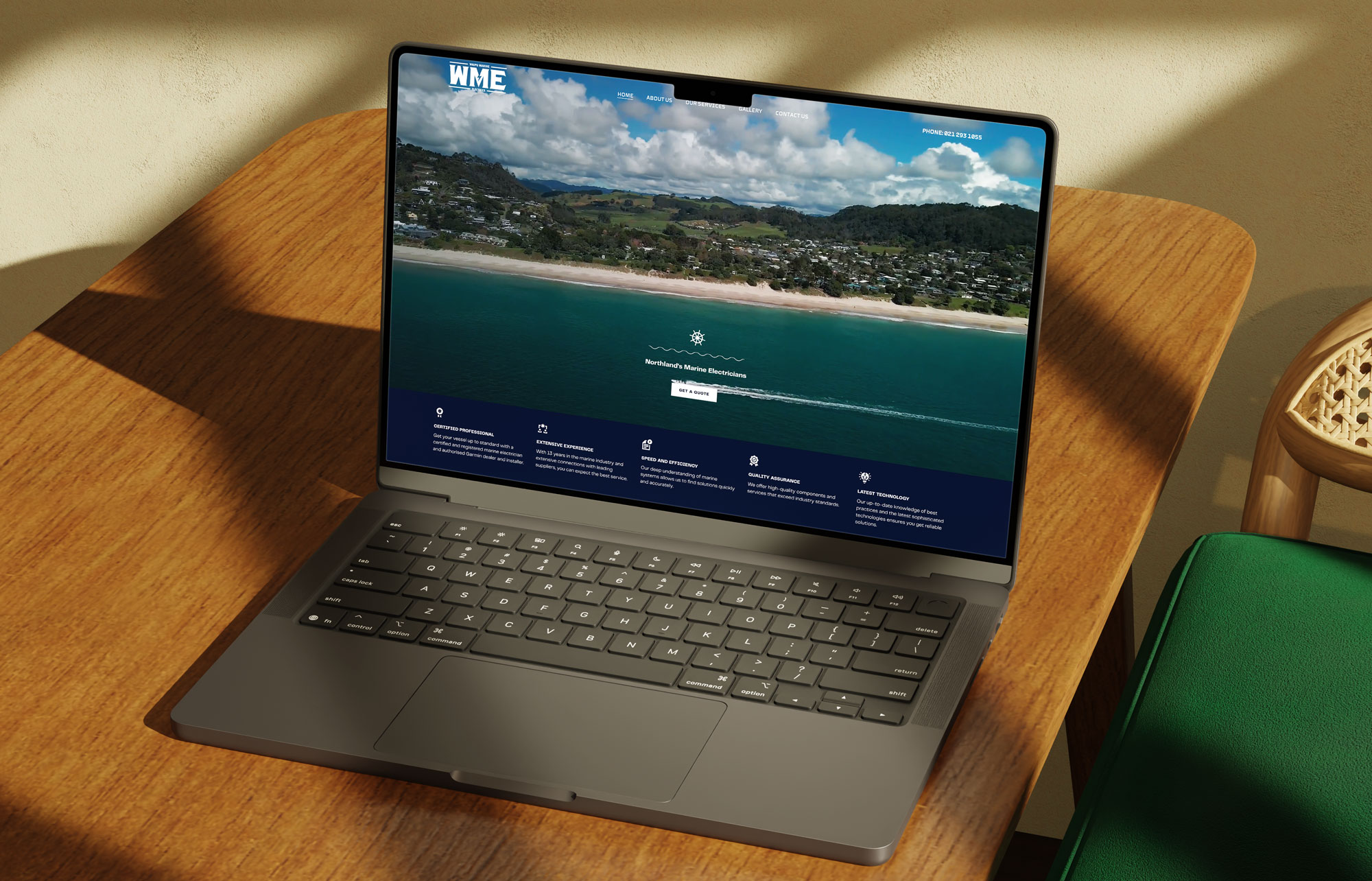
Example of a successful website rebrand for Waipu Marine Electrics — updated brand identity and website design that strengthened the business.

7. Expect Temporary Fluctuations

Even with careful planning, it’s normal to see small ranking changes after a rebrand. Search engines need time to crawl new pages, process redirects, and re-evaluate the updated site.

During this transition, you may notice:

  • Temporary traffic dips
  • Slight ranking changes
  • Gradual recovery over several weeks

The key is patience and monitoring performance rather than making drastic changes too quickly. If the rebrand has been implemented correctly, rankings usually stabilise as search engines adapt.

8. Use the Rebrand as an SEO Opportunity

A rebrand isn’t just about protecting what you already have. It can also be a chance to improve your website. Many businesses discover during a rebrand that their website structure, content, or messaging has become outdated.

This is the perfect time to:

  • Improve service pages
  • Add helpful blog content
  • Strengthen internal linking
  • Clarify value propositions
  • Improve page speed and usability

In other words, the rebrand can become a platform for better SEO, not just a risk to manage.

Final Thoughts

Rebranding your business can feel like starting fresh, but your online visibility doesn’t have to start from zero. With the right planning, you can protect the search engine credibility your website has built over time while introducing a stronger brand identity.

The key is remembering that your website is more than just design. It’s a network of pages, links, and signals that search engines use to understand your business. When those signals are handled carefully, a rebrand can strengthen your brand without sacrificing the search visibility you’ve worked hard to build.

Planning a rebrand for your business?

Sky Media can review your current website and help plan a rebrand that keeps your search visibility intact while introducing your new brand the right way. Get in touch with our tem today.

Local SEO in 2026: A Guide for Small Businesses

Local SEO in 2026: How Small Businesses Can Outrank Big Brands

By SEO, Tips and Guides

Big brands have budgets, teams, and name recognition. But in local search, that doesn’t automatically mean they win.

In 2026, Google’s local results still come down to a simple idea: show the best nearby option for the searcher. Google even explains local rankings are largely shaped by relevance, distance, and prominence.

Local SEO in 2026: A Guide for Small Businesses

That’s good news for small businesses — because “prominence” isn’t just about being famous nationwide. It can also mean being trusted, visible, and consistently talked about in your community.

Here’s how to compete (and often beat) bigger players with a focused Local SEO strategy that’s practical, sustainable, and easy to maintain.

1. Win the “relevance” game by being crystal clear about what you do

Local SEO starts with one question: Does Google understand your business properly?

If your Google Business Profile (GBP) category is wrong, your services are vague, or your website is a “general brochure” with no clear focus, you’ll struggle — even with lots of reviews.

Start here:

  • Choose the most accurate primary category (not the one that sounds nicest).
  • Add secondary categories only if you truly offer those services.
  • Use plain-language service descriptions that match how customers search (“blocked drain repair”, not “hydraulic solutions”).

Google doesn’t rank what it can’t confidently identify — and category clarity is one of the biggest levers small businesses can control.

Small-business advantage: you can specialise. Big brands often create generic pages that try to please everyone. You can create a sharper “this is exactly what we do” signal.

2. Accept that you can’t “hack” distance — so build strength everywhere else

Distance (proximity) is a major local ranking factor, and you can’t change where your business is located.

So instead of trying to “rank everywhere”, focus on:

  • Ranking very strongly in your real service area
  • Increasing visibility for suburbs and neighbourhoods you actually serve
  • Making it obvious you’re the best local choice through proof (reviews, photos, local content, local links)

If you’re a service-area business, follow Google’s guidelines on representing your location/service area properly (don’t use fake addresses or PO boxes). That’s not just an ethics point — it’s a risk-management point.

3. Treat your Google Business Profile like your new homepage

For many local searches, your GBP is what people see before they ever click to your website. Your photos, services, reviews, and Q&A often do the “selling” first.

A strong 2026 GBP baseline looks like:

  • Accurate NAP (Name, Address, Phone) + opening hours
  • Primary + secondary categories done properly
  • Services added (not just a vague description)
  • Fresh photos (real team, real work, real location)
  • Regular updates/posts when you have something meaningful to share
  • Review replies (yes, even the awkward ones)

Google also reinforces the idea that you can’t pay to rank higher in local results — the way forward is accuracy, quality, and trust signals.

Small-business advantage: you can show “realness” better than big brands. Authentic photos and specific service details often outperform polished but generic brand imagery.

4. Make reviews your unfair advantage (and do it consistently)

Reviews are the most obvious “prominence” signal customers notice — and they influence click choices even when rankings are similar.

BrightLocal’s 2025 review research points to consumers becoming more “objective” and reading both positive and negative reviews to form their own view.

Practical review moves that help in 2026:

  • Ask every happy customer (make it part of your process)
  • Aim for steady review flow, not random bursts
  • Encourage details: what service, which location, what problem you solved
  • Respond to reviews — it shows you’re active and accountable
  • Address negative reviews calmly and professionally

Small-business advantage: your customer relationships are closer. Use that. A consistent review engine can outperform a national chain with a “big total number” but weak recency and low detail.

5. Build “local authority” with citations and local mentions that make sense

This part isn’t glamorous — but it still matters.

Your business details should be consistent anywhere you’re listed: key directories, local associations, industry bodies, suppliers, and community websites.

Think of it like this: Google is cross-checking whether you’re a real, stable entity. Inconsistent phone numbers, mismatched business names, or old addresses create doubt.

Start with the basics:

  • Google Business Profile
  • Your website contact page
  • Major local directories (NZ-focused where relevant)
  • Industry associations and local chambers
  • Facebook/LinkedIn business profiles

Small-business advantage: you can be “locally everywhere” faster — sponsorships, community pages, local partnerships, and niche directories often don’t cost much but are highly relevant.

6.Create location pages that are genuinely helpful (not copy/paste suburb pages)

In 2026, thin location pages don’t impress users (or search engines). The goal isn’t to “stuff suburbs” — it’s to answer local intent.

A strong local service page includes:

  • The exact service + the area you serve
  • Common local problems you solve (weather, housing type, local compliance, etc.)
  • Pricing guidance or ranges (even “from” pricing helps)
  • Photos from jobs in that area (where appropriate)
  • FAQs based on real customer questions
  • Clear call to action (call, quote form, booking)
  • If you serve multiple areas, create fewer pages — but make them better.

Small-business advantage: your knowledge is local. Big brands struggle to write truly local content because they aren’t on the ground.

7. Prepare for AI-shaped search (and why local trust signals matter more)

Search is being reshaped by AI experiences. Google has publicly discussed AI-powered experiences like AI Overviews and how they change how people interact with results.

  1. Two important implications for local businesses:
  2. Some users will get answers without clicking as often

Being the trusted local entity becomes even more valuable

Industry studies have observed click-through changes on queries that show AI features (results vary by query type), which is a reminder that relying on “ten blue links” alone is risky.

So what do you do?

  • Double down on your Google Business Profile completeness and accuracy
  • Strengthen reviews and reputation signals
  • Publish clear “proof” content (case studies, FAQs, service explanations)
  • Make it easy for searchers to take action without thinking (call buttons, booking, quote forms)

In a world where attention is fragmented, clarity wins.

8. Turn Local SEO into a system (not a one-off project)

Big brands can spend their way into visibility. Small businesses win by being consistent.

Here’s a simple monthly routine that compounds:

Weekly (15 minutes):

  • Reply to new reviews
  • Add 1–2 photos to GBP (real work, team, before/after)
  • Check for incorrect GBP edits

Monthly (60–90 minutes):

  • Publish one helpful piece of local content (FAQ post, project spotlight, “what it costs”, “how it works”)
  • Audit your top service pages: do they still match how customers search?
  • Look at GBP insights + basic lead tracking (calls, forms)

Quarterly:

  • Add or refresh a key service page
  • Do a citation check (especially after moving address or changing phone numbers)
  • Run a lightweight competitor scan: what are they doing that you’re not?

The bottom line: small businesses can absolutely win local search in 2026

Local SEO isn’t about being the biggest. It’s about being the best match for the person searching nearby — and proving it with consistent signals:

  • Clear categories and services (relevance)
  • Strong reputation and real-world trust (prominence)
  • Accurate location/service area info (distance + legitimacy)

If you build those foundations, small businesses can compete with — and often beat — big brands because you can be more specific, more personal, and more locally trusted.

If you’d like, Sky Media can turn this into a practical plan for your business: a cleaned-up Google Business Profile, a tighter service-page structure, and a simple content system that keeps visibility growing month by month.

Get a Local SEO strategy that actually fits your business.

No guesswork. No generic checklists. Just a clear plan built around how your customers search — and how Google ranks local results in 2026. Talk to Sky Media about Local SEO.

Why a Fresh Website is Your #1 SEO Tool

Why Your “Set and Forget” Website is Hurting Your Business

By SEO, Web Design

You launched your website years ago. It looked great, showed off your services, and you hoped it would bring in customers. Then life and the day-to-day of running your business took over. Your website became that project you finished, and you haven’t touched it since—a digital “set and forget.”

Here’s the hard truth: that approach is now actively working against you. In the eyes of both Google and your potential customers, a static, outdated website signals a business that is no longer active, relevant, or trustworthy.

Why a Fresh Website is Your #1 SEO Tool

Think of SEO not as a one-time technical fix, but as an ongoing conversation with both your customers and Google. Updating your website regularly is how you keep that conversation lively, relevant, and successful. Let’s break down exactly why this is so critical, and how we’ve helped other Kiwi businesses transform their results by breaking the “set and forget” habit.

1. Google Rewards Freshness: The Algorithm Loves an Active Site

At its core, Google’s mission is to provide the best, most relevant, and most current answer to a searcher’s question. Which result do you think it will prefer when someone searches for “campervan hire NZ 2026” or “sustainable home builders Auckland”?

  • A website with “Latest News” from 2020.
  • A site with a regularly updated blog, fresh customer testimonials, and updated service pages reflecting current offers.

The answer is obvious. Google has a built-in “freshness factor.” By regularly updating your site, you send clear signals that it’s a living, active source of information. This can lead directly to a rankings boost, especially for time-sensitive or competitive searches.

In simple terms: A regularly updated website is like a shop with its lights on and fresh stock in the window. A stale site is like a shop with dusty shelves—people assume it’s closed or doesn’t care.

2. It’s Your Chance to Answer New Customer Questions

Your business evolves. The questions your customers ask evolve, too. A few years ago, people might have searched for “home builder.” Now, they’re looking for “energy-efficient passive home design” or “campervan hire with bike racks.”

If your website only has the old content, you’re invisible to people asking new questions. Regular updates allow you to:

  • Create new pages or blog posts that target these emerging trends and keywords.
  • Expand your service pages to reflect new offerings or FAQs you hear daily.
  • Showcase recent work to prove you’re actively excelling in your field.

Every new, relevant page is another front door to your business online. More doors mean more opportunities for customers to find you.

3. Updating Old Content: Your Secret SEO Weapon

Creating new content is great, but one of the most powerful strategies is updating and republishing what you already have.

That service page or blog post from a few years ago that used to get traffic? It might be slipping because it’s outdated. The process is simple:

  • Find it: Identify pages with potential that are now underperforming.
  • Refresh it: Update statistics, add new insights, include recent case studies or testimonials, and improve the images.
  • Republish it: Change the “last updated” date and share it again.

Why does this work? You’re taking a page that already has some SEO authority and making it 10x more valuable. It’s like renovating a well-located house instead of building on a new plot—the results are often faster and more dramatic.

Real-World Transformations: From Static to Strategic

These concepts might sound abstract, but their impact is incredibly concrete. Let’s look at two recent Sky Media clients and the tangible results of moving from a “set and forget” to an “always fresh” mindset.

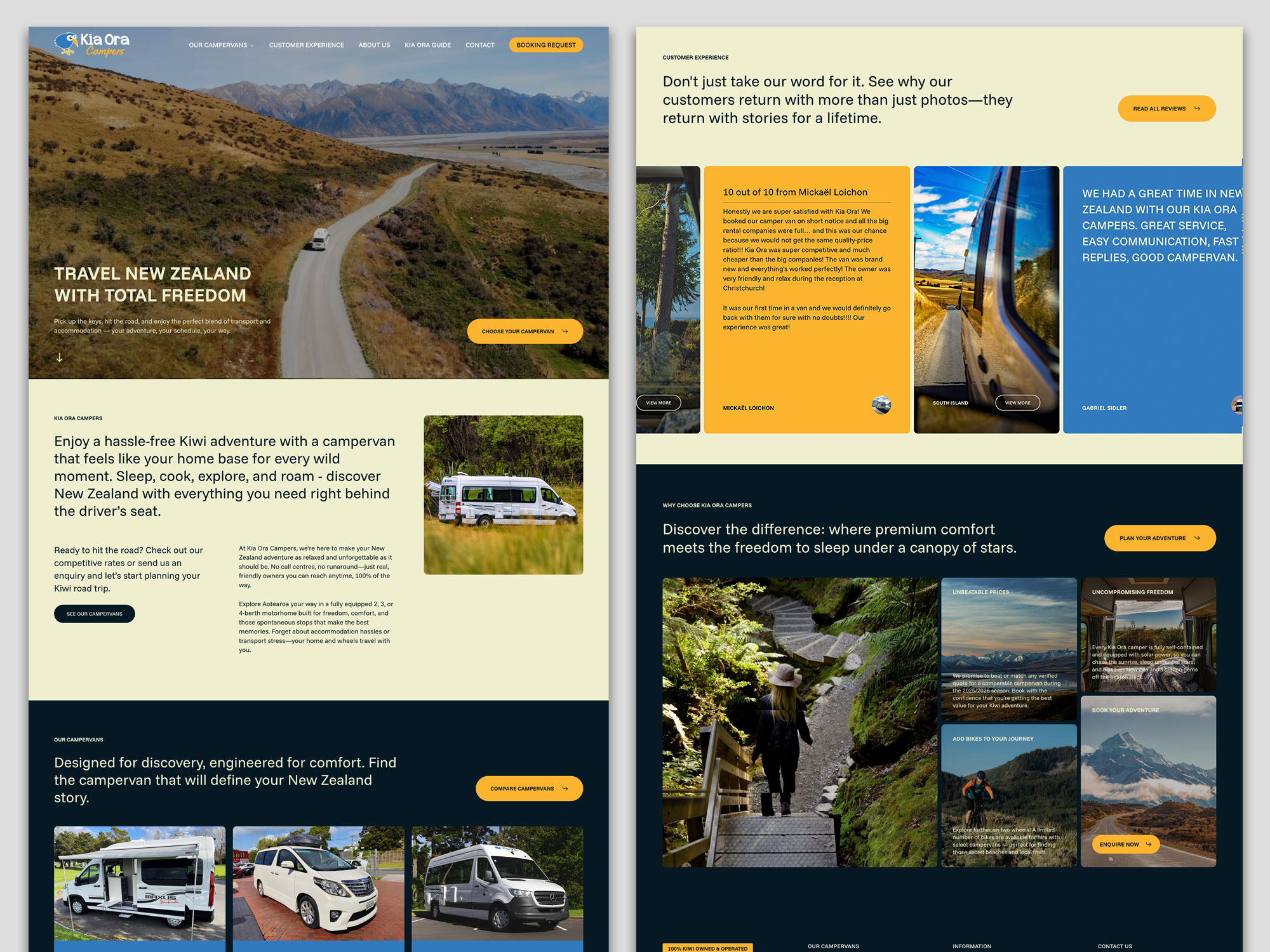
Case Study 1: Kia Ora Campers – Driving Online Bookings Off the Chart

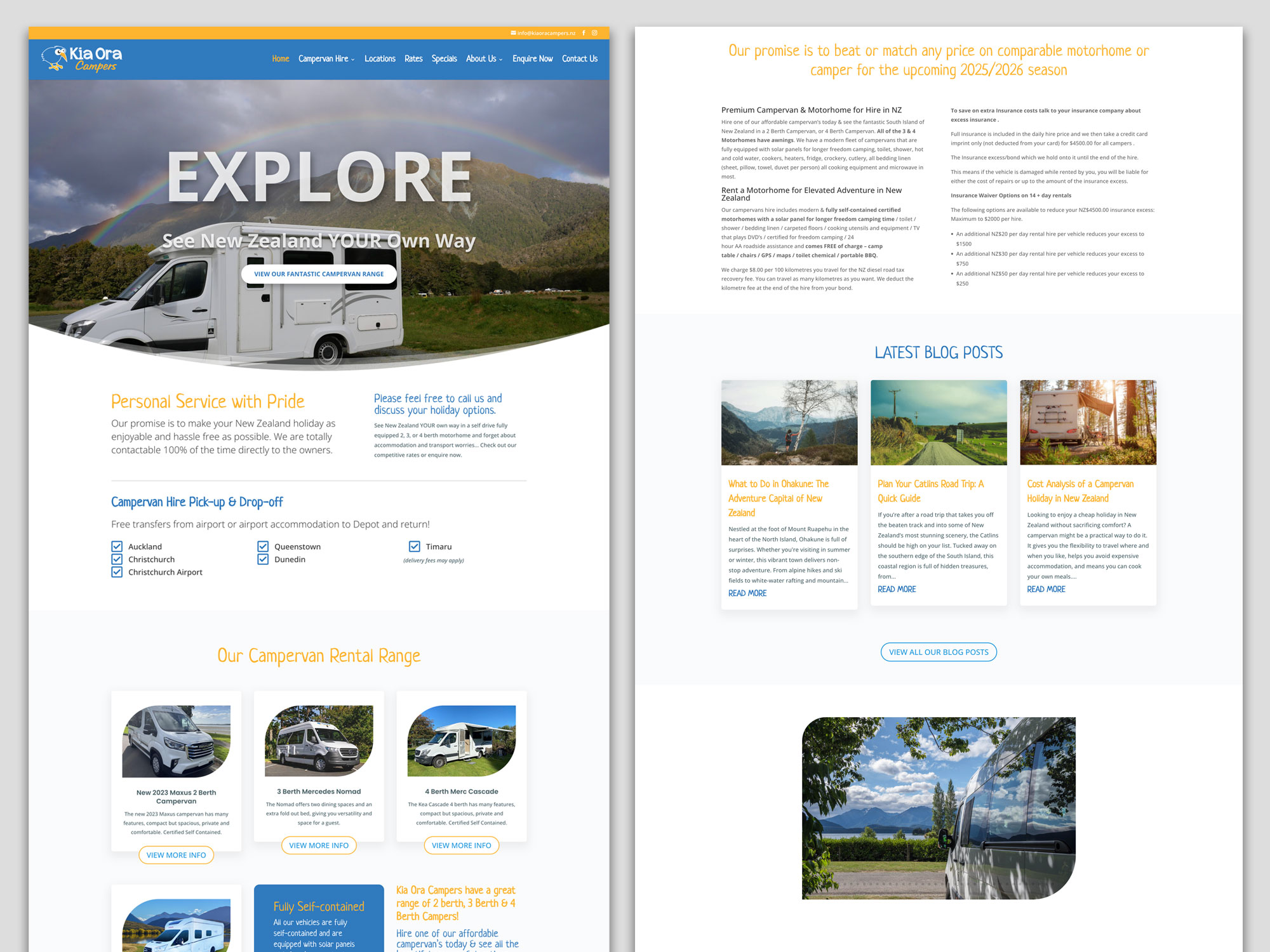
The ‘Before’ website: A Static Fleet List: The original Kia Ora Campers site functioned primarily as an online brochure. It listed vehicles and contact details, but the blog was hard to read, and key information for travellers (like detailed insurance explanations or current travel tips) wasn’t easily accessible. The site wasn’t actively working to answer the myriad questions potential renters have when planning a big trip.

Kia Ora Campers Website Before

The ‘After’ Strategy – Becoming a Travel Resource: We worked with Kia Ora Campers to shift their site from a brochure to a comprehensive travel hub. The strategy centred on consistent, valuable content updates:

  • A Visual, Editorial-Standard Blog: Moving beyond basic posts, we developed a blog with a magazine-grade design. Featuring compelling layouts, high-quality imagery, and scannable sections
  • Transparent & Detailed Content: Key pages were expanded with clear, reassuring details on insurance, bond processes, and what “fully self-contained” truly means for freedom camping.
  • Fresh Social Proof: The integration of recent, detailed customer reviews builds immense trust.

The Result: The site is no longer just a list of vans; it’s a trusted planning tool. By consistently publishing content that targets what travellers are searching for.

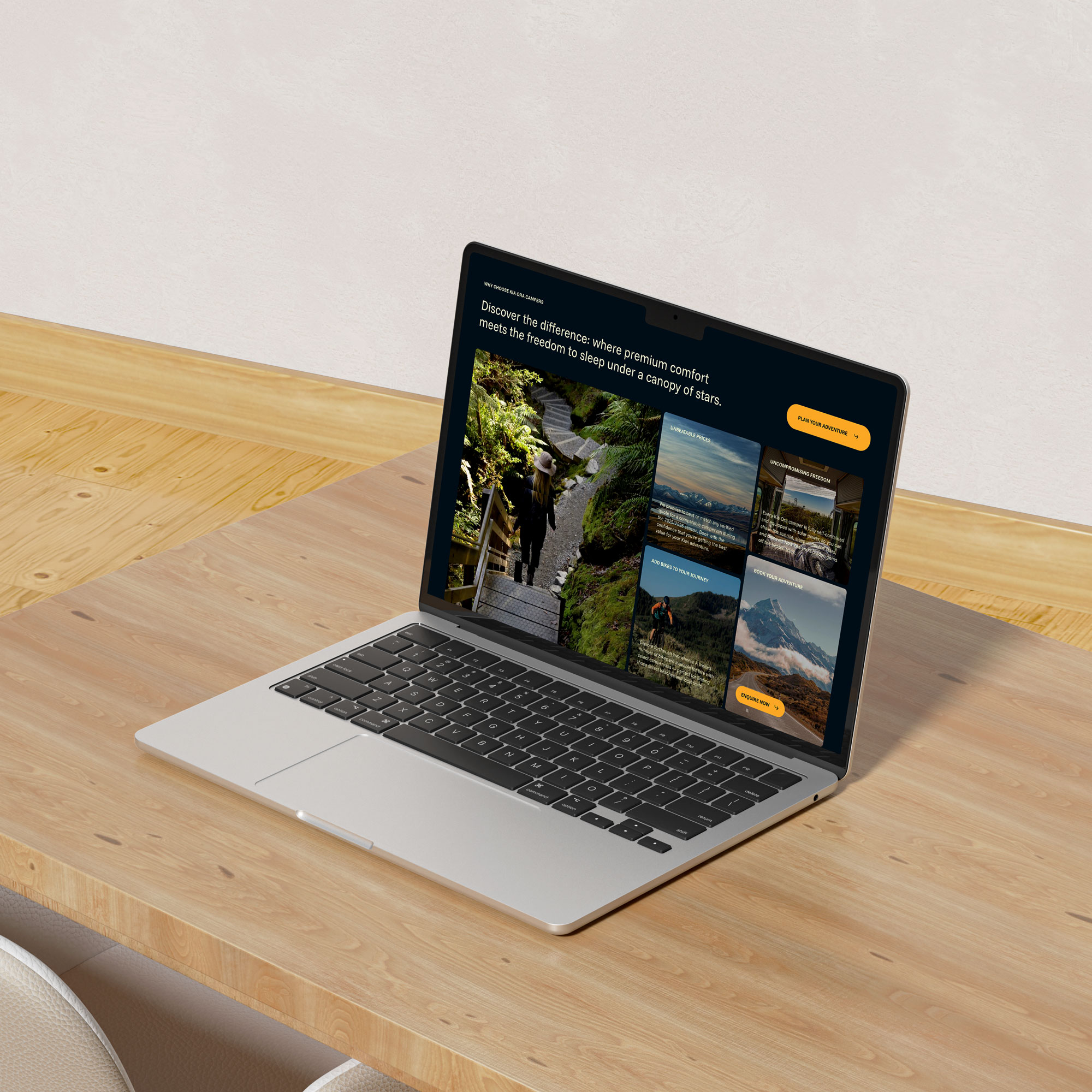
Kia Ora Campers Website After

Case Study 2: Integrated Homes – Building Authority in a Competitive Market

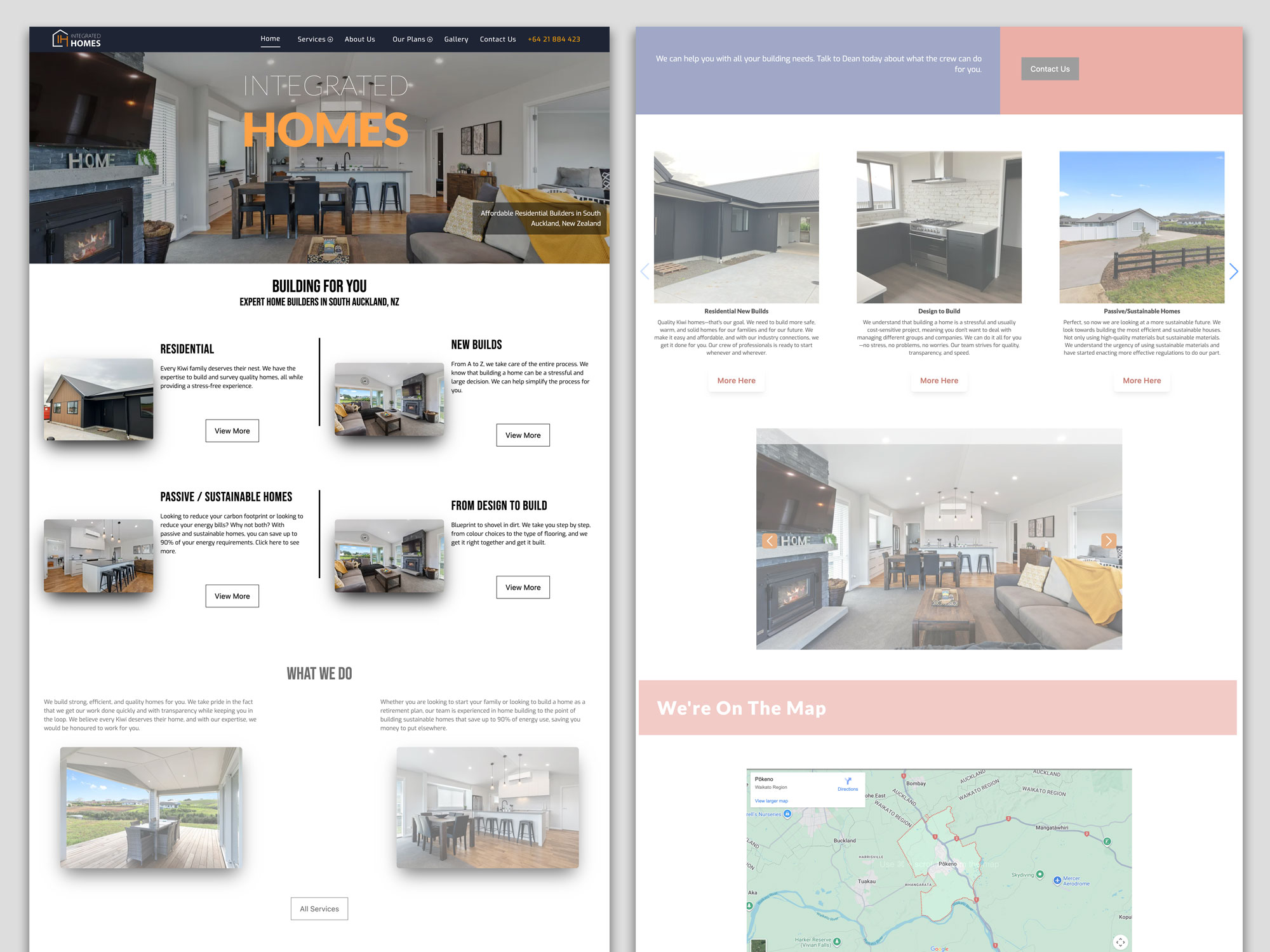
The ‘Before’ – A Generic Builder Site: Integrated Homes’ original site contained the essential information—they built quality homes—but it struggled to stand out in the crowded Auckland building market. The messaging was broad, and the site lacked the specific, expertise-driven content needed to attract clients looking for more than just a builder.

Integrated Homes Website Before

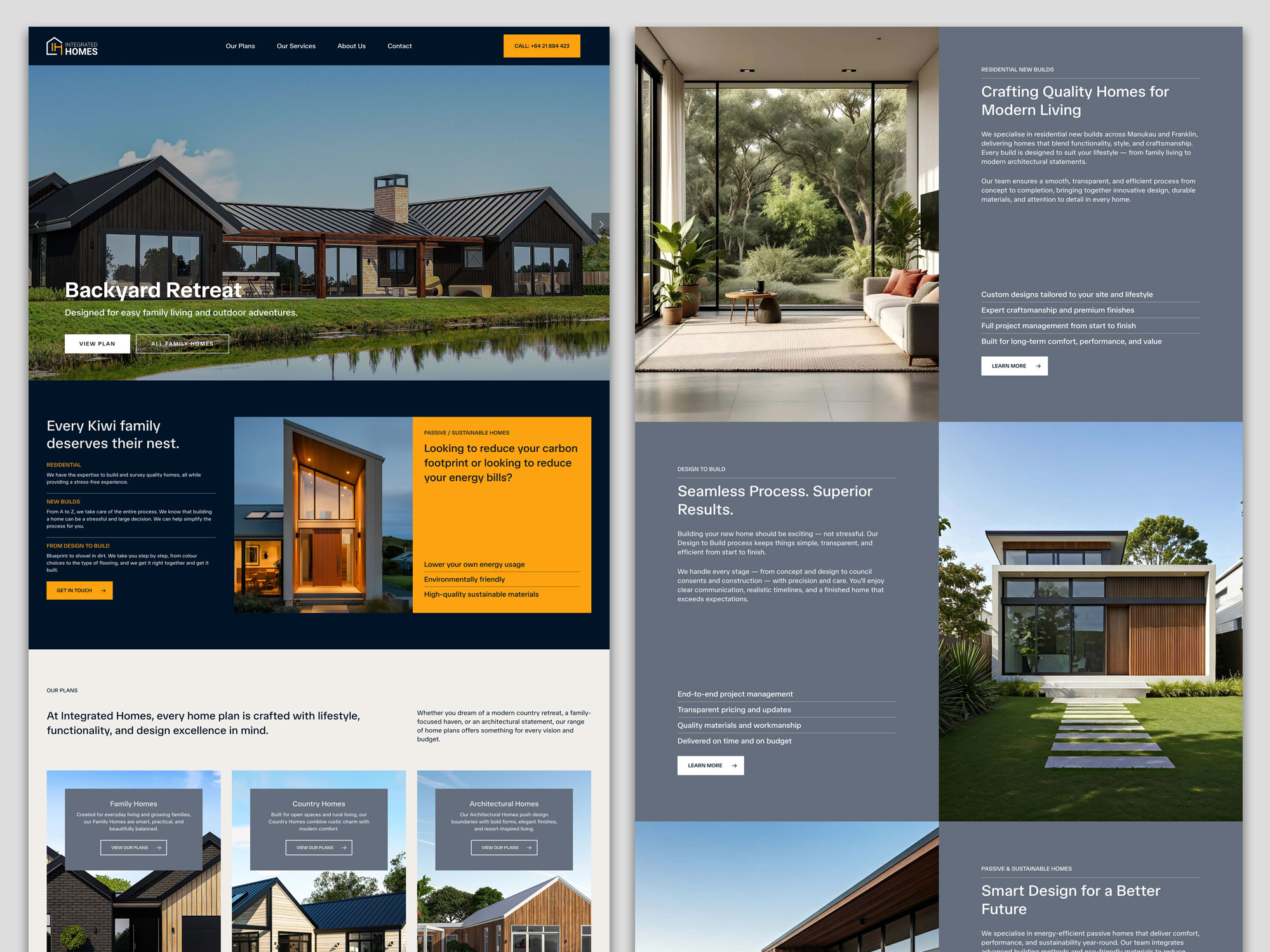
The ‘After’ Strategy – Owning a Niche with Expertise: Our focus was on positioning Integrated Homes as specialists, not generalists. This was achieved through targeted updates and content that showcased deep knowledge:

  • Highlighting Specialisations: We worked to clearly define and promote their service pillars, especially “Passive / Sustainable Homes,” moving it from a bullet point to a key differentiator. The content explains the benefits (like “saving up to 90% of your energy requirements”) in clear, compelling language.
  • Project-Focused Storytelling: The site now uses its house plans more effectively, presenting homes like “Your Own Elmshade Resort” or “Your Brick solid Windermere Home.” This tells a story of craftsmanship and results, not just showing pictures.
  • Building Trust through Transparency: Pages were updated to prominently feature certifications (LBP, NZCB Halo), clearly stating “Our team prides itself on our experience and quality craftsmanship.”

The Result: By consistently emphasising their specialised expertise in sustainable building and showcasing completed projects with narrative depth, Integrated Homes is able to attract clients who are specifically looking for their skill set.

Integrated Homes Website After

4. Building Trust and Authority: The Human Element

Regular updates build what Google calls EEAT (Experience, Expertise, Authoritativeness, Trustworthiness). This is shown through:

  • Fresh testimonials and case studies: Proof you’re doing great work now (as seen in both case studies above).
  • Industry commentary: Showing you’re engaged and knowledgeable.
  • Updated “About Us” and credentials: Like Integrated Homes’ builder certifications.
  • An active, helpful blog: Like Kia Ora’s travel guides, which build authority before a customer even picks up the phone.

A static website erodes trust. An active, updated website builds it with every visit.

5. Technical Health: Keeping the Digital Lights On

Websites are built on software that needs updates for security, speed, and mobile-friendliness. An outdated backend is a major risk and can slow your site down, causing both Google and users to bounce away. Regular maintenance is the non-negotiable digital equivalent of a Warrant of Fitness for your online presence.

“But I’m Too Busy Running My Business!” Your Action Plan

This is the most valid concern. You’re an expert in building or hospitality, not in content marketing. The key is to start small and be consistent, or partner with experts (like us) to handle it for you.

  1. Audit Your Key Pages: Pick your top 3 service pages. Are the descriptions, prices, and benefits accurate and compelling? Update them first.
  2. Add Fresh Proof: Upload your two most recent client testimonials or project photos this month.
  3. Revive One Old Piece: Find one blog post or page that has good history but old info. Spend an hour updating it.
  4. Schedule Time: Block out 90 minutes in your calendar next month to repeat this process. Consistency is everything.
  5. Talk to Your Experts: This is what we do at Sky Media. We become an extension of your team, creating and implementing a manageable, strategic update plan that turns your website from a static cost into your hardest-working business development tool.

In conclusion, your website is the heart of your digital presence. Just like your physical business needs ongoing care, your website needs regular attention to thrive. By committing to regular updates, you’re ensuring your business remains visible, relevant, and trusted. The transformation for Kia Ora Campers and Integrated Homes wasn’t magic—it was the systematic application of treating their website as the living, growing asset it truly is.

Ready to move from “set and forget” to “always growing”? Contact the Sky Media team today for a free, no-obligation website audit. Let’s build a plan that works for your business.

Checklist showing the connection between UX design and SEO success

Is Your Website’s Design Hurting Your Google Ranking? Here’s How to Tell.

By Digital Marketing, SEO

When most business owners think about getting found online, they think of Search Engine Optimisation (SEO)—keywords, backlinks, and content. And when they think about their website, they focus on design: colours, layouts, and beautiful images.

It’s common to see these as two separate projects: one for the marketing team and one for the web designer. But what if we told you that this separation is the very thing holding your website back?

Checklist showing the connection between UX design and SEO success

The truth is, your website’s design and its SEO performance are deeply intertwined. Google doesn’t just see a collection of pretty pictures and text. It “experiences” your website much like a human visitor does. A well-designed website doesn’t just look good; it functions in a way that search engines love.

In this post, we’ll demystify the technical jargon and show you, the business owner, how the core elements of your website’s design directly affect your search engine rankings. Understanding this connection is the first step to building a website that not only wins customers but also wins good rankings in Google search.

1. Site Architecture & Navigation: Building a Roadmap for Users and Google

Think of your website like a physical store. If a customer walks in and can’t find what they’re looking for because the aisles are a maze, they’ll leave frustrated. The same goes for your website.

Site architecture is the structure and hierarchy of your website’s pages. A clean, logical structure is crucial for both user experience (UX) and SEO.

How it Affects Users: Visitors should be able to find any piece of information within three clicks. A clear menu, a logical flow from general (Home > Services) to specific (Services > Renovations), and a helpful footer are essential.

How it Affects SEO: Google’s bots (called “crawlers”) navigate your website by following links. A messy, deep, or illogical structure makes it hard for them to discover and index all your important pages. If Google can’t find a page, it can’t rank it.

Actionable Tip: Create a simple, flat site structure. Use broad categories in your main navigation and use internal links to connect related pages (e.g., link from your “Renovations” service page to your “Completed Projects” page).

2. Mobile-First Design: No Longer an Option, but a Necessity

You’ve likely heard that your website needs to be mobile-friendly. But the concept has evolved. We’re now in the era of “mobile-first indexing”.

This means that Google primarily uses the mobile version of your website’s content for indexing and ranking. If your desktop site is perfect but your mobile site is slow, clunky, or poorly formatted, you are at a significant ranking disadvantage.

How it Affects Users: Over half of all web traffic comes from mobile devices. A non-responsive design forces users to pinch, zoom, and scroll horizontally, leading to a terrible experience and a high bounce rate (people leaving your site quickly).

How it Affects SEO: Google is explicitly prioritising the mobile experience. A slow or unresponsive mobile site will be penalised in search results. Furthermore, a poor mobile experience increases your bounce rate, which is a negative ranking signal.

Actionable Tip: Use Google’s free Mobile-Friendly Test tool. Ensure your website uses a “responsive” design, meaning it automatically adapts its layout to fit any screen size.

3. Page Speed & Performance: The Need for Speed

In our fast-paced world, patience for slow-loading websites is zero. A delay of just a few seconds can kill your conversions. But speed is also a direct Google ranking factor.

How it Affects Users: Slow loading times lead to frustration and abandonment. Think of it as a slow-loading checkout line in a supermarket—people will simply leave their cart and go elsewhere.

How it Affects SEO: Google’s Core Web Vitals are a set of specific metrics related to speed, responsiveness, and visual stability. Websites that perform well on these metrics are rewarded with better rankings. A fast site also gets crawled more efficiently by Google’s bots, meaning your new content can be indexed faster.

Actionable Tip: Compress and optimise your images (don’t upload massive, high-res files directly from your camera). Work with your developer to minimise code and leverage browser caching. Tools like Google PageSpeed Insights can give you a detailed report.

4. Content Layout & Readability: Making Your Content Scannable

You could have the most insightful, valuable content on the internet, but if it’s presented as a giant, intimidating “wall of text,” no one will read it—including Google.

How it Affects Users: Online readers don’t read word-for-word; they scan. They look for headings, bullet points, bold text, and short paragraphs. A clean, scannable layout respects the user’s time and helps them find the information they need quickly, keeping them on the page longer.

How it Affects SEO: When users stay on your page (a metric known as “dwell time”), it signals to Google that your content is valuable. Furthermore, using proper HTML heading tags (H1, H2, H3) to structure your content acts as a roadmap for search engines, helping them understand the context and hierarchy of your information.

Actionable Tip: Break up your text! Use a clear H1 for the main title, H2s for main section headings, and H3s for sub-sections. Employ bulleted lists, bold key phrases, and keep paragraphs to 2-3 sentences.

5. Secure & Accessible Website (HTTPS): The Foundation of Trust

Security is no longer just for E-Commerce sites handling payments. It’s a basic requirement for every website.

How it Affects Users: A secure site (indicated by a padlock icon in the address bar) assures visitors that their connection to your site is encrypted and safe. This builds trust, which is essential for any business hoping to generate leads or sales.

How it Affects SEO: Google has confirmed that HTTPS is a lightweight ranking signal. More importantly, browsers like Chrome now explicitly mark non-HTTPS sites as “Not Secure,” which can severely damage your credibility and increase your bounce rate.

Actionable Tip: Ensure your website has an SSL certificate installed, meaning your URL begins with https:// instead of http://.

6. Image Optimisation: The Hidden Power of Pictures

Images make your website visually engaging, but if not handled correctly, they can be a major drag on performance and a missed SEO opportunity.

How it Affects Users: Unoptimised, large images slow down your page speed, creating a poor user experience as discussed earlier.

How it Affects SEO: Slow loading is an SEO negative. However, properly optimised images present a fantastic SEO opportunity through Alt Text. Alt text is a written description of an image that is read aloud by screen readers for the visually impaired and is also crawled by search engines. It helps your images appear in Google Image Search, driving additional traffic.

Actionable Tip: Always compress images before uploading. When adding an image, describe it concisely in the alt text field, using relevant keywords naturally (e.g., alt=”Bathroom renovation before and after showing outdated pink tiles transformed into a modern walk-in shower” instead of just “image12345.jpg”).

7. Internal Linking: Weaving Your Website Together

Internal links are hyperlinks that point to another page on your own website. They are the glue that holds your site architecture together.

How it Affects Users: Internal links help visitors discover more relevant content, keeping them engaged and on your site longer. For example, you can link from a blog post about your new completed construction project to your service page for “New Builds”.

How it Affects SEO: Internal links help spread “link equity” (ranking power) throughout your site. They establish a hierarchy on your website, showing Google which pages you deem most important. They also help crawlers discover new pages more efficiently.

Actionable Tip: Don’t just use “click here” as link text. Use descriptive anchor text that tells the user and Google what the linked page is about (e.g., “Learn more about our renovation services”).

Bringing It All Together: The Synergy of Design and SEO

As you can see, web design is not a superficial layer on top of your SEO strategy. The elements we’ve discussed, from site structure to image optimisation, are fundamental to how both users and search engines interact with your website.

A beautiful website that is slow, confusing, and insecure will fail to rank and fail to convert visitors. Conversely, a technically perfect but ugly and hard-to-use website will also struggle to meet business goals.

The goal is a harmonious balance: a website that is visually appealing, intuitively easy to use, and built on a technically sound foundation. This is the sweet spot where user experience and search engine optimisation meet, creating a powerful asset that drives sustainable growth for your business.

Conclusion: Your Website is Your Hard-Working Employee

Think of your website as your business’s hard-working, 24/7 sales and marketing employee. For this employee to perform at its best, it needs the right tools and environment. The design elements we’ve covered are exactly that – the tools that allow your website to communicate effectively, build trust, and provide a seamless experience for every visitor.

By prioritising an SEO-friendly design from the very beginning, you’re not just building a website; you’re building a powerful engine for online visibility and business growth.

Is your current website designed for success? The team at Sky Media specialises in creating beautiful, high-performing websites that are built to rank. Contact us today for a free, no-obligation website and SEO audit to see how you can improve your online presence.

A business owner looking confidently at a screen displaying AI search results, showing how to adapt and succeed in the new digital landscape.

The New Rules of SEO: How to Win in the Age of AI Search

By SEO

If you’ve used Google lately, you might have noticed something different. The classic blue links are still there, but now you might also see a neat, conversational answer right at the top of the page, summarising exactly what you were looking for.

A business owner looking confidently at a screen displaying AI search results, showing how to adapt and succeed in the new digital landscape.

This is AI Search in action. Tech giants like Google and Microsoft have begun weaving powerful artificial intelligence directly into their search engines. Instead of just getting a list of links to click, you’re getting a direct, paragraph-style answer.

It’s a fundamental shift in how people find information online. And if your business relies on being found by customers through search, you’re probably wondering: “What does this mean for my website? Do I need to change my marketing strategy?”

The short answer is: the game is changing, but the goal remains the same. Let’s break down what’s happening in plain English.

What Exactly is AI Search?

Think of traditional search like a massive, incredibly fast librarian. You ask a question, and the librarian points you to the ten most relevant books on the shelf. You still have to pull the books off the shelf and find the exact chapter yourself.

AI Search, on the other hand, is like that librarian who has read every single book in the library. You ask your question, and she immediately gives you a concise, well-worded summary of the answer, pulling the best information from all those books. She’ll still show you the books she used, but you might not need to check them out anymore.

This “summary” is called an AI Overview or AI-Generated Answer. It’s designed to save you time by giving you the essence of the answer right away.

The AI does the 'searching' for you, pulling key info from top websites to provide an instant answer.

So, What Does This Mean for Your Business and SEO?

For years, the goal of Search Engine Optimisation (SEO) has been to get your website to rank as the #1 result. The thinking was, “If I’m at the top, I’ll get the click.” With AI providing the answer upfront, the number of clicks to regular websites could decrease for some types of searches.

This might sound alarming, but it’s not a reason to panic. It’s a reason to adapt. Here’s how the focus is shifting at our agency:

1. The “Click” is Becoming a Deeper Commitment

If the AI gives a basic answer, users will only click through if they want more—more detail, more depth, or a different format. This means your content needs to be more valuable than the AI’s summary.

Our Approach: We’re focusing even more on creating comprehensive, “deep-dive” content that an AI summary can’t fully capture. Think detailed service pages, unique project pages, interactive tools, and compelling videos that provide a richer experience.

2. It’s No Longer Just About Keywords, It’s About Being the “Expert Source”

The AI pulls information from what it considers the most trustworthy and authoritative sources. If your website is seen as a superficial or unreliable source, it won’t be featured in these answers.

Our Approach: We are doubling down on E-E-A-T (Experience, Expertise, Authoritativeness, and Trustworthiness). This means clearly showcasing your business’s real-world experience, the credentials of your team, and building a reputation as a leader in your field. Customer reviews and testimonials are more important than ever.

3. The “How-To” and “Local” Searches are Golden Opportunities

Ask an AI “How do I fix a leaking tap?” and it can give you the steps. But you know what it can’t do? Send a local plumber to your house.
Ask “What’s the best Italian restaurant near me?” and the AI might list a few, but it can’t capture the unique atmosphere and menu highlights that make your restaurant the best choice.

Our Approach: We are hyper-focused on optimising your local SEO and creating content that showcases what makes your business uniquely yours. Up-to-date business listings, photos of your team and location, and content that answers very specific local questions (e.g., “Where to get the best local builder in [Your City]?”) will be crucial.

4. Your Website’s User Experience is Now a Top Ranking Factor

If a user does click from an AI answer to your site, but it loads slowly, is hard to read on a phone, or is confusing to navigate, they will click the “back” button instantly. Search engines will notice this negative signal.

Our Approach: We are prioritising technical SEO and user experience (UX) more than ever. This includes ensuring your site is blazing fast, mobile-friendly, easy to navigate, and provides a seamless journey from question to answer to conversion.

The Sky Media Promise: We’re Not Just Keeping Up, We’re Leading the Way

The introduction of AI Search isn’t the end of SEO; it’s its evolution. It’s pushing us to create better, more helpful, and more authentic online experiences for your customers.

At Sky Media, we see this as an exciting opportunity. It separates businesses that are just “on the web” from those that truly provide value. Our strategies are already adapting to ensure your business doesn’t just survive this change, but thrives in it.

Ready to future-proof your online presence? Let’s talk about building a website and content strategy that both Google’s AI and your customers will love. Contact Sky Media today for a Free Consultation.

SEO-friendly website design with fast loading speed and mobile optimisation

The Cost of Cheap Web Design: Why Investing in SEO-Friendly Websites Pays Off

By SEO, Web Design

Every business owner loves a bargain. When searching for affordable web design in NZ, you’ll quickly find countless freelancers and overseas agencies promising a complete website for just a few hundred dollars. At first glance, this sounds like a smart way to save money — after all, your business just needs a website online, right?

SEO-friendly website design with fast loading speed and mobile optimisation

Why “Affordable” Doesn’t Always Mean Cost-Effective

The problem is that cheap websites often cut corners. They rely on generic templates, bloated code, and outdated practices. While you may save upfront, you’ll likely face slow loading speeds, limited flexibility, poor mobile performance, and expensive fixes later on.

In the digital space, “cheap” almost always ends up being expensive.

The Role of SEO in Modern Web Design

Web design is no longer just about how a site looks — it’s about how it performs. A modern website needs to be built with SEO in mind from day one. Why? Because search engines like Google are the gatekeepers to your customers.

Google ranks websites based on technical quality, mobile responsiveness, Core Web Vitals, and how well a site is structured. If your website isn’t SEO-friendly, you’ll struggle to appear in search results, no matter how nice your site looks.

This is why at Sky Media, we design websites that are not only visually appealing but also search engine optimised. It’s a long-term investment that ensures your website works for your business, not against it.

Hidden Costs of Cheap Web Design

A cheap website may seem like a quick win, but the hidden costs add up fast. Some of the most common pitfalls include:

  • Poor User Experience: Visitors land on your site only to find it slow, hard to navigate, or not mobile-friendly. This leads to high bounce rates and lost customers.
  • Lack of SEO Optimisation: Most budget sites don’t come with SEO best practices built in. Without proper on-page optimisation, you’ll struggle to rank on Google.
  • Security Issues: Many cheap providers use outdated plugins and free themes, making your site vulnerable to hackers. Fixing security breaches is far more expensive than prevention.
  • Constant Redesigns: If your site doesn’t scale with your business, you’ll need a complete rebuild every couple of years, multiplying costs.

In short, that “affordable” web design could cost your business thousands in lost leads, reduced trust, and ongoing maintenance.

Why Investing in SEO-Friendly Web Design Pays Off

Unlike a template website that’s designed just to look good, an SEO-friendly website is built to generate business results. Here’s why the investment pays off:

  • Better Google Rankings. Higher visibility means more people find you organically, without paying for ads.
  • More Organic Traffic. With strong SEO foundations, your website becomes a steady stream of new leads.
  • Higher Conversions. Clean design, fast load times, and good UX make visitors more likely to contact you.
  • Long-Term ROI. While you may pay more upfront, a properly optimised website works for years and reduces the need for constant redesigns.

For example, many businesses that invest in our SEO packages in Auckland find that within months, their new website begins paying for itself by delivering consistent leads.

What to Look for in an SEO-Friendly Website

Not sure how to tell if a website is SEO-friendly? Here are the key features to look out for:

  • Clean Site Architecture: Organised menus and internal linking that help users (and Google) navigate your site.
  • Fast Load Times: Speed is critical — both for users and search rankings.
  • Mobile-First Design: With most NZ users browsing on mobile, your site must perform flawlessly on smaller screens.
  • Core Web Vitals: Meeting Google’s standards for speed, responsiveness, and visual stability.
  • On-Page SEO: Optimised meta titles, descriptions, headers, and image alt text.
  • WordPress SEO-Friendly Platform: Flexible, scalable, and easy to optimise as your business grows.

When you choose a provider, ask them to show examples of SEO-friendly builds. If they can’t explain how their designs support search engine rankings, that’s a red flag.

Modern SEO-friendly WordPress website for Geeves New Zealand

Modern SEO-friendly WordPress website for Geeves Scaffolding New Zealand.

Affordable Doesn’t Mean Cheap – The Sky Media Approach

At Sky Media, we understand that businesses want affordable web design in New Zealand without sacrificing quality. That’s why our approach is simple: deliver value, not shortcuts.

  • Transparent Pricing: We provide clear quotes so you know exactly what you’re paying for.
  • SEO Built-In: Every website we design comes optimised for search, ready to rank.
  • Flexible SEO Packages: From Auckland to Wellington and Christchurch, we tailor SEO packages that fit your budget and goals.

Affordable doesn’t have to mean cheap. It means getting a website that’s fairly priced, performs well, and grows with your business.

Final Thoughts – Invest Smart, Not Cheap

When it comes to your website, the cheapest option rarely pays off. A low-cost build may look fine at launch, but without SEO it won’t bring in traffic, leads, or sales. Over time, the hidden costs of cheap design — poor rankings, low conversions, constant fixes — can far outweigh the initial savings.

An SEO-friendly website is a smart investment. It’s the foundation of your online presence and a tool that drives long-term business growth.

If you’re serious about building a website that performs, don’t settle for the cheapest option. Invest in a partner who understands both web design and SEO packages in Auckland — and your website will pay for itself many times over.

SEO Costs in New Zealand: What You Should Pay in 2025

By SEO

Search Engine Optimisation (SEO) is one of the most powerful long-term growth strategies for Kiwi businesses. Whether you’re a start-up café in Ponsonby, a professional service in Wellington, or a construction company in Christchurch, SEO ensures your business is visible when people search online.

But one of the first questions most businesses ask is: “How much should I pay for SEO services?”

The answer depends on a mix of factors—your target location, the competitiveness of your keywords, the quality of service you’re choosing, and even how well your website has been designed. In this guide, we’ll unpack the key elements that influence SEO pricing in New Zealand, weaving in local examples (SEO Auckland, SEO Wellington, SEO Christchurch) and why pairing SEO with a trusted web design agency makes such a big difference.

1. The Scope of Your Target Market: Why Location Drives Cost

Not all locations are created equal when it comes to SEO competition.

  • SEO Auckland: New Zealand’s largest city is home to thousands of businesses across industries, all vying for visibility. Ranking for keywords like “construction company Auckland” or “Auckland plumber” is highly competitive and usually requires more content, stronger backlinks, and higher monthly investment.
  • SEO Wellington & SEO Christchurch: These cities are smaller but still competitive. Businesses in Lower Hutt, Petone, or Riccarton often face less competition than those in the CBD, meaning SEO budgets stretch further.
  • Regional SEO (Nelson, Timaru, Tauranga, Dunedin): In smaller markets, SEO is often more affordable. With fewer competitors targeting local keywords, smaller campaigns can achieve strong visibility with less investment.

NZ Stat Snapshot: 96% of Kiwis use the internet, and over 90% use Google as their preferred search engine. With nearly 88.5% of users browsing on mobile, local search visibility is no longer optional—it’s essential.

2. Keyword Difficulty & Competition: Understanding the Playing Field

Keywords are the foundation of SEO, but some are harder—and more expensive—to rank for.

  • High-competition keywords: Terms like “renovations Auckland” or “Christchurch lawyer” have hundreds of businesses competing for visibility. To win, you’ll need consistent blogging, link building, and advanced technical SEO.
  • Moderate competition: Keywords like “Wellington property management agency” or “Hamilton builders” may be easier to target, though still competitive in their industries.
  • Low-competition opportunities: Long-tail keywords such as “affordable plumbing company in Nelson” can deliver quick wins with less cost, while still driving valuable leads.

Smart SEO strategies combine short-term quick wins with long-term high-value goals.

3. The Quality of SEO Services: You Get What You Pay For

SEO services vary widely in quality, and that directly impacts cost.

  • Cheap SEO ($500–$1,200/month): Often limited to basic on-page fixes, minimal link building, and maybe a blog or two. This can work for very small businesses in low-competition areas, but results are limited.
  • Mid-tier SEO ($1,500–$6,000/month): Includes keyword strategy, on-page SEO for multiple pages, Google Business Profile optimisation, ongoing content creation, and consistent link building. Ideal for SMEs in larger NZ cities.
  • Enterprise SEO ($7,000–$10,000+/month): Comprehensive campaigns covering multiple locations nationwide, advanced content marketing, CRO testing, and high-authority backlinks. Necessary for nationwide brands and industries like law, finance, or real estate.

Sky Media’s packages reflect these tiers:

  • Sky Lift ($499+GST/month): Great for small local businesses with 5 keywords.
  • Sky Climb ($899+GST/month): Adds 10 keywords, local citations, and monthly blogs.
  • Sky Orbit ($2,900+GST/month): Expands to 50 national keywords, advanced link building, and monthly strategy calls.
  • Sky Galaxy ($4,500+GST/month): A full-scale national SEO campaign, custom content, and high-authority link outreach.

Tip: Always ask for transparent reporting, clear deliverables, and case studies. With Sky Media, 96% of clients stay with us because we prioritise results and accountability.

SEO services cost New Zealand Summary Inforagraphic

4. The Role of Web Design in SEO: Building on the Right Foundation

Even the best SEO strategy can’t succeed if your website isn’t built properly. Google rewards websites that are fast, mobile-friendly, and user-focused.

  • Mobile-first: Nearly 90% of NZ internet users browse on mobile. If your site isn’t responsive, you’ll lose rankings and customers.
  • Speed & Core Web Vitals: With NZ mobile internet averaging 91 Mbps and fixed broadband at 180 Mbps, users expect sites to load quickly. A slow site increases bounce rates and decreases conversions.
  • Clean structure: Search engines need a clear, logical hierarchy to crawl. Websites with messy coding, missing headings, or no internal linking require extra SEO work (and cost more to optimise).

That’s why many businesses choose a web design agency in Auckland, Wellington, or Christchurch that also offers SEO. A properly designed site reduces SEO costs in the long run and makes optimisation much easier.

Pro tip: If your website is outdated, consider a redesign before committing to a full SEO campaign. It may increase upfront costs but will save significantly on wasted SEO spend later.

5. Content & Link Building: The Fuel of SEO

SEO success hinges on two things: content and links.

  • Content: High-quality blog posts, guides, and service pages demonstrate expertise and keep your site fresh. Local content like “Top Cafés in Te Aro” or “Building Regulations in Christchurch” helps capture regional traffic.
  • Links: Backlinks are still one of Google’s strongest ranking signals. Getting high-authority links from NZ media outlets, directories, and partner businesses shows Google your site is trustworthy.

Example:

  • Sky Climb ($899+GST) includes monthly blogs and local citations.
  • Sky Orbit ($2,900+GST) scales to 4 blogs per month and advanced link building.

The more content and authority links you produce, the higher the costs—but the payoff is exponential in rankings and leads.

6. Why Cheap SEO Usually Costs More

Cheap SEO might seem appealing, but it often leads to:

  • Spammy backlinks that harm your domain authority
  • Minimal reporting with no clear ROI
  • Short-lived rankings that collapse with Google algorithm updates
  • Penalties that can tank your website visibility for months

On the other hand, investing in ethical, white-hat SEO pays off like compounding interest. The longer you run high-quality SEO, the stronger your authority, traffic, and lead flow become.

Final Thoughts: How Much Should You Pay?

There’s no universal price tag for SEO—it depends on your:

  • Location (SEO Auckland vs SEO Timaru)
  • Industry (finance vs hospitality)
  • Website quality (modern vs outdated)
  • Ambition (local presence vs nationwide dominance)

For some, $500–$900/month may be enough to establish a local foothold. For others targeting Auckland, Wellington, and Christchurch simultaneously, a realistic budget is $2,900–$4,500/month.

The key is choosing a partner who understands your goals and market. With proven success across SEO Auckland, SEO Wellington, and SEO Christchurch, and integrated web design services nationwide, Sky Media delivers SEO that builds businesses—not just rankings.